According to the announcement, W*E content will include a variety of formats like cookings shows and interactive toy catalogues.
Eko CEO Yoni Bloch said they aren’t announcing any specific shows yet, but they will be “free and distributed everywhere,” and will be united by an aim to make the viewer “be the hero, be a part of the decision-making in the story.” The plan is to start releasing this content sometime next year.
Walmart might not seem like the most obvious partner on something like this, but the company has been expanding into digital media with efforts like Vudu (it just announced a partnership with MGM) and, more recently, Walmart eBooks.
Bloch said the deal also includes a Walmart investment of undisclosed size into Eko. Apparently the joint venture will work primarily as “the funding vehicle” for this new content, with Walmart staying out of the creative decisions.
“Walmart has been an incredible partner, allowing us to have creative control, which we are passing on to the creators,” Bloch said.
Tribeca Productions co-founder Jane Rosenthal will serve as strategic advisor to W&E Interactive Ventures, and Eko Chief Media Officer Nancy Tellem will be on the board.
“Our partnership with Eko will help us accelerate efforts to deepen relationships with customers and connect with new audiences in innovative ways and is one part of an overall entertainment ecosystem we’re building,” said Scott McCall, senior vice president for entertainment, toys and seasonal at Walmart U.S, in the announcement.
The challenger bank founded by Ricky Knox has launched its second credit card today, this time targeting people in the U.K. who have yet to build up a credit history at all. Credit cards are already one of the most effective ways of improving your credit score (presuming you are approved for one and always repay on time, of course) and it seems that Tandem wants a piece of that action.
Dubbed the “Journey Card,” Tandem says the new credit card is “a way for those who haven’t had credit before to build up a strong credit profile”. The upstart bank says it is tapping into a climate where people are realising the importance of credit scores for building a better future and how essential a decent credit score is when taking out further credit such as a car loan, mortgage and other longer-term financial products.
However, although the new Journey Card shares the same low FX fees when spending abroad, there are some key differences compared to the original Tandem Cashback Card. These include no cash back, for starters, and what appears to be a higher APR in recognition of the higher risk Tandem is taking on.
With that said, both cards integrate with the Tandem mobile banking app, which acts as a Personal Finance Manager (PFM), including letting you aggregate your non-Tandem bank account data from other bank accounts or credit cards you might have. Very recently the app has released a plethora of updates (including digital statements, at last!), and these include some useful budgeting tools, which sits well alongside a credit card designed to help you build your credit score.
Meanwhile, it is becoming clearer that Tandem sees consumer credit as its “attack vector” in the consumer banking space, as apposed to offering a current account or pre-paid/debit card, although I wouldn’t be surprised to see the challenger bank go there eventually. It already offers a fixed-saver account, after all.
Says Ricky Knox, CEO of Tandem: “The integration of credit products into our app is a game-changer for the industry. Our competitors have launched some great pre-loaded and debit cards, but we will own credit in this space”.
Shimon is a marbima-playing robot with some real soul. This crazy little robot, created by Gil Weinberg at the Georgia Tech Center for Music Technology, can listen to the other players around it and play out little ditties in response to the music. In short, it’s the world’s best jazz and hip hop collaborator because, unlike humans, Shimon can never get drunk and forget the van keys back at that Taco Bell in Fresno.
“Most of what Shimon is playing is generated using a new process where he creates hundreds of melodies off line based on deep learning analysis of large musical data sets,” said Weinberg. “Then us humans (me and my students) choose melodies we like and orchestrate / structure them into songs. It’s a new form of robot-human collaboration, at least for us.”
In this video Shimon and crew play along to Dash Smith, an Atlanta-based rapper who freestyles while Shimon and you’ll also notice another Georgia Tech product, a robotic drumming prosthesis that gives the drummer the power of four Neil Perts.
Weinberg, Shimon’s human, is excited by the new developments.
“Still under development is the other new element – we are working letting Shimon analyze in real time the rhythm, melodies and semantic meaning of the free style rapper lyrics and use this analysis to drive Shimon’s improvisation. As you know we have explored mostly improvised music, starting with drum circles moving to Jazz, rock jam-bands, and African marimba bands,” said Weinberg. “We are now ready to move to the next frontier of real time collaborative improvisation – free style rapping, where the hope is that the rapper will be influenced by what Shimon is coming up with and vice versa.”
Enterprise cloud service management company ServiceNow announced today that it will acquire FriendlyData and integrate the startup’s natural language search technology into apps on its Now platform. Founded in 2016, FriendlyData’s natural language query (NLQ) technology enables enterprise customers to build search tools that allow users to ask technical questions even if they don’t know the right jargon.
FriendlyData’s NLQ tech figures out what they are trying to say and then answers with text responses or easy-to-understand data visualizations. ServiceNow said it will integrate FriendlyData’s tech into the Now Platform, which includes apps for IT, human resources, security operations, and customer service management. It will also be available in products for developers and ServiceNow’s partners.
In a statement, Pat Casey, senior vice president of development and operations at ServiceNow, said “ServiceNow is bringing NLQ capabilities to the Now Platform, enabling companies to ask technical questions in plain English and receive direct answers. With this technical enhancement, our goal is to allow anyone to easily make data driven decisions, increasing productivity and driving businesses forward faster.”
The acquisition of FriendlyData is the latest in ServiceNow’s initiative to reduce the friction of support requests within organizations with AI-based tools. For example, it launched a chatbot-building tools called Virtual Agent in May, which enables companies to create custom chatbots for services like Slack or Microsoft Teams to automatically handle routine inquiries such as equipment requests. It also announced the acquisition of Parlo, a chatbot startup, around the same time.
SmileDirectClub, the at-home teeth-straightening startup, has just raised $380 million at a $3.2 billion valuation, the company announced today. Investors from Clayton, Dubilier & Rice led the round, which featured participation from Kleiner Perkins and Spark Capital.
This funding comes on top of Align Technology’s $46.7 million investment in SmileDirectClub in 2016, and another $12.8 million investment in 2017 to own a total of 19 percent of the company.
“We are very excited with the outcome of our most recent fundraising round,” SmileDirectClub co-founder Alex Fenkell said in a statement. “Our mission has always been to provide an affordable and convenient option to anyone who wants to transform their smile. We are excited to continue our growth into new spaces and be given the incredible opportunity to reach even more people with our life-changing service,” said Fenkell. “We can’t wait to see what the future holds and are grateful for the support from our new investors.”
SmileDirectClub is a direct-to-consumer teeth-aligner startup that started with the idea of using teledentistry to virtually connect licensed dentists and orthodontists with people who want to straighten their teeth. Since its inception in 2014, SmileDirectClub says it has helped more than 300,000 people straighten and brighten their teeth.
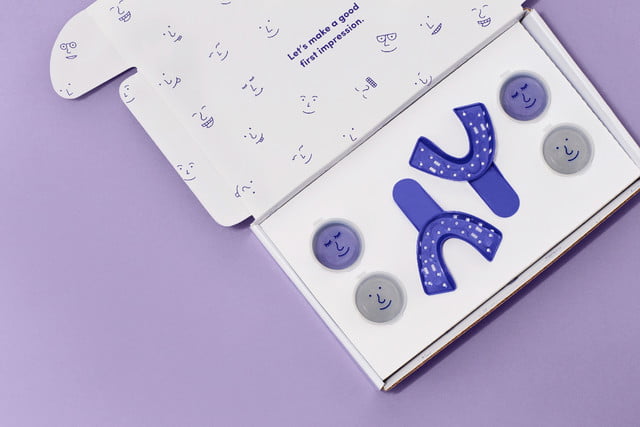
The company ships invisible aligners directly to customers, and licensed dental professionals (either orthodontists or general dentists) remotely monitor the progress of the patient. Before shipping the aligners, patients either take their dental impressions at home and send them to SmileDirectClub or visit one of the company’s “SmileShops” to be scanned in person. SmileDirectClub says it costs 60 percent less than other types of teeth-straightening treatments, with the length of treatments ranging from four to 14 months. The average treatment lasts six months.
Though, members of the American Association of Orthodontists have taken issue with SmileDirectClub, previously asserting that SmileDirectClub violates the law because its methods of allowing people to skip in-person visits and X-rays is “illegal and creates medical risks.” The organization has also filed complaints against SmileDirectClub in 36 states, alleging violations of statutes and regulations governing the practice of dentistry. Those complaints were filed with the regulatory boards that oversee dentistry practices and with the attorneys general of each state.
Back in June, the AAO expressed its disappointment in learning about Macy’s decision to offer SmileDirectClub in some of its locations, saying “orthodontic treatment is not a product. Rather, it is a complex medical process.”
In the statement, the AAO said “it is in the best interest of consumers to have orthodontic treatment conducted under the direct and ongoing, in-person supervision of a licensed orthodontist.”
But SmileDirectClub is not the only startup in this space. Check out the story below to learn more about the competitive market that has popped up around your teeth.
SmileDirectClub, the at-home teeth-straightening startup, has just raised $380 million at a $3.2 billion valuation, the company announced today. Investors from Clayton, Dubilier & Rice led the round, which featured participation from Kleiner Perkins and Spark Capital.
This funding comes on top of Align Technology’s $46.7 million investment in SmileDirectClub in 2016, and another $12.8 million investment in 2017 to own a total of 19 percent of the company.
“We are very excited with the outcome of our most recent fundraising round,” SmileDirectClub co-founder Alex Fenkell said in a statement. “Our mission has always been to provide an affordable and convenient option to anyone who wants to transform their smile. We are excited to continue our growth into new spaces and be given the incredible opportunity to reach even more people with our life-changing service,” said Fenkell. “We can’t wait to see what the future holds and are grateful for the support from our new investors.”
SmileDirectClub is a direct-to-consumer teeth-aligner startup that started with the idea of using teledentistry to virtually connect licensed dentists and orthodontists with people who want to straighten their teeth. Since its inception in 2014, SmileDirectClub says it has helped more than 300,000 people straighten and brighten their teeth.
The company ships invisible aligners directly to customers, and licensed dental professionals (either orthodontists or general dentists) remotely monitor the progress of the patient. Before shipping the aligners, patients either take their dental impressions at home and send them to SmileDirectClub or visit one of the company’s “SmileShops” to be scanned in person. SmileDirectClub says it costs 60 percent less than other types of teeth-straightening treatments, with the length of treatments ranging from four to 14 months. The average treatment lasts six months.
Though, members of the American Association of Orthodontists have taken issue with SmileDirectClub, previously asserting that SmileDirectClub violates the law because its methods of allowing people to skip in-person visits and X-rays is “illegal and creates medical risks.” The organization has also filed complaints against SmileDirectClub in 36 states, alleging violations of statutes and regulations governing the practice of dentistry. Those complaints were filed with the regulatory boards that oversee dentistry practices and with the attorneys general of each state.
Back in June, the AAO expressed its disappointment in learning about Macy’s decision to offer SmileDirectClub in some of its locations, saying “orthodontic treatment is not a product. Rather, it is a complex medical process.”
In the statement, the AAO said “it is in the best interest of consumers to have orthodontic treatment conducted under the direct and ongoing, in-person supervision of a licensed orthodontist.”
But SmileDirectClub is not the only startup in this space. Check out the story below to learn more about the competitive market that has popped up around your teeth.
The sharing economy ends up sharing a ton of labor’s earnings with middlemen like Uber and Airbnb . $38 million-funded Origin wants the next great two-sided marketplace to be decentralized on the blockchain so drivers and riders or hosts and guests can connect directly and avoid paying steep fees that can range up to 20 percent or higher. So today Origin launches its decentralized marketplace protocol on the Ethererum mainnet that replaces a central business that connects users and vendors with a smart contract.
“Marketplaces don’t redistribute the profits they make to members. They accrue to founders and venture capitalists” Origin co-founder Matt Lie, who was the third product manager at YouTube. “Building these decentralized marketplaces, we want to make them peer-to-peer, not peer-to-corporate-monopoly-to-peer.” When people transact through Origin, it plans to issue them tokens that will let them participate in the governance of the protocol, and could incentivize them to get on these marketplaces early as well as convince others to use them.
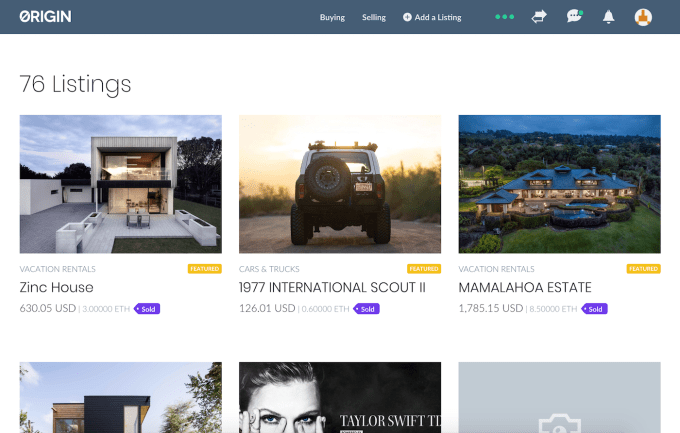
Origin’s in-house marketplace DApp
Today’s mainnet beta sees Origin offering its own basic decentralized app that operates like a Craigslist on the blockchain. Users can create profile, connect their ethereum wallet through services like MetaMask, browse product and service listings, message each other to arrange transactions through smart contracts with no extra fees, leave reviews, and appeal disputes to Origin’s in-house arbitrators.
Eventually with the Origin protocol, developers will be able to quickly build their own sub-marketplaces for specific services like dog walking, house cleaning, ride sharing, and more. These developers can opt to charge fees, though Origin hopes the cost-savings from its blockchain platform will let them undercut non-blockchain services. And vendors can offer a commission to any marketplace that gets their listing matched/sold.
It might be years before the necessary infrastructure like login systems and simple wallets make it easy for developers and mainstream users to build and adopt DApps built on Origin. But it has plenty of runway thanks to $3 million in seed token sale funding from Pantera Capital, $6.6 million raised through a Coinlist token sale, plus $26.4 million in traditional venture funding from Pantera Capital, Foundation Capital, Garry Tan, Alexis Ohanian, Gil Penchina, Kamal Ravikant, Steve Jang, and Randall Kaplan.
“Marketplaces are at the core of what makes the internet so valuable and useful and the Origin team has one of the most promising blockchain platforms for the new sharing economy — with currency baked in — this could be really disruptive (and one of the best utilizations of the ethereum blockchain)” says Ohanian, the Reddit and Initialized Capital co-founder.
Liu and co-founder Josh Fraser came up with the idea after trying to imagine the downstream effects of Ethereum. Liu recalls thinking, “What if we could replace dozens of multi-million and multi-billion dollar companies with open source protocols that aren’t owned or controlled by anyone?”
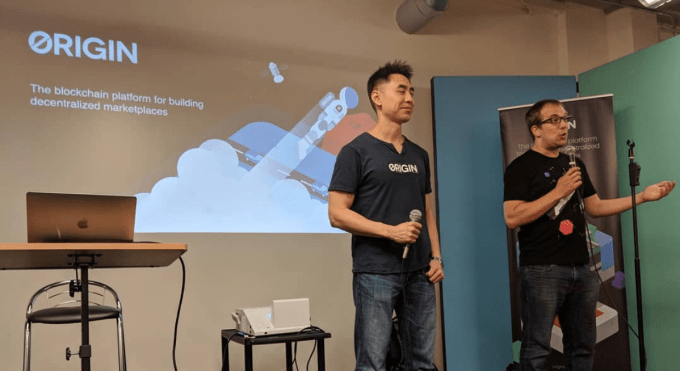
Origin co-founders (from left): Matthew Liu and Josh Fraser
So why would marketplaces want to build on Origin instead of creating their own blockchain or traditional proprietary system? Fraser tells me smart contracts can save money, but that “these individual pieces are incredibly difficult to build” so he sees Origin as “analogous to Stripe — able to abstract away all the friction of building on the blockchain.” 40 marketplaces have already signed letters of intent to build on the protocol.
If Origin reaches critical mass, it could also benefit from the concept of shared network effect. Users only have to sign up once, and can then interact with any marketplace built on Origin. That means new marketplaces the builds on the protocol instantly has a registered user base.
Origin will face some stiff challenges, though. There’ll be a chicken-and-egg problem of getting the first marketplaces signed up before there are users on its self-sovereign identity platform, or geting those users aboard when there’s little for them to do. Liu admits that timing is the startup’s biggest threat. “We believe that decentralized marketplaces are inevitable, but a lot of smart people seem to think we’re too early and that we should be focused on building lower-level infrastructure instead” the co-founder says. For us, we’d rather be too early than too late.”
There’s also the trouble of leaving actors in a capitalist system to treat each other properly without a centralized authority. If an Uber driver treats you terribly, you can complain and get them kicked off the platform. Even with Origin’s review system, abusers of the system may be able to continue operating. It’s easy to imagine its arbitration service becoming completely overwhelmed with disputes. Luckily, Origin has made some strong hires to tackle these challenges, including Yu Pan who it says was a PayPal co-founder, former head of Dropbox’s NYC engineering tream Cuong Du, and Franck Chastagnol who previously led engineering teams at Paypal, YouTube, Google, and Dropbox.
Origin’s success will all come down to usability. Your average Uber driver or Airbnb host is no blockchain expert. They vend through those apps because it’s easy. Those centralized organizations are also highly incentivized to fulfill transactions quickly and smoothly in ways prohibited by eliminating fees. Origin will have to effectively make the blockchain aspects of its service disappear so all users and vendors know is that they’re paying less or earning more.
On stage at Vanity Fair’s New Establishment Summit in Los Angeles, Jeffrey Katzenberg and Meg Whitman unveiled the name of their highly-anticipated mobile video company known until now as NewTV.
The name is Quibi, short for “quick bites,” per a note on its new website: “Something cool is coming from Hollywood and Silicon Valley — quick bites of captivating entertainment, created for mobile by the best talent, designed to fit perfectly into any moment of your day.”
The short-form video service, launching next year, will operate on a two-tiered subscription model similar to Hulu, per Deadline. Quibi is cooking up original content with Oscar-winning filmmaker Guillermo del Toro, Southpaw director Antoine Fuqua and Spiderman director Sami Raimi, as well as Get Out producer Jason Blum and Van Toffler, the CEO of digital media production company Gunpowder & Sky.
The Hollywood Reporter says the del Toro project “is a modern zombie story,” the Fuqua project is “a modern version of Dog Day Afternoon” and the Blum project, titled Wolves and Villagers, could be compared to Fatal Attraction.
Katzenberg, the former chairman of Walt Disney Studios and founder of WndrCo, a consumer tech investment and holding company, has raised $1 billion for Quibi from Disney, 21st Century Fox, Entertainment One, NBCUniversal, Sony Pictures Entertainment, Alibaba Goldman Sachs, JPMorgan Chase, Madrone Capital and several others. He hired Meg Whitman as Quibi’s CEO in January.
Quibi, given Katzenberg and Whitman’s entertainment and business acumen, is expected to compete with the biggest players in the space, including Instagram, Netflix and Snap, which today announced Snap Originals. The new effort will have the ephemeral messaging service rolling out 12 new scripted shows on its app from Keeping Up With The Kardashians creator Bunim/Murray, Friday Night Lights writer Carter Harris and more.
Quibi is hiring aggressively, recently bringing on former Viacom executive Doug Herzog, former Instagram product manager Blake Barnes and former Hulu chief technology officer Rob Post, also per THR.
Quibi did not immediately respond to a request for comment.
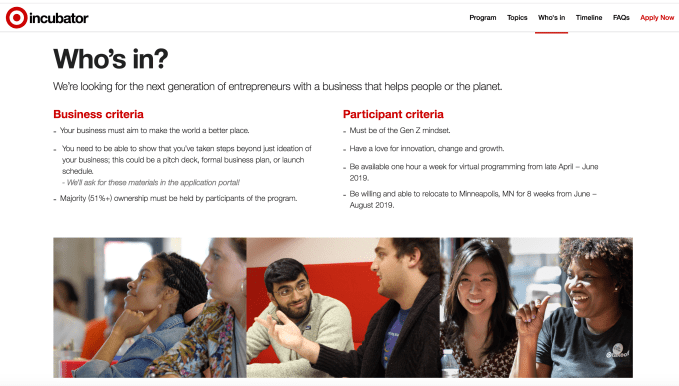
Target is no stranger to running startup accelerators. The company today operates its Target + Techstars program, the beauty-focused Target Takeoff, and the India-based Target Accelerator Program. Now it’s adding a fourth business accelerator to the mix with the launch of Target Incubator. The new program is aimed at Gen Z entrepreneurs and its only real require is that the businesses involved are doing some sort of good.
As Target puts it, the businesses simply need to be making things “better for people or the planet.”
That broad requirement could cover a range of businesses, including those with new product ideas, new technology, or new services. Target says these could be things that impact everything from how you get your groceries to greenhouse emissions.
The businesses themselves don’t have to be too far along, either. All Target is asking is the company has taken some steps to try to get traction, but the business itself doesn’t have to have already publicly launched. It just needs to be more than “an idea” and it needs to be established as a legal entity. The founders must also still retain majority ownership (51%+) to be considered.
The retailer says it will select eight businesses for the program, with up to two members per business directly participating in the new incubator.
These “Gen Z”-focused entrepreneurs will then participate in virtual programming one hour per week from late April through June 2019, followed by a two-month in-person incubator program at Target’s HQ in Minneapolis from mid July through early August 2019.
While there, they’ll receive mentorship from Target leaders and other businesses; participate in workshops, learning sessions and team-building events; be able to access subject matter experts across industries; and participate in other founder growth and development opportunities, Target says.
Applications opened up Monday and will close on October 29, with offers doled out on December 5, following a round of finalist interviews.
The businesses selected will also receive a $10,000 stipend from Target.
And the retailer will cover travel and accommodations for the interviews, plus travel and housing for those attending the eight-week program, which wraps with a demo day.
For Target, being involved with startups gives it the chance to invest in businesses at an early stage, which can ultimately benefit Target’s own bottom line, help it keep up with trends – especially those that draw in younger shoppers – and aid in its battle with Amazon.
The company has already established itself as a company that wants to work with emerging brands, through moves like its investment in online mattress company Casper, as well as through partnerships with digital-first brands like Bevel, Harry’s, Bark, Who What Wear, Native, Quip, Rocketbook, GIR, NatureBox, Hello, and others. It also last year acquired same-day delivery service Shipt, a still-emerging company that allowed it to get into the hot grocery delivery market.
Beyond working with new and digital-first brands, Target wants to reach businesses doing “good.” Today, many younger shoppers – those Target dubs as “Gen Z” – are driven to stores by more than just price. They often want to feel happy about their purchases because they believe in the company’s mission, or because it supports sustainable businesses, for example. Target Incubator will give the retailer a first look into those kinds of businesses now, too.
French startup Skello just raised a $6.9 million funding round (€6 million) from Aglaé Ventures, XAnge, Jean-Baptiste Rudelle and existing investors Thomas Landais, Guillaume le Dieu de Ville and Gilles Blanchard.
The startup is helping bar, restaurant and hotel managers keep track of all the shifts and staffing issues. Skello uses a software-as-a-service approach to help you save time on pesky admin tasks.
After setting up your rules, you can easily generate shifts. Waiters, receptionists and other staff members receive their schedule via email and SMS. Employees can also request shift changes, say when they’re unavailable and make sure everything is taken into account.
At the end of the month, Skello can generate detailed reports with bonuses, leaves, etc. Everything is then exported to payroll solutions. And of course, Skello helps you visualize how much you’re spending on staff, if you’re keeping costs under control and more.
There are many companies trying to do the same thing. But in reality many bars and restaurants still rely on Excel. Chances are it works quite well if you’re running a small business. But it doesn’t scale well. 30,000 employees are now using Skello every day. Alain Ducasse, Planet Sushi and AccorHotels’ Ibis are using Skello.
With today’s funding round, the company first wants to expand to new categories, such as retail and healthcare. Skello then plans to expand to other European countries.

 There’s also the trouble of leaving actors in a capitalist system to treat each other properly without a centralized authority. If an Uber driver treats you terribly, you can complain and get them kicked off the platform. Even with Origin’s review system, abusers of the system may be able to continue operating. It’s easy to imagine its arbitration service becoming completely overwhelmed with disputes. Luckily, Origin has made some strong hires to tackle these challenges, including Yu Pan who it says was a PayPal co-founder, former head of Dropbox’s NYC engineering tream Cuong Du, and