About Startup365

Chaque jour nous vous présenterons une nouvelle Startup française ! Notre pays regorge de talents et d'entrepreneurs brillants ! Alors partons à la découverte des meilleures startup françaises ! Certaines d'entre elles sont dans une étape essentielle dans la vie d'une startup : la recherche de financement, notamment par le financement participatif (ou crowdfunding en anglais). Alors participez à cette grande aventure en leur faisant une petite donation ! Les startups françaises ont besoin de vous !

#USA The best tech books of 2018

//

This year has been good for tech titles. Books like Bad Blood and Brotopia brought us some in-depth reporting on crashes and burns while Stephen Hawking brought us his last thoughts. Here are some of our favorite tech titles for 2018.

from Startups – TechCrunch https://tcrn.ch/2EOWxRX

#Blockchain 50% of Chinese Stock Exchange Companies Investigated Fail to Demonstrate Real Applications for Blockchain

Chinese Stock Exchanges Investigate Blockchain Companies, Half Fail to Demonstrate DLT Applications

According to Chinese state media, the Shanghai and Shenzhen stock exchanges have carried out investigations into 30 percent of companies listed on their exchanges that are performing operations pertaining to distributed ledger technology (DLT). Of the companies investigated, less than half were able to demonstrate applications for blockchain technology.

Also Read: Chatter Report: Vitalik Doesn’t Believe in Proof of Work, Chris Pacia Discusses Big Blocks

Listed Blockchain Companies Undergo Questioning From Shanghai and Shenzhen Stock Exchanges

50% of Chinese Stock Exchange Companies Investigated Fail to Demonstrate Real Applications for BlockchainThe recent speculative frenzy surrounding cryptocurrencies has led to a number of businesses seeking to associate their operations with virtual currencies and DLT. In many cases, the purported foray into blockchain has appeared dubious at best, despite many companies seeing dramatic volatility in the price of their shares, buoyed by news of blockchain adoption.

Chinese state-operated media outlet Securities Daily estimates that 80 public companies listed on the exchanges purport to have included DLT in their business model. Of the 80 companies, 56 have seen a rise in price, placing blockchain among the few sectors to be performing well in the two cities.

Data produced by Hithink Flush Information Network has indicated that 70 of the 80 blockchain-related stocks have seen price moves meeting the daily limit 10 percent price volatility during 2018, seven of which exceeded the limit more than 10 times this year.

More than 50 Percent of Investigated Blockchain Companies Fail to Demonstrate DLT Applications

50% of Chinese Stock Exchange Companies Investigated Fail to Demonstrate Real Applications for Blockchain23 of the 80 DLT companies have been directly investigated by the Shenzhen and Shanghai stock exchanges. Two thirds of the examinations took place during the first quarter of 2018.

According to Sina, the exchanges’ investigations predominantly sought to ascertain “the specific model of the blockchain business, including application scenarios and profit models,” and potential “operational risks” that may arise as a consequence of adopting DLT.

When asked to demonstrate the results of their blockchain operations, the companies are reported to have most frequently used the words “exploration” and “research,” with 13 of the 23 companies suspected of having sought to associate themselves with blockchain solely to drive speculation while failing to evidence applications for DLT.

What is your response to the exchanges’ findings that the majority of companies seeking to ride the blockchain bandwagon have no intention of delivering products and applications built on the technology? Share your thoughts in the comments section below!


Images courtesy of Shutterstock


At Bitcoin.com there’s a bunch of free helpful services. For instance, have you seen our Tools page? You can even lookup the exchange rate for a transaction in the past. Or calculate the value of your current holdings. Or create a paper wallet. And much more.

The post 50% of Chinese Stock Exchange Companies Investigated Fail to Demonstrate Real Applications for Blockchain appeared first on Bitcoin News.

from Bitcoin News http://bit.ly/2SnBeKi 50% of Chinese Stock Exchange Companies Investigated Fail to Demonstrate Real Applications for Blockchain

#Blockchain The Daily: UFC 232 to Have Official Crypto Partner, 5% of Israelis Use Bitcoin

The Daily: UFC 232 to Have Official Cryptocurrency Partner, 5% of Israelis Use Crypto

In today’s edition of The Daily we feature the latest sports sponsorship by the cryptocurrency community. We also cover stories about new statistics on bitcoin usage in Israel, mining malware growth during 2018, and another bank blockchain patent.

Also Read: Investment Robo-Adviser Wealthfront Adds Support for Coinbase

UFC 232 to Have Official Cryptocurrency Partner

The Daily: UFC 232 to Have Official Crypto Partner, 5% of Israelis Use BitcoinThe Litecoin Foundation has announced that it will be the Official Cryptocurrency Partner of UFC 232: Jones vs. Gustafsson 2, which will take place this Saturday, Dec. 29. The Ultimate Fighting Championship event will feature a rematch between former UFC light heavyweight champion Jon Jones and UFC light heavyweight Alexander Gustafsson. The terms of the sponsorship cover the Litecoin logo being displayed on the Octagon’s canvas which the foundation hopes can bring new people to hear about it for the first time.

“There are several reasons why we think it makes sense for Litecoin to step into UFC’s world-famous Octagon now,” the group stated. “Over the last 25 years, UFC, the world’s premier mixed martial arts organization, has evolved from a tiny grassroots movement to a global phenomenon, largely based on the extremely passionate community it has cultivated along the way. We see many parallels to Litecoin in this way as our amazing community has been instrumental in our growth and providing unwavering passion and enthusiasm that continues to propel us forward.”

The cryptocurrency community has a strong record of supporting such sports events. Back in May for example, the mixed martial artist (MMA) Mei Yamaguchi was sponsored by Bitcoin.com as she faced the Atomweight World Champion Angela Lee. Dash has also previously provided sponsorship for fighters.

5% of Israelis Report Investing in Bitcoin

The Daily: UFC 232 to Have Official Crypto Partner, 5% of Israelis Use BitcoinBezeq, one of the largest telecom companies in Israel, released its 2018 State of the Internet Report on Wednesday. The report, based on data from Bezeq’s own system as well as a survey of 1,300 people aged 13 and above, revealed several interesting statistics about Israelis’ online habits during the year.

The figures show that cryptocurrency adoption still has a long way to go Israel, with only 5 percent of people in the country having invested in or used BTC and digital coins. Moreover, a total of 44 percent of Israelis say they either don’t know what Bitcoin is or just don’t understand the concept. In contrast, 42 percent of people have reported using the direct money transfer apps that the big banks in Israel having been pushing hard over the last year in an attempt to stay relevant in the digital age.

Crypto Mining Malware Boomed in 2018

The Daily: UFC 232 to Have Official Crypto Partner, 5% of Israelis Use BitcoinMcAfee, the cyber security company formerly led by the notorious crypto influencer of the same name, has released its latest Threat Report, highlighting notable cybercrime trends in Q3 of 2018. The report states that the “Cryptomining Boom Times Continue,” with covertly mining cryptocurrency via malware one of the big stories of 2018. Total instances of coin miner malware have grown more than 4,000 percent in the past year, despite the bear market. The report also shows that malware miners have been installed via exploits in everything for Macs to routers, media players and even very small IoT devices.

“Cryptominers will take advantage of any reliable scenario,” the researchers noted. “We would not usually think of using routers or IoT devices such as IP cameras or video recorders as cryptominers because their CPUs are not as powerful as those in desktop and laptop computers. However, due to the lack of proper security controls, cybercriminals can benefit from volume over CPU speed. If they can control thousands of devices that mine for a long time, they can still make money.”

The Daily: UFC 232 to Have Official Crypto Partner, 5% of Israelis Use Bitcoin

Bank of America’s Latest Blockchain Patent

The Daily: UFC 232 to Have Official Crypto Partner, 5% of Israelis Use BitcoinBank of America, who we reported on back in August as having filed a patent regarding the custody of cryptocurrencies, has applied for another blockchain-related patent. Documents from the U.S. Patent and Trademarks Office made public on December 25 cover the use of the technology for “banking systems controlled by data bearing records.”

The bank writes in the application that, among other things, blockchain technology may be used by automated teller machines to accelerate transaction speeds or facilitate other types of transactions in addition to ATM transactions such as cash withdrawals and deposits or gift registry transactions. Additionally, ATMs may use blockchain technology to track transactions, thereby enabling a larger amount of transaction volume while reducing physical cash transportation needs.

What do you think about today’s news tidbits? Share your thoughts in the comments section below.


Images courtesy of Shutterstock.


Verify and track bitcoin cash transactions on our BCH Block Explorer, the best of its kind anywhere in the world. Also, keep up with your holdings, BCH and other coins, on our market charts at Satoshi’s Pulse, another original and free service from Bitcoin.com.

The post The Daily: UFC 232 to Have Official Crypto Partner, 5% of Israelis Use Bitcoin appeared first on Bitcoin News.

from Bitcoin News http://bit.ly/2rYY2Vc The Daily: UFC 232 to Have Official Crypto Partner, 5% of Israelis Use Bitcoin

#Blockchain Chatter Report: Vitalik Doesn’t Believe in Proof of Work, Chris Pacia Discusses Big Blocks

Vitalik Doesn’t Believe in Proof of Work, Pacia Clarifies Stance on Large Blocks

In this latest roundup of crypto chatter from social media, Vitalik Buterin sparks debate by declaring that he doesn’t believe in proof of work. Also, developer Rhett Creighton is accused of foul play in the Bitcoin Private pre-mine scandal. Finally, Chris Pacia clarifies his stance on large block limitations.

Also read: A Look at Some of 2018’s Most Popular Cryptocurrency Traders

Vitalik Doesn’t Believe in Proof of Work

Ethereum founder Vitalik Buterin turned a lot of heads recently when he tweeted to Bitcoin maximalist Giacomo Zucco that he doesn’t “believe in proof of work.”

Crypto Twitter erupted with responses. One commentator, Crypto Domains, pointed out the ridiculousness of Vitalik’s comment, comparing it to not believing “in oxygen.” Crypto Domains’ remark resonated widely, not least since Ethereum itself currently runs on a proof of work model.

Bitcoin Community Skeptical of Rhett Creighton

The Bitcoin Private team recently released an official statement explaining that they had no prior knowledge of the BTCP coins that were covertly created during the fork that birthed the project. Instead, they were mislead by developer airk42, they insist. Airk42 had started out innocently by accepting a bounty the team had placed. He then managed to became a BTCP developer and was promoted to contributor on Github. However, when airk42 merged his own code, he left out one crucial line and a bad actor exploited this bug, creating approximately 2 million additional coins.

Many in the cryptocurrency community were suspicious of the BTCP team and their official response. In a recent live stream by bitcoin trader Tone Vays, developer Jimmy Song pointed out that former BTCP developer Rhett Creighton left the project in a rather cryptic manner that foreshadowed the hack.

Likewise, Vays expressed skepticism at Creighton’s sincerity and quickly theorized that he may have secretly been airk42. Cryptocurrency trader Nick Core also agreed with Tone, explaining that scammers are prone to “leave projects before they are finished.”

Chris Pacia Clarifies Tweet on Blocksize Limitations

Bitcoin commentator u/satoshi_vision 1 recently called out Openbazaar developer Chris Pacia on the r/bitcoincashSV subreddit for Pacia’s comments that bitcoin software will start to break down when blocks reach about 22 MB in size. u/satoshi_vision 1 was criticizing Pacia, as Coingeek had mined a 64MB block at block height 557335.

We were told by Chris Pacia that 22MB blocks would not work, not we have blocks nearly 3x that size. from bitcoincashSV

Pacia was unable to defend himself on the subreddit, as he had been banned from participating on r/bitcoincashSV, despite never having commented on it before. Instead, Pacia took to Twitter to defend himself, explaining that his tweet wasn’t about the ability to mine a single large block.

Rather than large single blocks, Pacia was referring to the ability to mine many large blocks in tandem. He then went on to point out that the average blocksize over a one-hour period never went above 7 MB when BSV was mining 32 MB blocks.

What do you think of Vitalik’s thoughts on proof of work? Let us know in the comments below.


Images courtesy of Shutterstock.


Do you like to research and read about Bitcoin technology? Check out Bitcoin.com’s Wiki page for an in-depth look at Bitcoin’s innovative technology and interesting history.

The post Chatter Report: Vitalik Doesn’t Believe in Proof of Work, Chris Pacia Discusses Big Blocks appeared first on Bitcoin News.

from Bitcoin News http://bit.ly/2GESysI Chatter Report: Vitalik Doesn’t Believe in Proof of Work, Chris Pacia Discusses Big Blocks

#Blockchain PR: Write off Crypto Losses With CoinTracking.info

Write off Crypto Losses With CoinTracking.Info

This is a paid press release, which contains forward looking statements, and should be treated as advertising or promotional material. Bitcoin.com does not endorse nor support this product/service. Bitcoin.com is not responsible for or liable for any content, accuracy or quality within the press release.

Last Thanksgiving, Bitcoin was in the middle of a bull run that would result in a record high of $19,511 just before Christmas. Now, Bitcoin is worth just $3,752.

If you bought Bitcoin and other cryptos when their prices were high, there’s a silver lining around the gray state of crypto markets now: any losses you take this year could place you in a lower tax bracket. What’s more, claiming those losses is easier than you might assume.

For the purposes of taxation, the US and most other governments consider cryptocurrencies to be assets. This means that whenever you trade cryptocurrency, the transaction falls into one of two categories: a capital gain or a capital loss.

Capital gain: A capital gain occurs when you sell cryptocurrency for more than the amount that you paid to purchase it.
Capital loss: If you sell cryptocurrency for less than the amount that you paid for it, this is considered to be a capital loss.

You have to sell or buy an asset to trigger a taxable gain or loss. Once you decide to make a move, tax authorities consider the loss to be “realized.” If your loss is great enough, you may be able to use it to enter a lower tax bracket.

One of the biggest benefits of claiming a loss is that you can offset income gained from other sources.

In the US, the IRS lets you deduct up to $3,000 worth of net capital losses each year from the amount of money you’ve earned at your day job. If the amount you lost was greater than $3,000, you can get another deduction of up to $3,000 when you file your taxes next year.

If you currently make just over $50,000 per year at your job, that $3,000 cryptocurrency loss could place you in a lower tax bracket. This could result in thousands of dollars of tax savings.

What’s more, if you’ve earned some income through stocks or through the sale of property, there’s no limit to the amount you can deduct from those revenues.

If you’re in the $38,701 – $82,500 tax bracket and your crypto capital loss deduction puts you below the $38,700 mark, you’d only have to pay $952.50 plus 12% of any amount over $9,525. But if you made $38,701 or more, you’d have to pay over four times as much in taxes, plus 22% of any amount over $38,700.

In other words, if you fail to deduct your crypto losses and you fall into the third bracket as a result, you’d have to pay at least $4,453.50 to the IRS. But if you do file your losses and make it into bracket two, you’d pay just $952.50.

Total tax savings: $3,501.50.

If you’re married and filing jointly or widowed, moving into a lower tax bracket can result in even more tax savings. If you made $77,402 in 2018, you’d have to pay the IRS $8,907 and change.

Dropping down to the $19,051-$77,400 tax bracket by filing a crypto loss would save you $7,002.

In addition to cryptocurrency traders, cryptocurrency miners can use deductions to reach lower tax brackets.

A notice that the IRS published in March of 2014 provides some relevant details:

“…when a taxpayer successfully “mines” virtual currency, the fair market value of the virtual currency as of the date of receipt is includible in gross income.”

If the value of the cryptocurrency you mined decreased and you decide to sell it, then that would mean that you have triggered a capital loss. You can report this loss in the same way that you would if you bought and then sold your coins through an exchange.

IRS analysts told CNBC that electricity costs and other expenses may be written off as well.

Figuring out how much you’ve made or lost can be a headache, particularly if you haven’t been keeping track of your purchases or if you placed a huge amount of trade orders last year.

Sorting out how much you lost or earned requires access to historical pricing data. Without that historical data, you won’t be able to determine what the price of your crypto asset was when you bought and sold it.

Fortunately, there is software available that can crunch all your crypto tax data for you.

With CoinTracking.info, can import your transactions from all your cryptocurrency wallets and exchanges. The interface walks you through how to do the imports.

At the end of the import process, you can download IRS form 8949. This is the form you need to submit to report your loss.

Other download options include CSV, TaxACT and TurboTax.

If you use a crypto tax calculator to do your own taxes, filing your taxes is a straightforward process. All you have to do is take the total from IRS form 8949 and transfer that to IRS form 1040 Schedule D.

In fact, most CPAs that work with crypto traders use CoinTracking and other publicly available software to determine what their clients owe. These tools are not difficult to use. Many have free trials, which let you see how they work for yourself before you commit.

If you lost money in crypto markets last year, you may be able to offset some– or perhaps even all– of those losses at tax time. Reporting your capital losses might help you move to a lower tax bracket. If your deductions qualify you for a lower bracket, filing them could save you thousands of dollars when you submit your taxes this year.

Press Contact Email Address
alex@cointracking.info

Supporting Link
https://cointracking.info

This is a paid press release. Readers should do their own due diligence before taking any actions related to the promoted company or any of its affiliates or services. Bitcoin.com is not responsible, directly or indirectly, for any damage or loss caused or alleged to be caused by or in connection with the use of or reliance on any content, goods or services mentioned in the press release.

The post PR: Write off Crypto Losses With CoinTracking.info appeared first on Bitcoin News.

from Bitcoin News http://bit.ly/2Q50oes PR: Write off Crypto Losses With CoinTracking.info

#Blockchain Maduro’s Promotion of the Petro Yet to Yield Results

Maduro’s Promotion of the Petro Yet to Yield Results

Venezuelan President Nicolas Maduro has been tirelessly promoting the petro, ever since his administration announced the creation of what is now considered the first state-issued cryptocurrency. Although no one is really sure whether the coin actually works, Venezuelans have already seen their salaries denominated in the national crypto and their pensions converted to petro. Imposing the virtual currency on other nations, however, is proving much harder.

Also read: Private Blockchains Have Few Applications, Study Finds

Russia Not Ready for Petro Bookkeeping

Maduro’s Promotion of the Petro Yet to Yield ResultsMaduro attempted to push the petro during his recent visit to Moscow, offering Russia the opportunity to use the Venezuelan coin in its oil industry finances. Speaking to journalists in the Russian capital, he revealed that Caracas intends to gradually introduce the oil-backed cryptocurrency in its trade relations with international partners and has already prepared a schedule to do so. The head of the Bolivarian Republic, who met high-ranking Russian officials including President Putin, added that his country will start using the petro for all transactions in its oil sector in 2019.

The news that the cryptocurrency will be on the agenda of the meetings in Moscow came from the Venezuelan ambassador to Russia, Carlos Rafael Faria Tortosa, who claimed the Russian side has shown great interest in the Venezuelan proposals. Later, Russia’s deputy finance minister Sergey Storchak confirmed the petro has been presented to the Russian officials but said there were no immediate plans to use it in bilateral trade with Venezuela.

This is not the first attempt by Caracas to sell the petro to the Russians. In April of this year, officials from both countries discussed the expansion of the economic cooperation between their governments. Following the meetings, the South American country revealed plans to assemble Russian Kamaz trucks and intentions to pay for the auto parts with petro coins. The agreement, however, was not officially confirmed by the representatives of the Russian Federation who visited Caracas.

Belarus Prefers Raw Materials Over Crypto

Maduro’s Promotion of the Petro Yet to Yield ResultsMore recently, Venezuela offered another of its allies, Belarus, to pay a portion of the $113 million it owes for housing projects realized by the state-owned Belarusian construction company Belzarubezhstroy using the petro. “The financial situation in Venezuela is tense. We are considering alternative options for repaying the existing debt. One of them is to use the petro cryptocurrency,” said the company’s deputy director Alexander Falevich.

Despite the outstanding debt, Belzarubezhstroy continues to build apartment blocks in Venezuela, even after the departure of all Russian and Chinese companies from the country, Falevich told Sputnik. He added that the Venezuelan authorities do want to pay the money but the Belarusian law currently does not recognize cryptocurrencies such as the petro as legal tender. That’s why Minsk is trying to convince Caracas to repay the debt with raw materials, which Belarus can then re-export to the global market.

Caracas Pitches the Petro to OPEC Members

Maduro’s Promotion of the Petro Yet to Yield ResultsVenezuela also plans to offer its sovereign cryptocurrency as a unit of account in the Organization of the Petroleum Exporting Countries (OPEC). International oil trade is dominated by U.S. fiat currency and over the past decades a number of proposals to replace the greenback have been put forward by countries under U.S. sanctions.

In a video address, published last month on Twitter by the state-owned energy giant PDVSA, the country’s oil minister Manuel Quevedo said he intends to acquaint OPEC members with the “main oil-backed digital currency.” He also stated:

The petro will become the digital currency of the international oil trade. We will present it to OPEC. This will be a move to spread cryptocurrencies internationally.

Venezuela wants to start using the petro in its oil exports as soon as the first quarter of next year. Its government has already called on distributers of Venezuelan oil and petroleum products as well as air carriers and sea shipping companies to set up cryptocurrency wallets in order to be able to pay and be paid in petro. The problem is, however, that despite announcing the public sale of the national crypto in October, at this point its buyers can only get “petro certificates,” not the digital coins themselves.

That, of course, did not stop President Maduro from promoting the state-issued Venezuelan coin to another international organization, the regional “Bolivarian Alliance for the Peoples of Our America” (ALBA). “We need to unite for economic liberation and go along the path of joint development,” the socialist leader told his colleagues from nine other member states, while suggesting that ALBA should put the petro in the focus of its monetary policy efforts.

What do you think of Venezuela’s attempts to promote its national cryptocurrency, the petro? Share your thoughts on the subject in the comments section below.


Images courtesy of Shutterstock, Belzarubezhstroy. 


Express yourself freely at Bitcoin.com’s user forums. We don’t censor on political grounds. Check forum.Bitcoin.com.

The post Maduro’s Promotion of the Petro Yet to Yield Results appeared first on Bitcoin News.

from Bitcoin News http://bit.ly/2ELvAh7 Maduro’s Promotion of the Petro Yet to Yield Results

#Africa Kenyan experience-booking platform Cloud9xp launches mobile apps

//

Kenyan startup Cloud9xp, an online marketplace and booking service for leisure experiences, has launched its new app for iOS and Android mobile devices.

Disrupt Africa first reported on Cloud9xp back in 2016, but the startup has been busy since – raising some funding, taking part in the Google Launchpad Africa accelerator, and pitching at DEMO Africa in Morocco.

Its online marketplace lists more than 80 experience providers and 550 experiences, allowing leisure seekers to discover and book fun activities to do across different categories, styles and locations in Africa.

Cloud9xp has now launched Android and iOS apps as alternative booking channels for its customers as it bids to become Africa’s largest curated marketplace for leisure experiences. The new mobile apps allow users to discover the best nearby experiences, book these experiences in less than three minutes, and plan travel itineraries.

“Cloud9xp is altering the way people find things to do in their city and when travelling for

leisure or business in a way never seen before,” said Mesongo Sibuti, the startup’s co-founder and chief technology officer (CTO).

“Beyond helping make things easier for leisure seekers, Cloud9xp also provides access to booking management tools that enable experience providers and tour operators to tap into an audience of potential customers for bookings by creating exposure for their experiences; and an alternative revenue channel.”

The post Kenyan experience-booking platform Cloud9xp launches mobile apps appeared first on Disrupt Africa.

from Disrupt Africa http://bit.ly/2SnwvYX

#Blockchain The 2018 Bitcoin Mining Ecosystem Saw Record Hashrates and New Devices

The 2018 Bitcoin Mining Ecosystem Saw Record Hashrates and New Devices

2018 was a crazy year in regard to the price of cryptocurrencies losing more than 80 percent of their values since they touched all-time highs. Interestingly enough, even though the prices of major digital assets plummeted, the hashrate for SHA-256 coins skyrocketed during the months of August through October. Although the hashrate has declined significantly since the price was severely impacted negatively this past November.

Also Read: Crypto Bear Market Triggers Rise in M&A Activity

A Look at the Hashrates Securing the Most Popular SHA-256 Coins in 2018

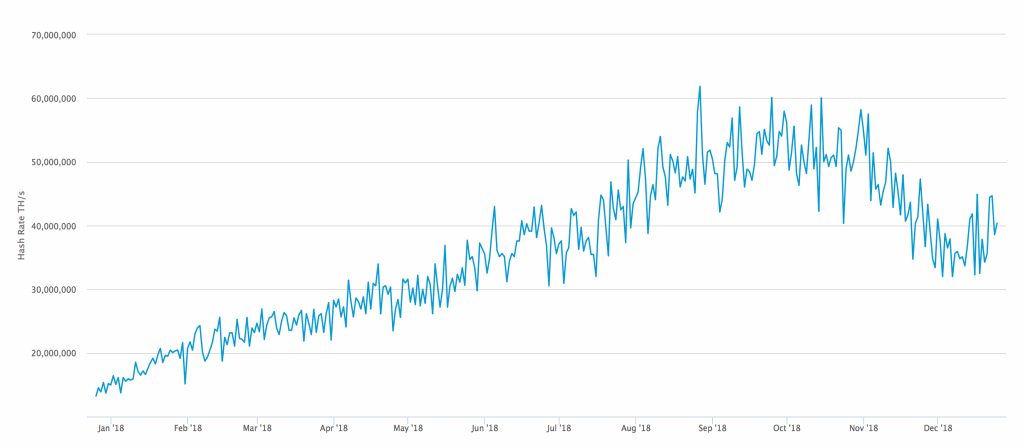
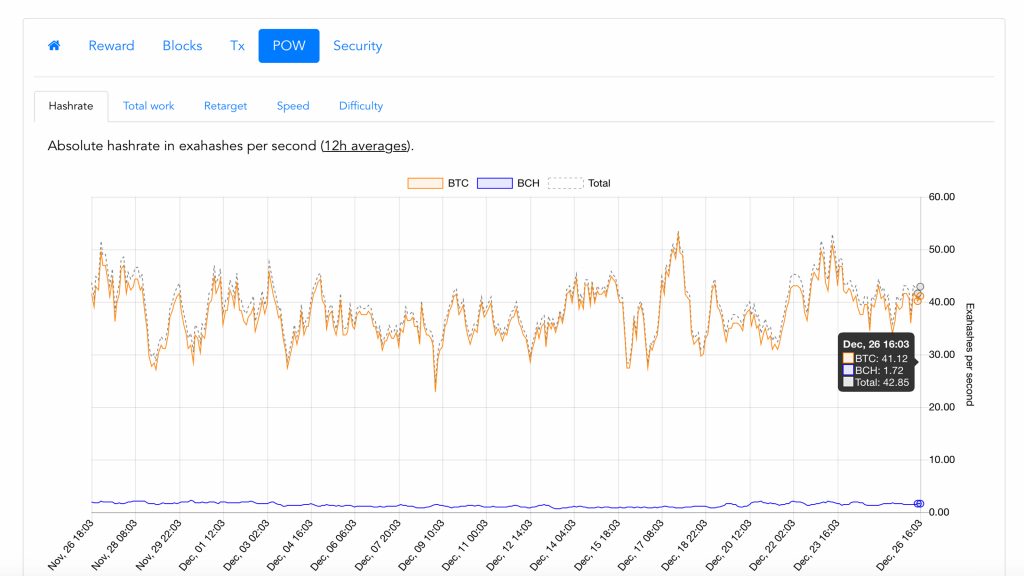
Cryptocurrency miners secure blockchain networks for a profit and the cumulative proof-of-work (PoW) hashrate of all the SHA-256 coins has seen milestone after milestone in 2018. The total hashrate of both Bitcoin Cash (BCH) and Bitcoin Core (BTC) networks combined surpassed 65 exahash per second (EH/s) last August. Since then, the combined hashrate of both networks is averaging 42 EH/s during the final week of 2018, as the hashrate tumbled over the course of the last eight weeks. The hashrate is still twice higher than it was last January, even though it had lost around 20-25 EH/s after the high.

The 2018 Bitcoin Mining Ecosystem Saw Record Hashrates and New Devices
Bitcoin Core (BTC) network hashrate 2018.

According to Coin Dance statistics, it is currently 4.10 percent more profitable to mine on the Bitcoin Cash blockchain. Furthermore, Coinwarz data details the BCH chain is the third most profitable PoW chain today. Since the SHA-256 hashrate declined rapidly during the first week of November and the BCH blockchain split occurred on the 15th, the Bitcoin Cash network hashrate has seen much better days. For instance, the cryptocurrency’s hashrate captured an average of 4-5 EH/s for most of 2018.

The 2018 Bitcoin Mining Ecosystem Saw Record Hashrates and New Devices
Bitcoin Core (BTC) and Bitcoin Cash (BCH) hashrates combined, on Dec. 26.

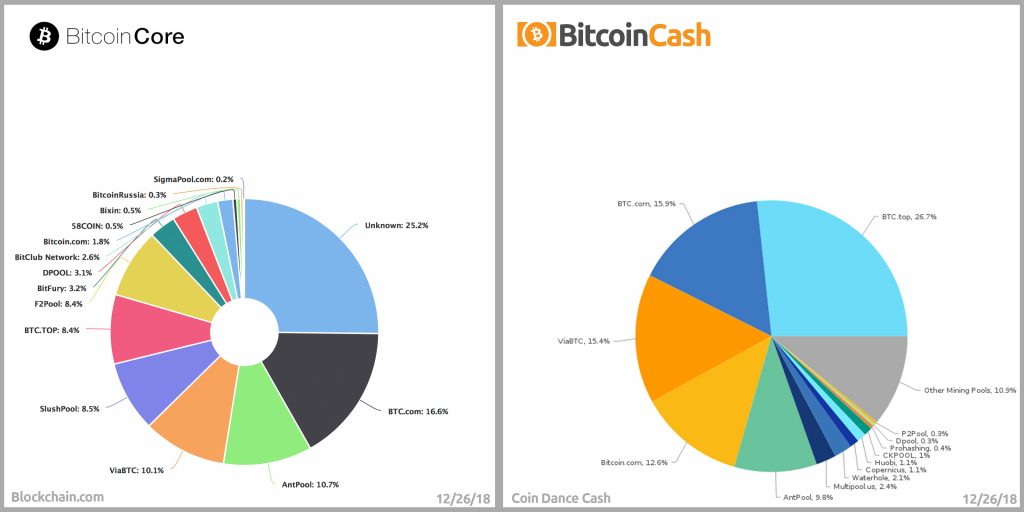
However, because of the split and falling BCH prices, the network is only capturing 1.5-1.9 EH/s but has improved considerably since the last big price drop. When the price was under $100 per BCH, the hashrate was only .5-.9 EH/s (or 5,000-9000 petahash per second). The biggest mining pools on the Bitcoin Cash network this month are BTC.top, Viabtc, and BTC.com. The Bitcoin Core network’s largest pools today include BTC.com, Antpool, and Viabtc.

The 2018 Bitcoin Mining Ecosystem Saw Record Hashrates and New Devices
The top SHA-256 mining pools of 2018.

2018’s Next Generation ASICs

2018 also saw a lot of buzz surrounding new ASIC miners that utilize next-generation chips like 7 nanometer (nm) and 10nm semiconductors. Even though these machines received a lot of attention because crypto-markets had plummeted, they really haven’t lived up to their hype so far. Even if a machine packs a lot of terrahash per second (TH/s), it still has a hard time profiting this year. There are roughly six SHA-256 ASIC machines at the time of publication that are pulling in a profit by mining either BTC or BCH. The most profitable miner today is the Asicminer 8 Nano Pro, a machine that claims to pack a monstrous 76 TH/s. It is followed by the Ebang Ebit E11+ which makes $3.73 per day at current prices and claims to capture 44 TH/s per machine.

The 2018 Bitcoin Mining Ecosystem Saw Record Hashrates and New Devices

The 2018 Bitcoin Mining Ecosystem Saw Record Hashrates and New DevicesAsicminer’s 44 TH/s Nano version is capturing $3.36 per day but the fourth most profitable miner, the Innosilicon T3, isn’t available for purchase yet. Only five of the six most profitable SHA-256 miners can be purchased today and most of these devices process more than 23 TH/s. Also, a big surprise came this week from the manufacturers of the 7nm-powered B2 and B3 miners created by the GMO Group from Japan. According to the company, it won’t be manufacturing these machines going forward and it saw a record loss of $218 million during the last four months. Other mining operations have also recorded deep losses this year, like when Washington-based firm Giga Watt filed for bankruptcy. And local reports stemming from China this past November explained that miners in the region were “selling mining rigs by the Kilo as scrap.”

Even With the Ups and Downs — Hashrate Continues to Increase Over Time

The bear market of 2018 has definitely taken a toll on miners but even more so during Q4. This month, news.Bitcoin.com explained how Chinese miners have been shorting the spot markets in order to break even on electric costs stemming from unprofitable devices. These rigs are then sold on the secondary market and miners keep repeating the cycle until they can buy new machines when prices get bullish. Although our publication also reported on Matt D’Souza, the co-founder of Blockware Solutions, who explained that even though some operations were going bankrupt, other mining facilities have handled the cryptocurrency recession in a more inventive fashion.

Moreover, even though SHA-256 mined coins had their values chopped considerably in 2018 and their hashrate plummeted by 20-25 EH/s, both metrics are still significantly higher than ever before. There will always be highs and lows but an economy with an upward healthy trend over the long run is always a good sign.

What do you think about the hashrate climb this year and all the new machines announced? Let us know what you think about this subject in the comments section below.

Disclaimer: Bitcoin.com does not endorse nor support these products or services. Readers should do their own due diligence before taking any actions related to the mentioned company or any of its affiliates or services. Bitcoin.com and the author is not responsible, directly or indirectly, for any damage or loss caused or alleged to be caused by or in connection with the use of or reliance on any content, goods or services mentioned in this article. This editorial is for informational purposes only.


Images via Shutterstock, Ebang, Asicminer, Blockchain.com, Coin Dance Cash, Fork.lol.


Want to create your own secure cold storage paper wallet? Check our tools section.

The post The 2018 Bitcoin Mining Ecosystem Saw Record Hashrates and New Devices appeared first on Bitcoin News.

from Bitcoin News http://bit.ly/2VcixLl The 2018 Bitcoin Mining Ecosystem Saw Record Hashrates and New Devices

#Africa Highlights of 2018 – what the investors said

//

As 2018 comes to a close, at Disrupt Africa, we’re reflecting on an active year in Africa’s startup and investor ecosystem.  2018 has seen the ecosystem develop in leaps and bounds. We’ve seen the most funding flowing into African startups on record; a burst in investor networks launching Africa-wide; and the continent’s top entrepreneurs starting to receiving the attention they deserve.  But what were the highlights? A selection of investors from around the continent give us their take.

Clive Butkow, chief executive officer, Kalon Venture Partners:

“For me, there were three main highlights this year:  the amount of capital being deployed to tech startups both in South Africa and Africa; the interest from international investors to invest in African early stage tech companies; and the rise of angel networks, number of accelerators and other entities assisting startups succeed.”

Tidjane Dème, general partner at Partech, managing the Partech Africa fund:

“It’s a difficult question. So much happened.  But if I try and keep to only three highlights, then first, this was a pivotal year in how fintech took off in volume as well as in scope. While an even larger portion of funding has gone into this space, fintech startups engaged in a more diverse set of opportunities and we are finally seeing really interesting and innovative solutions for SMEs as well as consumer lending, savings, insurance, etc.

In the investment space, there was a crucial development for the long term prospect of the ecosystem: the launch of locally managed funds dedicated to Africa backed by strong LPs (limited partners). Local teams, living on the continent and within the context startups are working in, are more likely to bring valuable networks and insights. They will also diversify the geography and the profile of founders. A more important fact, some of these funds received support from global LPs who have never entered this space in Africa. With these barriers down, more such funds will emerge and this is great news for the ecosystem.  

Finally, significant deals in the Series B and C spaces signal the advent of more mature startups, reaching across borders to create scale.”

Justin Stanford, co-founding general partner, 4Di Capital:

“A key highlight for me has been the increasing interest of foreign investors coming to our shores, looking to co-invest with local investors, and bringing experience, knowledge and international networks and market access. Additionally it is clear the ecosystem continues to mature nicely, as the quality of deal flow is improving and the level of pre-baking in the oven that is taking place (angel investment, mentoring, market testing, prototyping) with early-stage startups is increasing. This improves things for us as institutional investors as we have more fleshed out opportunities to consider.”

Nico Blaauw, director for marketing, Goodwell Investments

“Highlights have been the fast enrollment of digitization of products and services as well as supply chains; convergence – with ever more business models aiming to combine benefits and learning experiences of other sectors and technologies; and pioneering tech businesses from five years ago entering maturity phase and attracting new, larger investors invest in economic growth.”

Yele Bademosi, founder and managing partner, Microtraction:

“For me the highlight was the number of Africa focused funds that were announced, across various stages – this shows an increasing maturity of our ecosystem.”

Andrea Böhmert, co-managing partner, Knife Capital

“In my view, 2018 was a year where the ecosystem matured a lot. Not that it is mature – we are still far away from this. But I have seen some very interesting changes that I believe point towards maturity. Let me elaborate. There is more money available then ever and the money comes in different shapes and sizes. That again, doesn’t mean that there is enough and that it is easy to get funded but it does mean that investors, despite all the doom and gloom, consider Africa to be an investment destination worthy of allocating money to. The larger variety of investors also means that entrepreneurs can now start approaching investors who have a more aligned fit, which should ultimately result in more success stories. So in short, the diversity of money investing in Africa is for me one of the key highlights of 2018.

Another one, also pointing toward the increased maturity of the ecosystem, is the increase in discussions that value substance over hype. There are more talks now about grit, perseverance, and how to deal with challenges then the normal “how to become an overnight success by raising a funding round”. Entrepreneurs are starting to value the journey, and how important it is to have the right partners at your side. And service providers across the board are embracing the concept that you need to start building partnerships early.

Another interesting highlight for me was the second week of September where Cape Town was home to a number of events. Two of them stood out for me, the Learning Indaba in Stellenbosch and the AI Expo in Cape Town. Both brought together the AI community from across Africa, both were overwhelmed by the interest and again, both showcased the quality of quantity Africa has to offer in such a cutting edge science.

Lastly, it is great to see how many South African companies are increasing their reach into other geographic territories, competing on global levels. The likes of Clickatell, Entersekt, DataProphet, Snapplify, Mix Telematics – the list is increasing rapidly and demonstrates not just the maturity of the ecosystem but also the maturity of what our companies have to offer.”

The post Highlights of 2018 – what the investors said appeared first on Disrupt Africa.

from Disrupt Africa http://bit.ly/2CBU22X