
About Startup365

Chaque jour nous vous présenterons une nouvelle Startup française ! Notre pays regorge de talents et d'entrepreneurs brillants ! Alors partons à la découverte des meilleures startup françaises ! Certaines d'entre elles sont dans une étape essentielle dans la vie d'une startup : la recherche de financement, notamment par le financement participatif (ou crowdfunding en anglais). Alors participez à cette grande aventure en leur faisant une petite donation ! Les startups françaises ont besoin de vous !

#Blockchain US Law Professor: Confusing Cryptocurrency Regulations Will Hamper Innovation

US Law Professor: Confusing Cryptocurrency Regulations to Hamper Innovation

Carol Goforth is a professor at the University of Arkansas School of Law. She recently published a paper about the consequences of having cryptocurrency regulations fall under a number of conflicting laws, defined by various U.S. authorities, all at the same time.

Also Read: IRS to Face Record Number of Crypto-Related Loss Claims

Confusing, Prohibitive and Expensive Regulations

US Law Professor: Confusing Cryptocurrency Regulations Will Hamper InnovationCrypto assets are currently regulated in the U.S. as property by the Internal Revenue Service (IRS), as money by the Department of Treasury’s Financial Crimes Enforcement Network (Fincen), as commodities by the Commodity Futures Trading Commission (CFTC), and as securities by the Securities and Exchange Commission (SEC). Additionally, every single state has its own set of laws that may apply to crypto, and some have even adopted unique regulatory approaches towards the matter.

This has produced a set of overlapping rules and confusing requirements that is likely to hamper innovation in the American crypto industry, according to law professor Carol Goforth. Moreover, the expenses associated with complying with all of these obligations can be prohibitive and time-consuming for U.S. crypto businesses such as exchanges. And with the added risk of investigations and enforcement actions, “it is easy to see why the U.S. is not regarded as being receptive to crypto,” she explained in her paper.

A Paradigm Shift Is Required

US Law Professor: Confusing Cryptocurrency Regulations Will Hamper InnovationUnfortunately, professor Goforth has determined that it is unlikely that the U.S. will do away with any of the aforementioned bodies or limit the jurisdiction of existing agencies so as to consolidate regulatory power. This is because prior attempts to consolidate functions of different financial regulators have failed, legislators think that existing authorities have differing areas of expertise, and the courts have approved the situation.

It therefore behoves these agencies to get together and make a concerted effort to coordinate enforcement and regulatory oversight based on a more nuanced approach. “This change in perspective requires a paradigm shift that moves away from treating crypto as a single kind of asset, when in reality, it is not. Hopefully, American regulators will realize this, and act on this reality, sooner rather than later,” she concluded.

How should US-based cryptocurrency innovators deal with confusing regulation? Share your thoughts in the comments section below.


Images courtesy of Shutterstock.


Verify and track bitcoin cash transactions on our BCH Block Explorer, the best of its kind anywhere in the world. Also, keep up with your holdings, BCH and other coins, on our market charts at Satoshi’s Pulse, another original and free service from Bitcoin.com.

The post US Law Professor: Confusing Cryptocurrency Regulations Will Hamper Innovation appeared first on Bitcoin News.

from Bitcoin News https://ift.tt/2EoZN66 US Law Professor: Confusing Cryptocurrency Regulations Will Hamper Innovation

#Blockchain Gibraltar Exchange Obtains Insurance for Crypto Assets as Cyber Attacks Soar

Gibraltar Exchange Buys Insurance Cover for Listed Crypto Assets as Cyber Attacks Soar

With cyberattacks on the rise, Gibraltar Blockchain Exchange (GBX) has announced an insurance policy to cover its digital assets in partnership with Gibraltar-based Callaghan Insurance. Cryptocurrencies held in both the hot and cold wallets of the trading platform will be insured.

Also read: Report: Swiss City of Zug Named Fastest Growing Tech Hub in Europe

Cyber Insurance for Cryptocurrencies

“We are delighted to announce the introduction of insurance coverage … this represents an important step in attracting users who require strict assurances around the security of their assets,” Nick Cowan, chief executive officer of GBX, said in a statement on Dec. 10.

Gibraltar Exchange Obtains Insurance for Crypto Assets as Cyber Attacks Soar

Cowan said his exchange, licensed by the Gibraltar Financial Services Commission only last month, was “committed to building a platform focused on the highest regulatory standards and the strictest due diligence processes.”

The insurance cover ensures that assets in the custody of the GBX are insured. It also means digital currencies held by the exchange for investors will be covered, “providing additional reassurance to a wide variety of traders around security and transparency,” stated the CEO.

Cyber Attacks on the Rise

Attacks by hackers on exchanges are not uncommon in the fledgling cryptocurrency industry. Estimated losses from cyber crime have topped $930 million so far this year, according to data by U.S. security firm Ciphertrace.

As thefts have rocked exchanges worldwide, some platforms have woken up to the need to not only strengthen their security to safeguard investor funds, but also to buy insurance to cover potential losses. This is particularly crucial in an industry that has drawn its share of unsophisticated investors who trade with a certain degree of naivety in many cases, lured by the promise of quick riches.

Gibraltar Exchange Obtains Insurance for Crypto Assets as Cyber Attacks Soar

Incidents of fraud and stolen funds can smear a market struggling to build confidence in the absence of regulatory oversight. Exchanges will also have to worry about the costs associated with investigating and closing a breach in the event of a hack, loss of business, public relations to repair confidence and other issues. Given these factors, it is of little surprise that GBX has opted to invest in cyber insurance.

Gibraltar Developing Into a Cryptocurrency Hub

Bruno Callaghan, managing director of Callaghan Insurance Brokers, said: “I am delighted that Callaghan have been able to procure, after much research and collaboration with the London insurance market, a bespoke, fit for purpose coverage option that affords our clients and the jurisdiction the necessary protection to move forward confidently in the distributed ledger technology arena.”

GBX, a unit of the GSX Group, owners of the Gibraltar Stock Exchange, was recently granted a full license to operate by the country’s financial regulator. In the past 24 hours, about $6.5 million worth of BTC had been traded on the platform, according to Coingecko.

Gibraltar Exchange Obtains Insurance for Crypto Assets as Cyber Attacks Soar

Gibraltar is positioning itself to be a major center for cryptocurrency development. Earlier this year, the European territory introduced a purpose-built distributed ledger regulatory framework. GBX chief executive officer Nick Cowan said the partnership with Callaghan Insurance “highlights the relentless efforts being made by businesses and regulators in Gibraltar to provide a sustainable environment for blockchain development.”

What do you think about cyber insurance cover for cryptocurrency exchanges? Let us know in the comments section below.


Images courtesy of Shutterstock.


Need to calculate your bitcoin holdings? Check our tools section.

The post Gibraltar Exchange Obtains Insurance for Crypto Assets as Cyber Attacks Soar appeared first on Bitcoin News.

from Bitcoin News https://ift.tt/2L7AOVB Gibraltar Exchange Obtains Insurance for Crypto Assets as Cyber Attacks Soar

#Blockchain Only Five Bitcoin Mining Devices Released in 2018 Are Profitable This December

Only Five Bitcoin Mining Devices Released in 2018 Are Profitable This December

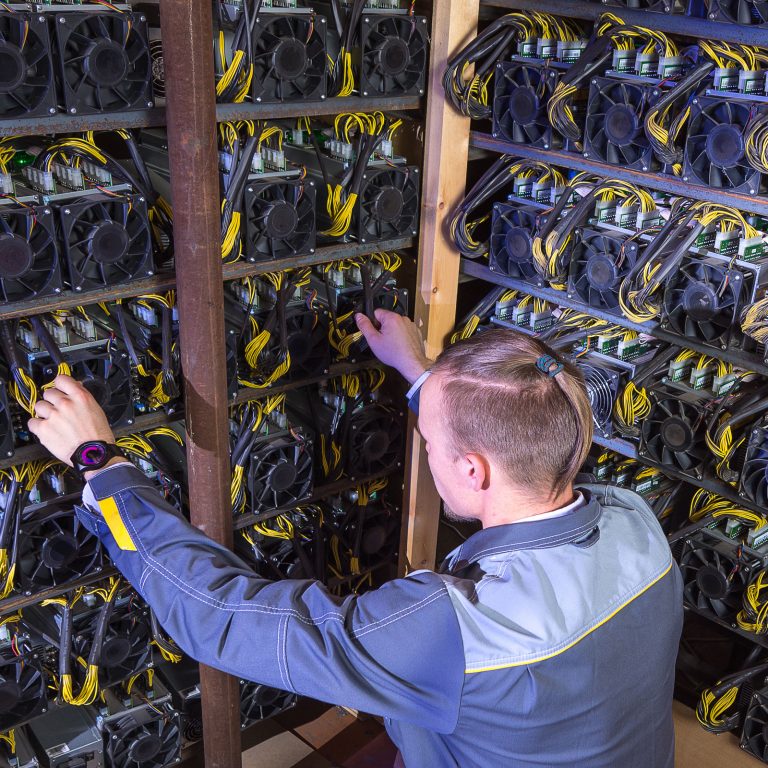
There has been a slew of bitcoin mining rigs announced during the last 12 months that claim to process more terahash per second while consuming less energy. However, with cryptocurrency prices so low, lots of newly launched machines are not profitable and many of them haven’t even shipped yet.

Also read: Federal Agents Told This Silk Road Moderator to Fake His Own Death  

The Five Profitable Mining Rigs

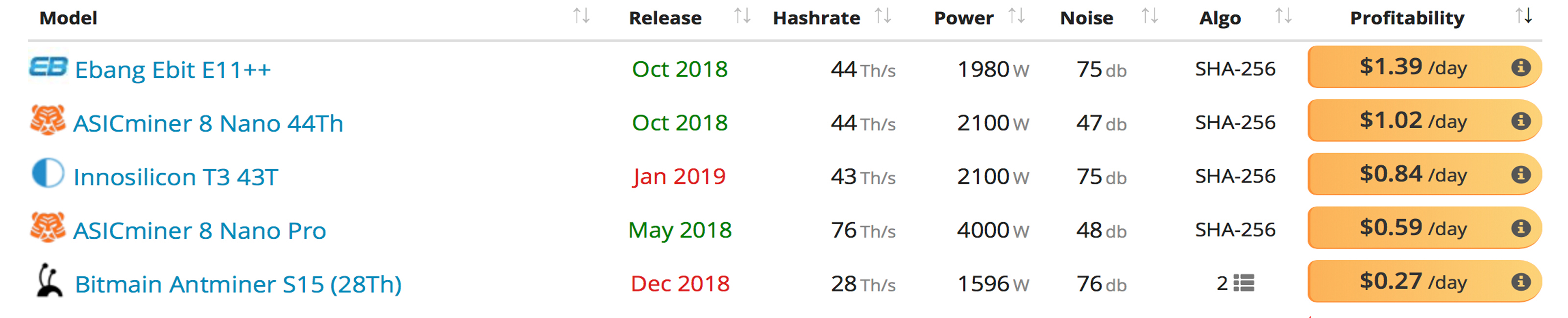
Digital asset prices have seen better days as cryptocurrency markets throughout the entire 2018 calendar year have been riding a long bearish trend. Many coins with the SHA-256 mining algorithm such as bitcoin cash (BCH), bitcoin core (BTC), and peercoin (PPC) have lost considerable value. Because cryptocurrency prices are so low, many mining devices announced this year are failing to bring a profit and some machines cannot be purchased on the open market. According to real-time statistics from Asicminervalue.com at the time of publication, only five mining devices make a profit and two machines are not yet available on the market. The data website uses a combination of electrical costs, current network difficulty, block reward, and exchange rates to figure out whether or not certain ASIC machines are profitable.

Only Five Bitcoin Mining Devices Released in 2018 Are Profitable This December

Machines With Significant Terrahash Pull Small Profits

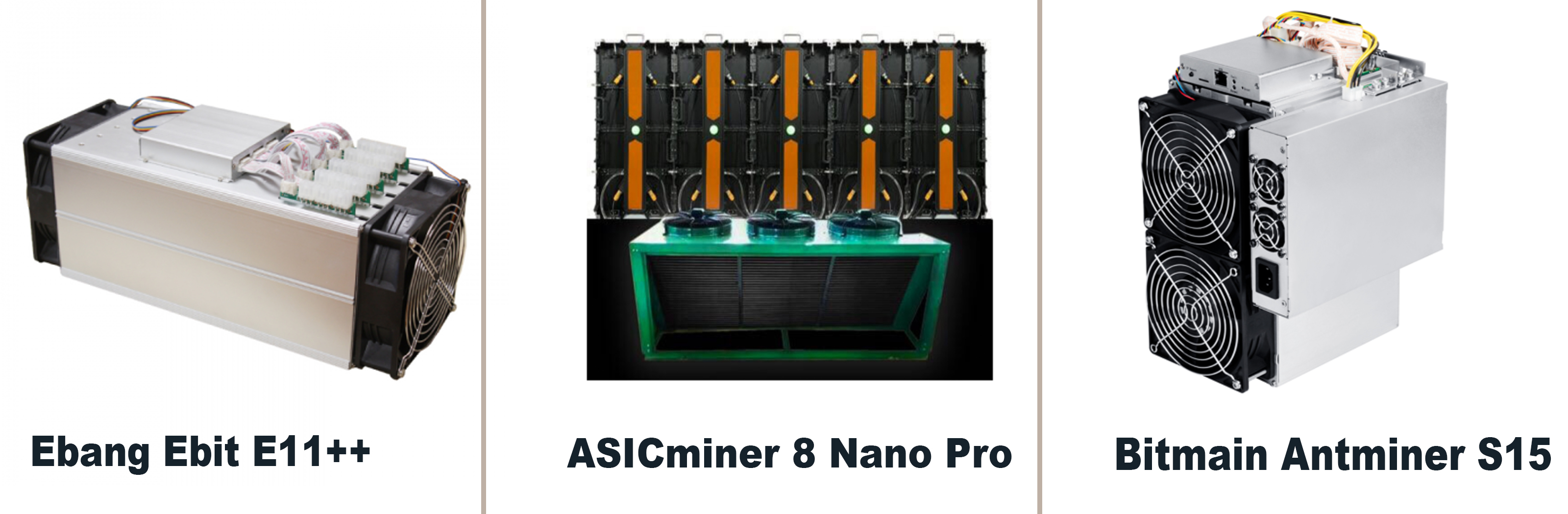
The most profitable machines on Monday, Dec. 10, 2018, three weeks before the new year, are manufactured by the corporations Ebang, Asicminer, Innosilicon, and Bitmain. The Ebang Ebit E11++ is currently the most profitable mining device on the market with 44 terrahash per second (TH/s) and it consumes 1,980W. The Ebang mining rig priced at $2,500 makes about $1.39 per day profit with current BTC prices. The E11++ is currently available on the open market from two companies but one vendor is only taking pre-order right now. The Asicminer 8 Nano is another machine that processes 44TH/s but pulls 2,100W from the wall. The machine created by Asicminer was launched in October and pulls a profitability of about $1.02 per day, at the time of writing. The company’s 8 Nano is available for purchase through the Canadian dealer Mining Cave for $2,045.

Only Five Bitcoin Mining Devices Released in 2018 Are Profitable This December

Then there’s the new Innosilicon T3 model, which also claims to boast roughly 43TH/s but the rig is not available to the public just yet. The T3 will be released in January 2019, according to the company, at a price of $2,500 per machine. With current market statistics, this gives the T3 a profitability of about $0.84 per day for a machine you cannot obtain. The next most profitable miner, Asicminer 8 Nano Pro, is obtainable according to Asicminervalue. The Nano Pro claims to process a whopping 76TH/s but consumes over 4,000W in electricity. These metrics make the $11,600 machine only profitable by $0.59 per day. Lastly, Bitmain contends the Antminer S15 machine produces about 28TH/s, pulling 1,596W from the wall, giving the device a profitability of $0.27 every 24 hours.

Only Five Bitcoin Mining Devices Released in 2018 Are Profitable This December

Operating at a Loss

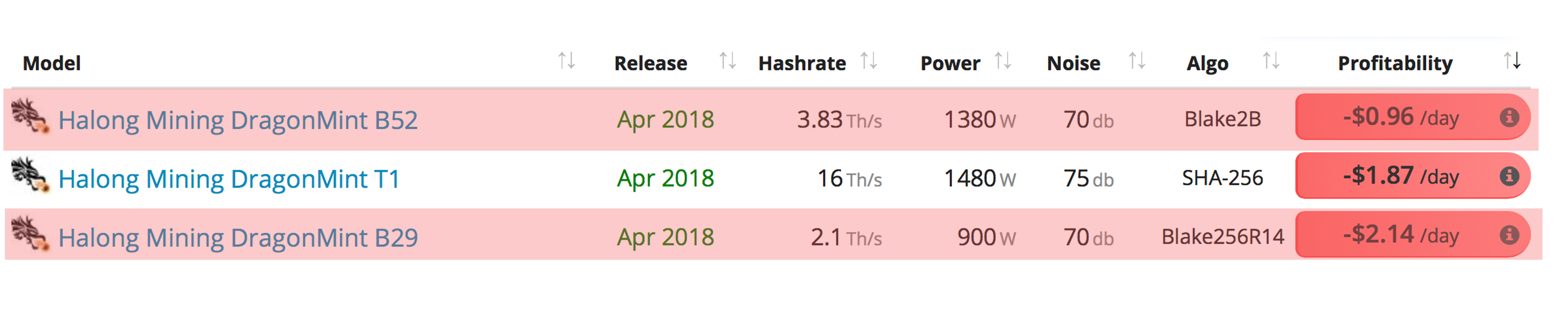
Many other machines that were announced this year are not showing profits and consume more energy cost if the companies continue to operate them. GMO’s B2 and B3, which boast 24-33TH/s, can lose between $1.90-4.98 per day at current BTC prices. The infamous Halong Mining Dragonmint T1 model sees a loss of around $1.87 per day.

Only Five Bitcoin Mining Devices Released in 2018 Are Profitable This December

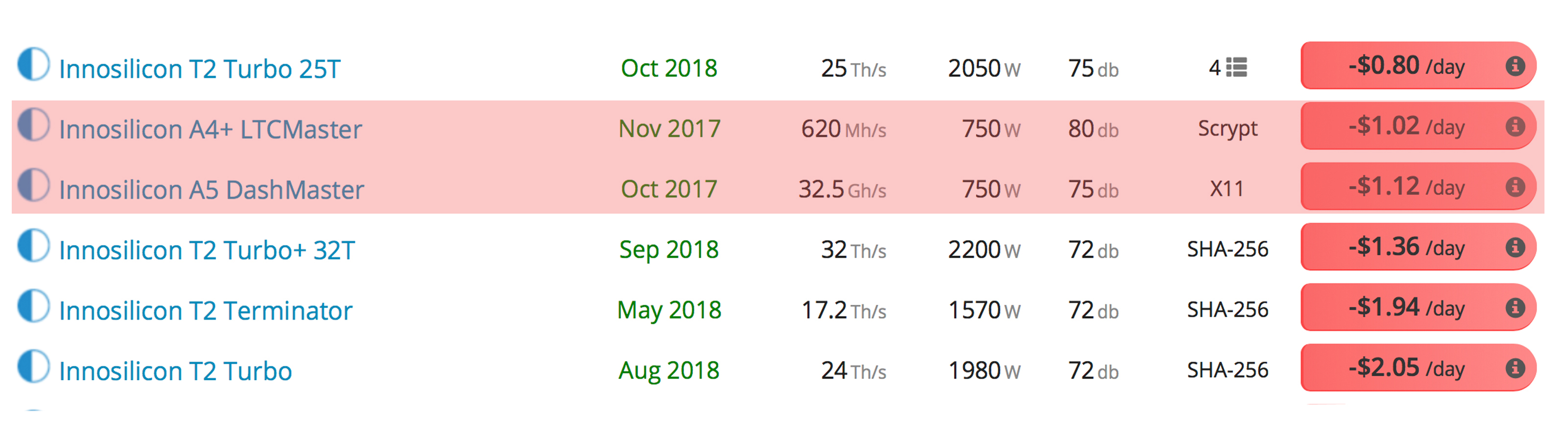
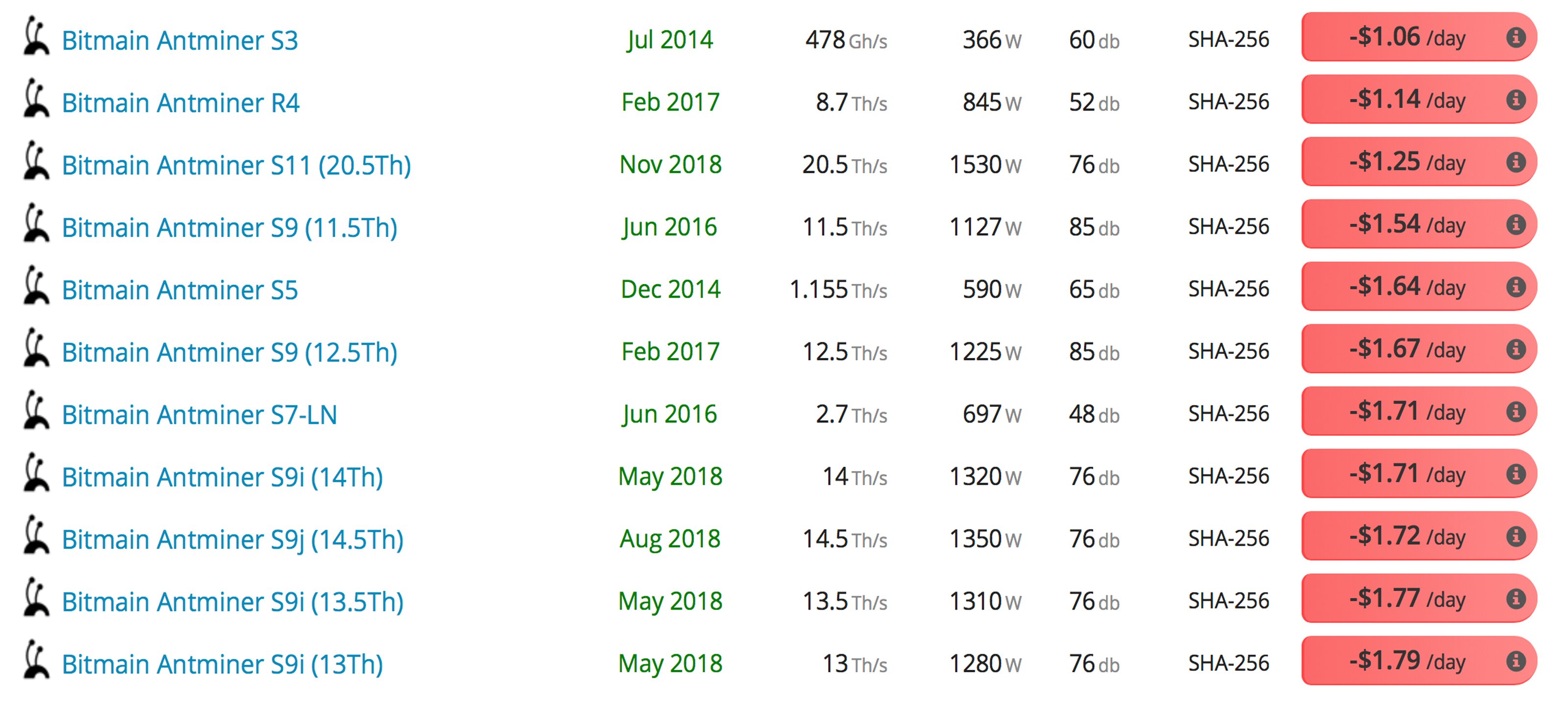
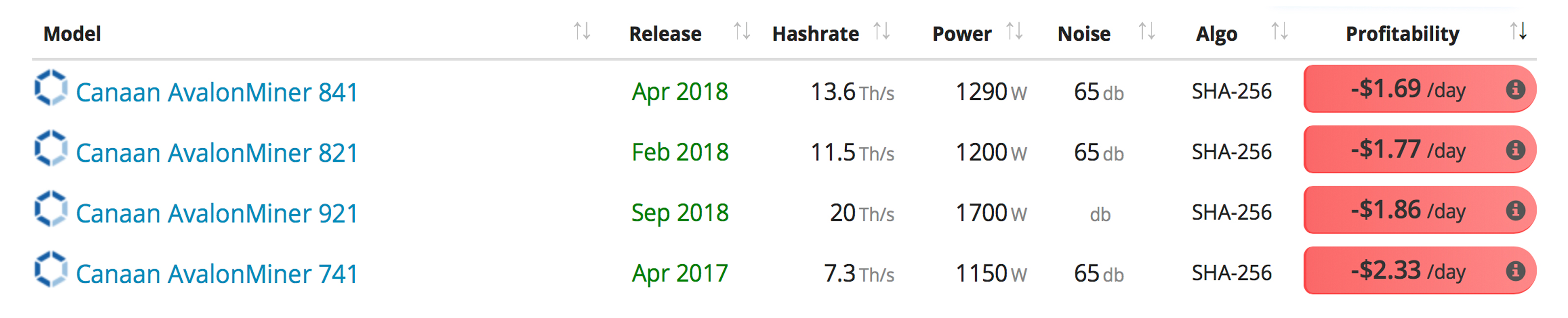
Innosilicon’s previous models, besides the unobtainable T3, are all seeing losses at the time of publication. The top four Whatsminer models (M10, M10s, M3, and M3X) lose $1-4.25 every 24 hours, according to the statistics. A large variety of SHA-256 Bitmain models, including the S9, R4, S11, and many other series, are unprofitable. The Canaan Avalon series is in the same boat as the 841, 821, and 921, losing about $1.69-1.86 per day with current BTC prices at $3,500 per coin.

Only Five Bitcoin Mining Devices Released in 2018 Are Profitable This December

Bearish SHA-256 algorithm coin prices have affected network hashrate considerably over the last few months. For instance, the bitcoin core (BTC) hashrate touched 61 exahash per second (EH/s) during the last week of August, but this month the BTC hashrate is only 35 EH/s. However, there may be many facilities which are still making a profit with older machines if their electric cost is highly subsidized or nearly free.

Only Five Bitcoin Mining Devices Released in 2018 Are Profitable This December

Many flashy machines announced this year have touted 7 and 10 nm chips and much bigger processing power, but cryptocurrency market prices have made it so only a few machines are profitable. But if markets push higher again turning from a bearish-to-bullish trend, then a great majority of the newly released 2018 mining rigs should become profitable again.

What do you think about these mining rigs and their profitability rates with current prices? Let us know what you think about this subject in the comments section below.

Disclaimer: Bitcoin.com does not endorse these products/services. Readers should do their own due diligence before taking any actions related to the mentioned companies or any of its affiliates or services. This editorial is intended for informational purposes only. Bitcoin.com and the author are not responsible, directly or indirectly, for any damage or loss caused or alleged to be caused by or in connection with the use of or reliance on any content, goods or services mentioned in this article.


Images via Shutterstock, Ebang, Asicminer Nano, Bitmain, and Asicvalue.com.


Need to calculate your bitcoin holdings? Check our tools section.

The post Only Five Bitcoin Mining Devices Released in 2018 Are Profitable This December appeared first on Bitcoin News.

from Bitcoin News https://ift.tt/2SCycRW Only Five Bitcoin Mining Devices Released in 2018 Are Profitable This December

#USA HypeHop is a product to fix sponsored videos

//

I’ve been thinking hard about the concept of sponsored content – you can find some of it on TechCrunch if you look hard enough and it appears almost everywhere else. It’s an important consideration because as a online journalist I’ve heard everything from “How much did Apple pay you to post this?” to “How much can I pay you to post something to TechCrunch?”

And I’m sick of it.

Journalists afflict the comfortable and comfort the afflicted. Marketers comfort the comfortable. The only person who wins in that struggle is the guy with the biggest wallet to buy as much coverage as possible. Crypto, for all its faults, promises to change that.

Now I’d like to introduce something else I built (and I never do this on TC so I think it’s pretty important and interesting.) It’s called HypeHop and it’s an experiment in sponsored video. Most sponsored video appears in front of your YouTube selections like a cold sore – you know it’s there, it’s unwanted, and you know it will take a while for it to go away. For example, this deeply applicable ad appeared as my son was watching Nerf videos, for example, proving that algorithms aren’t always the smartest.

Enough.

In the current system marketers pay media platforms for their audience. The marketer gets eyeballs, the media platform gets money, and the user gets bupkus. I wanted to try to change that.

With a few friends I made something called HypeHop. It basically pays you for watching videos. At this point it’s a proof-of-concept that accepts uploaded videos, a small payment for hosting, and then watches the viewer to ensure they are watching the video. “Watching the viewer?” you ask? Sure. We’re being surveilled every day. Isn’t it time we were paid for it?

Viewers currently get about 40 cents in BTC per view. I created a demo video with my son here to show off how it worked and preseeded some videos with BTC to test. Thus far it’s been an interesting experiment.

I’d love to talk to like-minded folks about expanding this technology. I could, for example, see this as a tool to make sponsored posts more interesting to readers – who doesn’t want a few pennies for reading marketing dross – and a way to monetize many marketing tools for readers, producers, and marketers. Ultimately this is a win-win-win in a win-win-lose world and it’s vitally important we look at it as a way forward in our fight against fake news and faker marketing.

from Startups – TechCrunch https://ift.tt/2QqFUSI

#USA HypeHop is a product to fix sponsored videos

//

I’ve been thinking hard about the concept of sponsored content – you can find some of it on TechCrunch if you look hard enough and it appears almost everywhere else. It’s an important consideration because as a online journalist I’ve heard everything from “How much did Apple pay you to post this?” to “How much can I pay you to post something to TechCrunch?”

And I’m sick of it.

Journalists afflict the comfortable and comfort the afflicted. Marketers comfort the comfortable. The only person who wins in that struggle is the guy with the biggest wallet to buy as much coverage as possible. Crypto, for all its faults, promises to change that.

Now I’d like to introduce something else I built (and I never do this on TC so I think it’s pretty important and interesting.) It’s called HypeHop and it’s an experiment in sponsored video. Most sponsored video appears in front of your YouTube selections like a cold sore – you know it’s there, it’s unwanted, and you know it will take a while for it to go away. For example, this deeply applicable ad appeared as my son was watching Nerf videos, for example, proving that algorithms aren’t always the smartest.

Enough.

In the current system marketers pay media platforms for their audience. The marketer gets eyeballs, the media platform gets money, and the user gets bupkus. I wanted to try to change that.

With a few friends I made something called HypeHop. It basically pays you for watching videos. At this point it’s a proof-of-concept that accepts uploaded videos, a small payment for hosting, and then watches the viewer to ensure they are watching the video. “Watching the viewer?” you ask? Sure. We’re being surveilled every day. Isn’t it time we were paid for it?

Viewers currently get about 40 cents in BTC per view. I created a demo video with my son here to show off how it worked and preseeded some videos with BTC to test. Thus far it’s been an interesting experiment.

I’d love to talk to like-minded folks about expanding this technology. I could, for example, see this as a tool to make sponsored posts more interesting to readers – who doesn’t want a few pennies for reading marketing dross – and a way to monetize many marketing tools for readers, producers, and marketers. Ultimately this is a win-win-win in a win-win-lose world and it’s vitally important we look at it as a way forward in our fight against fake news and faker marketing.

from Startups – TechCrunch https://ift.tt/2QqFUSI

#USA SoftBank invests in parking startup ParkJockey pushing valuation to $1 billion

//

SoftBank continues to invest in the future of transportation — this time in ParkJockey, a startup that has built a technology platform aimed at monetizing parking lots. And ParkJockey, which was founded in 2013, is already using that capital to scale up.

Along with the SoftBank investment news, ParkJockey also announced that it was acquiring two of the largest parking operators in North America. The startup, with help from Abu Dhabi-based Mubadala Capital and debt financing from Owl Rock, said it had reached an agreement to acquire Imperial Parking Corporation, a North American-based parking management company often referred to as Impark. The agreement follows ParkJockey’s acquisition of parking management operator Citizens Parking Inc.

The investment puts the ParkJockey valuation to more than $1 billion, reported Miami Herald.

Miami-based ParkJockey developed a parking management platform that helps commercial property owners better monetize parking lots as well as handle operations at large venues and stadiums. The company’s platform offers features like automatic license plate recognition and pay-by-app, among others.  The company’s app also can be used by drivers to find parking spaces more efficiently.

Financial terms of the SoftBank investment or the acquisitions weren’t disclosed. The announcement follows an Axios article last week that reported SoftBank was backing the startup.

The Impark transaction is subject to regulatory approvals. The acquisition is expected to close in the first half of 2019, ParkJockey said. 

SoftBank’s investment in parking might seem rather, well, pedestrian. It’s actually a bet on an automated future from present-day parking management issues like electric vehicle charging, designated areas for ride-hailing and automatic pay, as well as a day when vehicles are fully autonomous.

from Startups – TechCrunch https://ift.tt/2QtrGk8

#Asia #Japan Can capitalism ever allow us a good night’s sleep?

//

There is something odd about the way we treat sleep. 

We understand that it is essential for good health, but we are almost ashamed when we admit that we get enough of it. We are rightfully proud when we keep our resolutions to go to the gym more or to eat a more healthy diet, but if we get a good night’s sleep, we tend to keep it to ourselves.

In fact, when we talk about sleep at all, it’s usually to brag about how little sleep we are getting. We seem to consider getting a healthy amount of sleep to be some kind of luxury, or worse, as evidence of laziness. 

Today we are going to talk with Taka Kobayashi, the founder, and CEO of NeuroSpace, and he’s going to explain how things got so bad, and what he plans to do about it.   

Taka is is building a business around that idea that companies should not only encourage employees to get more sleep but that they should pay NeuroSpace a helthy sum to do so. 

Most sleep-based startups have failed in the past, but Taka explains how NeuroSpace is doing things differently and how he his building on his initial successes.

It’s a great conversation, and I think you’ll enjoy it.

Show Notes

Why sleep is really a skillThe reason we ignore the importance of sleepHow to fall asleep more quicklyWhat your iWatch isn’t telling you about sleepThe right way to track your sleepA way to overcome jet lagThe real challenge facing all sleep startupsThe good and bad sides of Japanese govement startup grants 

Links from the Founder

Everything you wanted to know about  NeuroSpaceCheck out Taka’s blog Follow him on Twitter @kobat_jpFriend him on FacebookThe ANA jet-lag project

Leave a comment

Transcript

Welcome to Disrupting Japan, straight talk from Japan’s most successful entrepreneurs. 

I’m Tim Romero and thanks for joining me.

Let’s talk about sleep. Are you feeling tired? 

If you’re like most workers in Japan, the US, or Europe, the answer is yes, and oddly, even if you’re not feeling particularly tired, you probably won’t admit to be well-rested to your coworkers. 

We, and by we, I mean all of the developed world, we have this funny relationship with sleep. We all know, we all acknowledge how important sleep is. Science and personal experience have proven conclusively that our own health and performance depend on it, but for some reason, we all like to brag about how little sleep we’re getting. 

Normally, I’d call this macho bullshit, but women seem to be every bit as bad about this as men are. We seem to consider getting a healthy amount of sleep to be some kind of luxury or worse, as evidence of laziness. 

Now, there are a lot of reasons for this and we are going to talk about them with Taka Kobayashi, the founder and CEO of NeuroSpace.

NeuroSpace is doing something important but something very difficult. Taka is building a business model based on convincing companies that not only should they encourage their employees to get more sleep but that they should pay NeuroSpace to help them do so. Taka is fighting some deeply ingrained culture here, but he is making progress, and today, we will talk about some of the unlikely partners and bedfellows he finds himself with, why so many other startups in the space have failed to achieve product market fit, and most important, what NeuroSpace is doing different. 

But you know, Taka tells that story much better than I can, so let’s get right to the interview.

    [pro_ad_display_adzone id=”1411″  info_text=”Sponsored by”  font_color=”grey”  ]

Interview

Tim: I’m sitting here with Taka Kobayashi of NeuroSpace who is a startup specializing in sleep. So, thanks for sitting down with me.

Taka: Thank you.

Tim: What NeuroSpace is doing is really fascinating but I think you can explain it better than me, so why don’t you tell us a bit about what NeuroSpace does?

Taka: NeuroSpace is a company focusing on technology which is evaluating sleep relation and quality,

from Disrupting Japan: Startups and Innovation in Japan https://ift.tt/2PxhoKi

#USA CTRL-labs’ first dev kit is a gesture-tracking neural controller

//

The race to replace the mouse and keyboard has yielded a lot of weird tech, but as various hardware startups try to find the missing link between what we have now and some sort of embedded brain chip, we’re seeing some fascinating solutions surface.

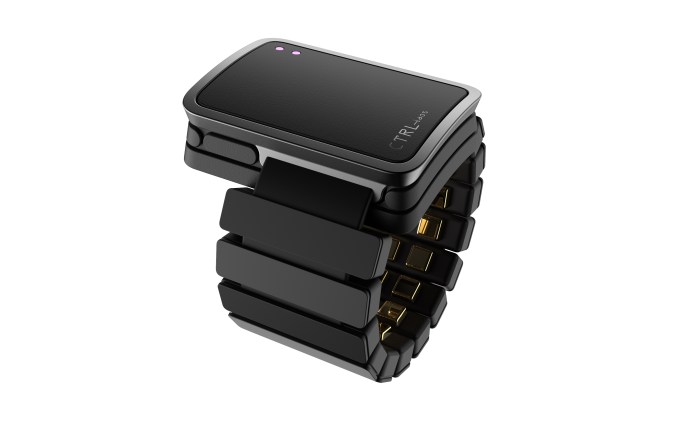
New York-based CTRL-labs just announced its first developer kit that’s aiming to refresh how people interact with computers — an armband that can track a user’s finger movements by measuring electrical impulses. It’s not quite a brain controller, though in practice this type of tech can definitely feel like it’s reading your mind, taking minor finger movements and yielding a surprising amount of insight into the position of your hand and the pressure you’re applying on your finger tips.

CTRL-labs’ investors are betting big on the insight this unconventional interface type can deliver. The startup closed a $28 million Series A in May with funding coming from Vulcan Capital, GV and others.

The use cases for something like this seem to be a little up in the air at the moment, hence the interest in getting a developer kit out into the wild. There are some more obvious use cases in the VR space, but pushing a theoretical input type on an industry with theoretical appeal obviously isn’t the best basket in which to put a Series A.

The system (called CTRL-kit) is, indeed, a developer kit, so there hasn’t been the highest premium placed on miniaturizing all of the tech in the tethered system, but the company tells TechCrunch that the intent is definitely to get into a wrist-worn form factor like a smartwatch in the future. Watch a few of the tech demos and you’ll see what an interesting proposition this is for the wearable of the future.

CTRL-kit

Think about the link between some lightweight glasses with a heads-up display and an Apple Watch-type controller that can parse hand gestures and you can see a more predictable endgame for this kind of tech.

Controlling augmented reality systems has always been a big UX question. Hand-tracking startups like Leap Motion have delivered very polished solutions that offer finesse but sidestep realistic user behaviors. Who’s going to wave their hands in front of their face while walking down the street? Microsoft has dumbed this down into optically tracked gestures like the “air tap” for HoloLens that let you select things in a pretty straightforward, yet cumbersome way. Magic Leap integrates a few input types into their system but seems to be pushing developers toward a physical controller while the current hardware is more focused on home use.

The company says they’re also intrigued by potential with the automotive industry and more conventional desktop applications. Like a good amount of technologies that are attractive for VR and AR tech, what CTRL-labs is building has an attractive endgame but suspect near-term utility. Startups like Thalmic Labs, now North, tried and failed to gain an audience for a consumer-grade motion-control armband like this. For the time being, the company expects a decent amount of developer attention to go toward using this tech for gaming.

The company says it plans to begin shipping the CTRL-kit in the first quarter of next year.

from Startups – TechCrunch https://ift.tt/2L93sWe

#Blockchain Markets Update: Cryptocurrency Traders Are Still Searching for the Elusive ‘Bottom’

The entire crypto-economy has been meandering just above $109 billion after the last two weeks of market dumps. Volume has been light this week as digital asset enthusiasts and traders are now pondering the crypto market’s next big move.

Also Read: Former Israeli Prime Minister Calls Cryptocurrencies a ‘Ponzi Scheme’

Market Surfers Wait for the Next Big Crypto Wave

Digital currency prices are at their lowest in over 15 months and prices have dropped considerably over the last few weeks. After many of the top cryptocurrencies touched significant lows on Dec. 7, about 48 hours later markets saw a brief spike upwards. Right now, most of the top coins are moving in a consolidated triangular pattern, seeing some lighter swings on Monday, Dec. 10.

Markets Update: Cryptocurrency Traders Are Still Searching for the Elusive 'Bottom'
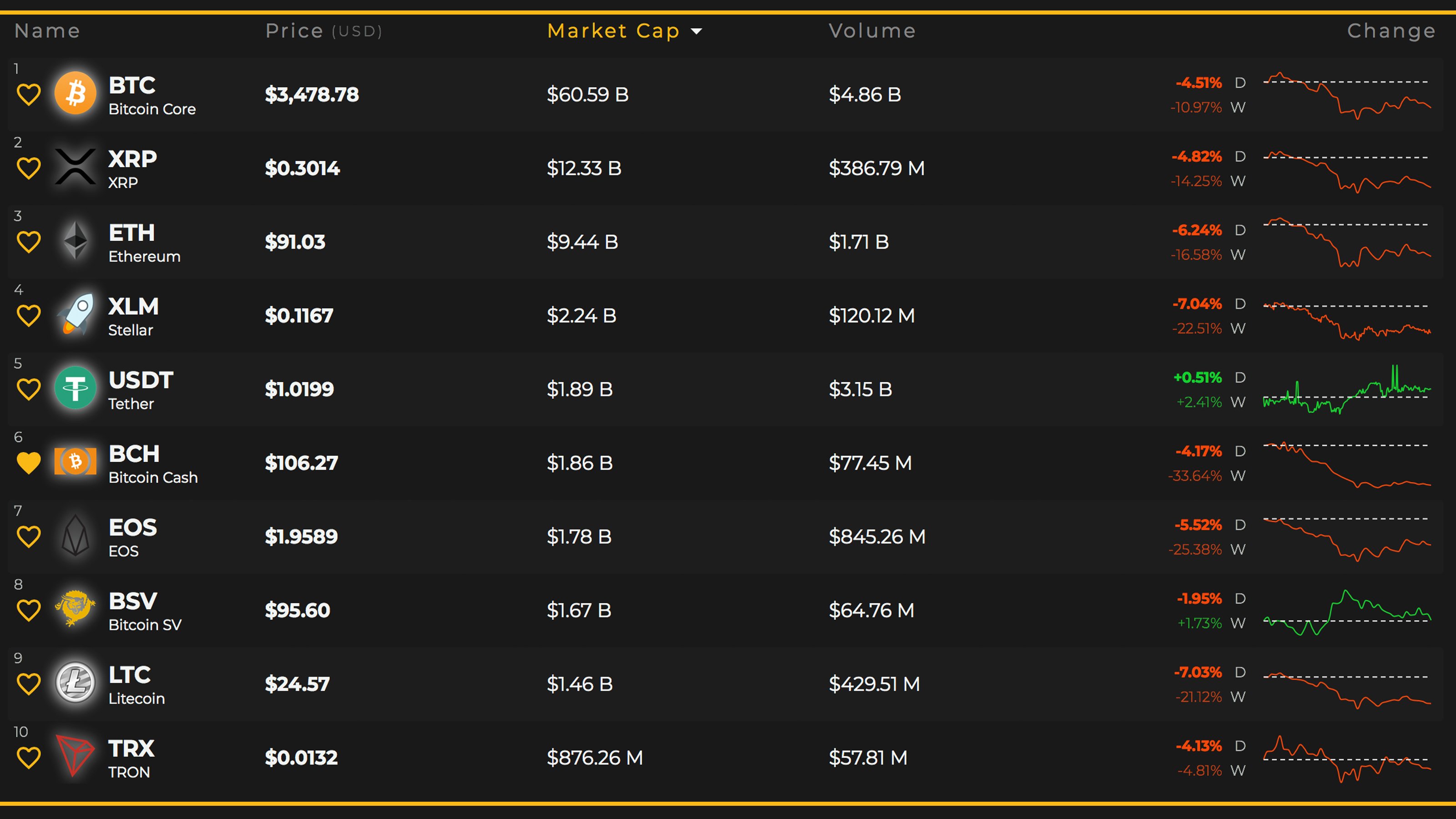
The top 10 cryptocurrencies on Monday, Dec. 10, 2018.

At the time of publication, the price of bitcoin core (BTC) is about $3,478 and is down roughly 4.5% over the last 24 hours. The second highest valued market held by ripple (XRP) is down 4.8% and each coin is trading for $0.30. Ethereum (ETH) prices have lost 6.2% during the last day and the coin is being swapped for $91. The cryptocurrency stellar (XLM) is the fourth largest market cap today as each coin trades for $0.11. Meanwhile, the stablecoin tether (USDT) has seen significant demand and now captures the fifth largest crypto valuation. Tether usage has reached a three-month low, however, as other stablecoins like TUSD, USDC, and GUSD have seen significant volume increases.  

Bitcoin Cash (BCH) Market Action

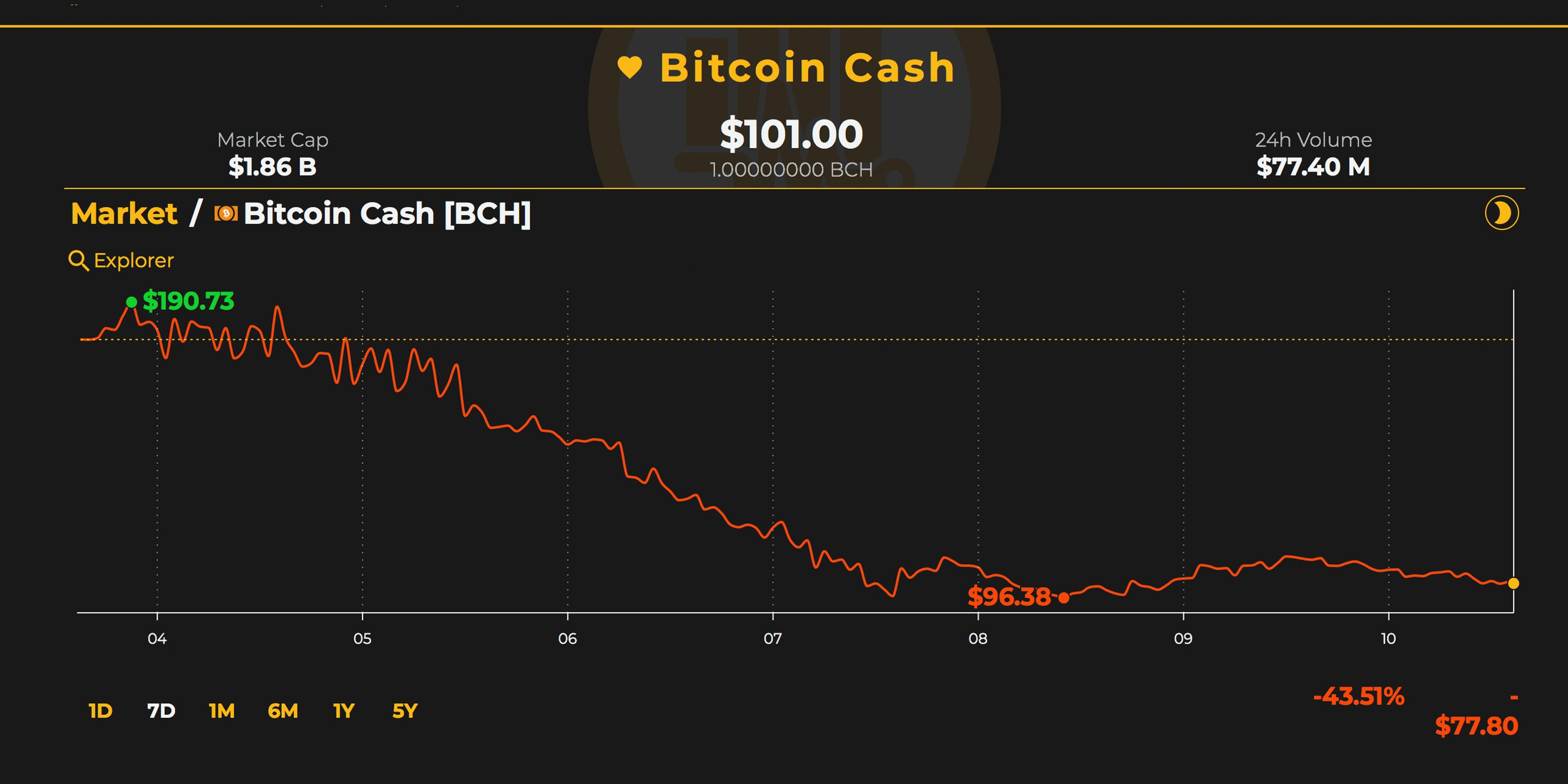
Bitcoin cash (BCH) markets are doing better today after a little skirmish with BSV in terms of prices on Dec. 7. Today, BCH is trading for $106 per coin and markets are down 2.9% for the day and 33% for the week. Bitcoin cash has about $86 million in trade volume which still pales in comparison to the $500 million global trades per day the coin held prior to the fork. The top five trading platforms swapping the most BCH today are Lbank, Binance, Huobi, Bluebelt, and Hitbtc. The biggest pair today being swapped against BCH is ethereum (ETH) which captures over 34% of Monday’s BCH trades. This is followed by BTC (28.5%), USDT (25.6%), USD (4.9%), and the EUR (2.3%). This week BCH is the 13th most traded cryptocurrency out of the 2,000+ coins on the market.

Markets Update: Cryptocurrency Traders Are Still Searching for the Elusive 'Bottom'
BCH/USD 7-day chart on Dec. 10.

BCH/USD Technical Indicators

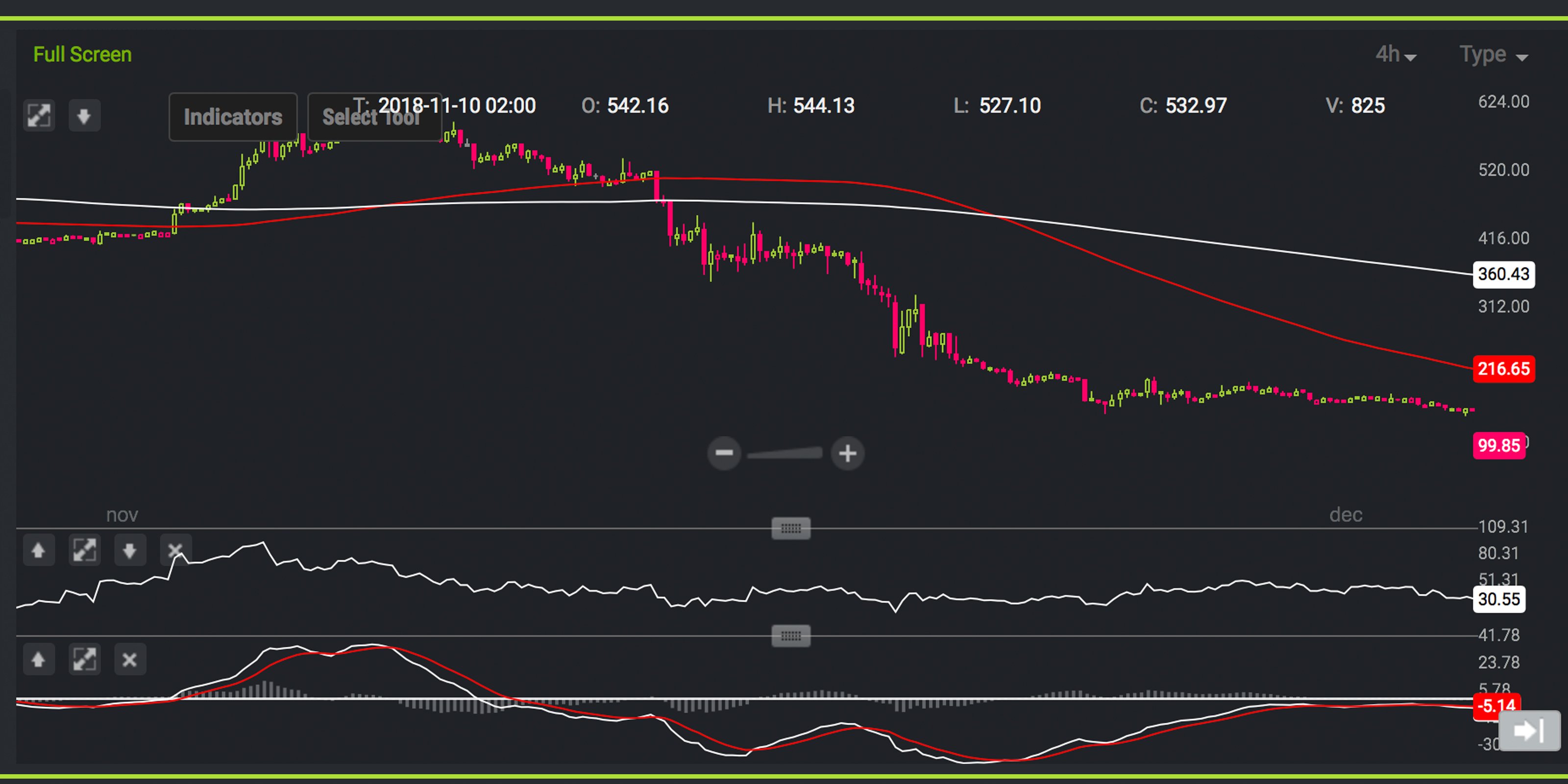
Looking at the BCH/USD four-hour chart on Bitstamp shows bulls are attempting to push forward after some heavy hits the past few days. At the moment, one BCH is trading for $101 per coin. The two Simple Moving Averages (SMA) show the long-term 200 SMA is still above the short term trendline indicating the path toward the least resistance is still down.

Markets Update: Cryptocurrency Traders Are Still Searching for the Elusive 'Bottom'
BCH/USD 4-hour chart on Bitstamp. 12/10/18

However, the 30-minute BCH/USD chart shows the two trend lines recently crossed paths and on the four-hour chart it looks as though they may cross hairs as well. The relative strength index on the four-hour shows oversold conditions at -39 and the MACd shows room for improvement too, but more so toward the downside. Order books on Bitstamp indicate that BCH bulls need to fight current resistance that’s stacked up until the $125-$150 zones. If bulls can surpass this region then they could gain some upward momentum. On the backside, order books show fairly solid foundations between now and $88 per BCH.

Markets Update: Cryptocurrency Traders Are Still Searching for the Elusive 'Bottom'
BCH/USD 4-hour chart 3:00 p.m. EST, 12/10/18.

The Verdict: Traders Too Skeptical to Call the Bottom

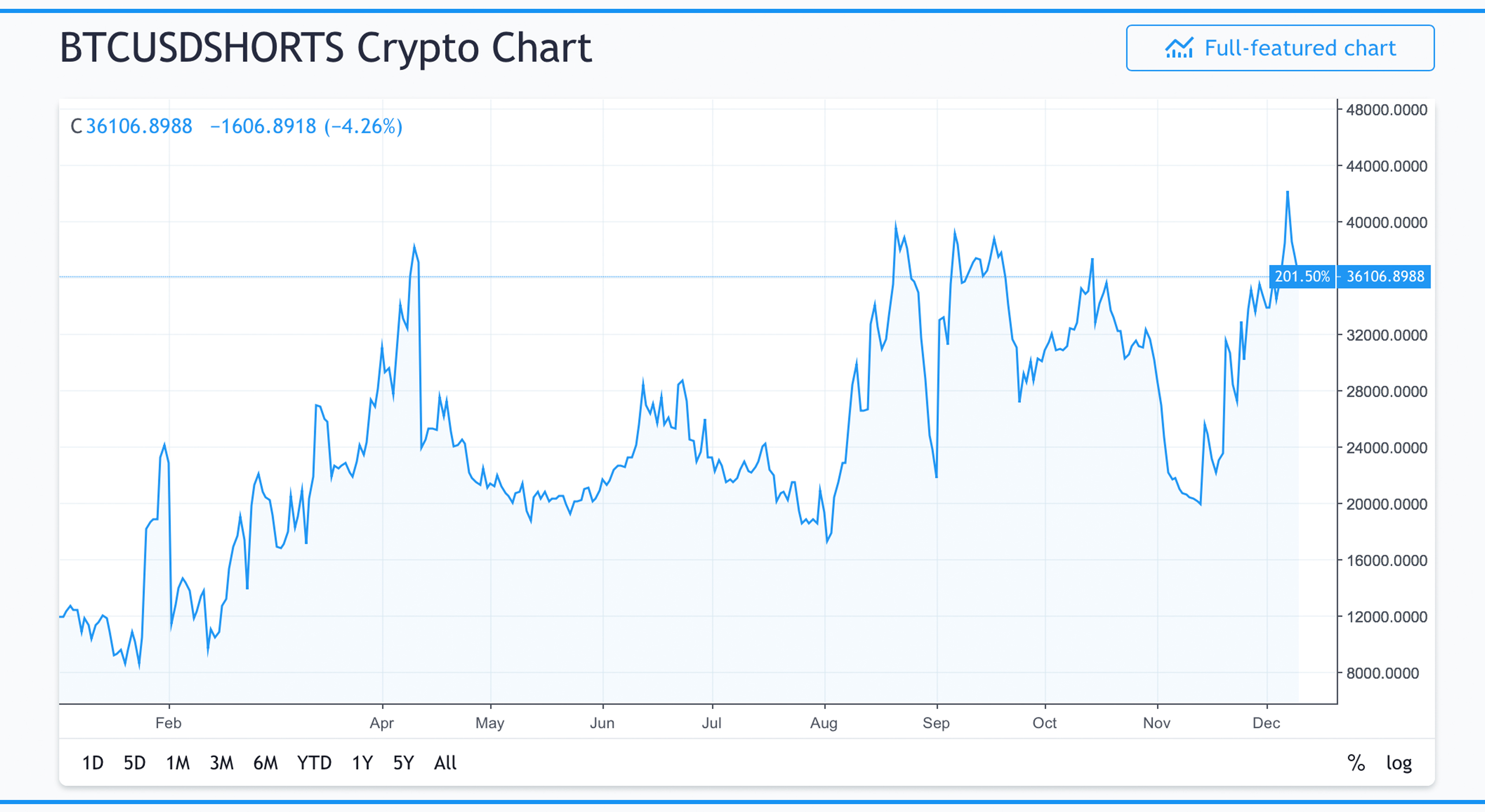
Most traders have been conversing about whether or not current prices can be regarded as ‘the bottom’, a topic they have pondered multiple times this year. Prices have shown various bull traps and dead kittens bouncing from the all-time highs last December all the way to the lowest of lows this December. BTC/USD shorts are still incredibly high and short positions placed on Bitfinex touched all-time highs on Dec. 6, reaching more than 42,000 that day.

Markets Update: Cryptocurrency Traders Are Still Searching for the Elusive 'Bottom'
BTC/USD shorts on Bitfinex. 12/10/18.

This metric has tapered off a little, but BTC/USD short positions are still incredibly high (37,000) with the price as low as it is today. Nevertheless, BTC dominance among all digital asset market valuations has remained unscathed over the last three months. Again, another week has passed and cryptocurrencies have seemingly bottomed out and continue to consolidate for now, leaving traders to pray they played their positions right this time around.

Where do you see the price of BCH, BTC and other coins heading from here? Let us know in the comments below.

Disclaimer: Price articles and markets updates are intended for informational purposes only and should not to be considered as trading advice. Neither Bitcoin.com nor the author is responsible for any losses or gains, as the ultimate decision to conduct a trade is made by the reader. Always remember that only those in possession of the private keys are in control of the “money.”


Images via Shutterstock, Trading View, and Satoshi Pulse.


Want to create your own secure cold storage paper wallet? Check our tools section.

The post Markets Update: Cryptocurrency Traders Are Still Searching for the Elusive ‘Bottom’ appeared first on Bitcoin News.

from Bitcoin News https://ift.tt/2rsXJBs Markets Update: Cryptocurrency Traders Are Still Searching for the Elusive ‘Bottom’

#Blockchain Markets Update: Cryptocurrency Traders Are Still Searching for the Elusive ‘Bottom’

The entire crypto-economy has been meandering just above $109 billion after the last two weeks of market dumps. Volume has been light this week as digital asset enthusiasts and traders are now pondering the crypto market’s next big move.

Also Read: Former Israeli Prime Minister Calls Cryptocurrencies a ‘Ponzi Scheme’

Market Surfers Wait for the Next Big Crypto Wave

Digital currency prices are at their lowest in over 15 months and prices have dropped considerably over the last few weeks. After many of the top cryptocurrencies touched significant lows on Dec. 7, about 48 hours later markets saw a brief spike upwards. Right now, most of the top coins are moving in a consolidated triangular pattern, seeing some lighter swings on Monday, Dec. 10.

Markets Update: Cryptocurrency Traders Are Still Searching for the Elusive 'Bottom'
The top 10 cryptocurrencies on Monday, Dec. 10, 2018.

At the time of publication, the price of bitcoin core (BTC) is about $3,478 and is down roughly 4.5% over the last 24 hours. The second highest valued market held by ripple (XRP) is down 4.8% and each coin is trading for $0.30. Ethereum (ETH) prices have lost 6.2% during the last day and the coin is being swapped for $91. The cryptocurrency stellar (XLM) is the fourth largest market cap today as each coin trades for $0.11. Meanwhile, the stablecoin tether (USDT) has seen significant demand and now captures the fifth largest crypto valuation. Tether usage has reached a three-month low, however, as other stablecoins like TUSD, USDC, and GUSD have seen significant volume increases.  

Bitcoin Cash (BCH) Market Action

Bitcoin cash (BCH) markets are doing better today after a little skirmish with BSV in terms of prices on Dec. 7. Today, BCH is trading for $106 per coin and markets are down 2.9% for the day and 33% for the week. Bitcoin cash has about $86 million in trade volume which still pales in comparison to the $500 million global trades per day the coin held prior to the fork. The top five trading platforms swapping the most BCH today are Lbank, Binance, Huobi, Bluebelt, and Hitbtc. The biggest pair today being swapped against BCH is ethereum (ETH) which captures over 34% of Monday’s BCH trades. This is followed by BTC (28.5%), USDT (25.6%), USD (4.9%), and the EUR (2.3%). This week BCH is the 13th most traded cryptocurrency out of the 2,000+ coins on the market.

Markets Update: Cryptocurrency Traders Are Still Searching for the Elusive 'Bottom'
BCH/USD 7-day chart on Dec. 10.

BCH/USD Technical Indicators

Looking at the BCH/USD four-hour chart on Bitstamp shows bulls are attempting to push forward after some heavy hits the past few days. At the moment, one BCH is trading for $101 per coin. The two Simple Moving Averages (SMA) show the long-term 200 SMA is still above the short term trendline indicating the path toward the least resistance is still down.

Markets Update: Cryptocurrency Traders Are Still Searching for the Elusive 'Bottom'
BCH/USD 4-hour chart on Bitstamp. 12/10/18

However, the 30-minute BCH/USD chart shows the two trend lines recently crossed paths and on the four-hour chart it looks as though they may cross hairs as well. The relative strength index on the four-hour shows oversold conditions at -39 and the MACd shows room for improvement too, but more so toward the downside. Order books on Bitstamp indicate that BCH bulls need to fight current resistance that’s stacked up until the $125-$150 zones. If bulls can surpass this region then they could gain some upward momentum. On the backside, order books show fairly solid foundations between now and $88 per BCH.

Markets Update: Cryptocurrency Traders Are Still Searching for the Elusive 'Bottom'
BCH/USD 4-hour chart 3:00 p.m. EST, 12/10/18.

The Verdict: Traders Too Skeptical to Call the Bottom

Most traders have been conversing about whether or not current prices can be regarded as ‘the bottom’, a topic they have pondered multiple times this year. Prices have shown various bull traps and dead kittens bouncing from the all-time highs last December all the way to the lowest of lows this December. BTC/USD shorts are still incredibly high and short positions placed on Bitfinex touched all-time highs on Dec. 6, reaching more than 42,000 that day.

Markets Update: Cryptocurrency Traders Are Still Searching for the Elusive 'Bottom'
BTC/USD shorts on Bitfinex. 12/10/18.

This metric has tapered off a little, but BTC/USD short positions are still incredibly high (37,000) with the price as low as it is today. Nevertheless, BTC dominance among all digital asset market valuations has remained unscathed over the last three months. Again, another week has passed and cryptocurrencies have seemingly bottomed out and continue to consolidate for now, leaving traders to pray they played their positions right this time around.

Where do you see the price of BCH, BTC and other coins heading from here? Let us know in the comments below.

Disclaimer: Price articles and markets updates are intended for informational purposes only and should not to be considered as trading advice. Neither Bitcoin.com nor the author is responsible for any losses or gains, as the ultimate decision to conduct a trade is made by the reader. Always remember that only those in possession of the private keys are in control of the “money.”


Images via Shutterstock, Trading View, and Satoshi Pulse.


Want to create your own secure cold storage paper wallet? Check our tools section.

The post Markets Update: Cryptocurrency Traders Are Still Searching for the Elusive ‘Bottom’ appeared first on Bitcoin News.

from Bitcoin News https://ift.tt/2rsXJBs Markets Update: Cryptocurrency Traders Are Still Searching for the Elusive ‘Bottom’