A report recently published by Diar has estimated that nearly $15.42 billion of value was added to the market capitalization of the combined cryptocurrency markets in the form of newly created tokens and crypto asset inflation during 2018.
12 Percent of Current Crypto Market Cap Was Created During 2018
According to Diar’s report, new crypto asset value created during 2018 is estimated to comprise more than 12 percent of the current combined cryptocurrency market cap.
The largest contribution to newly created value during 2018 was new token additions, representing $4.96 billion, or 32 percent of the $15.42 billion that was added to the markets last year.
More than 700 new crypto assets entered into circulation during 2018, a more than 50 percent increase when compared with the start of 2018, and an addition of 110 percent of the number of circulating cryptocurrencies as of the start of 2017.
BTC and ETH Added 27 Percent of Newly Created Value Last Year
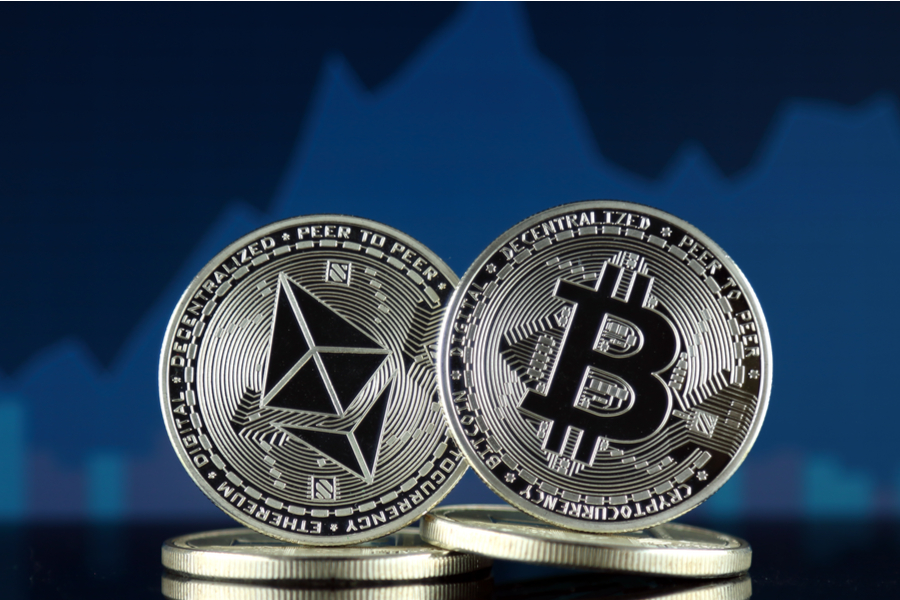
BTC added roughly $2.63 billion to the combined crypto asset market cap during 2018, with inflation and newly mined BTC comprising 17 percent of new value added to the cryptocurrency markets, forming the largest contribution made by a single virtual currency.
New value created in the form ETH comprised the second largest contribution from a single market to the combined cryptocurrency capitalization during 2018, adding $1.55 billion, or 10 percent of new value.
Inflation on all other cryptocurrency tokens that were circulating as of the start of 2018 added a further $4.17 billion to the combined market cap, comprising 27 percent of last year’s newly created crypto asset value.
Burned Tokens Removed $195 Million From Combined Market Cap in 2018
Newly issued stablecoins comprised a significant contribution to the cryptocurrency market cap, adding more than $1.26 billion in value. The BSV fork also comprised a notable source of new crypto asset value, adding $1.04 billion to the combined cryptocurrency market cap.
Finally, burned tokens comprised $195 million in value that was removed from the combined cryptocurrency market cap during 2018.
Are you surprised that $15.4 billion of last year’s newly created cryptocurrency value survived to see 2019? Share your thoughts in the comments section below!
Images courtesy of Shutterstock, Diar
At Bitcoin.com there’s a bunch of free helpful services. For instance, have you seen ourTools page? You can even lookup the exchange rate for a transaction in the past. Or calculate the value of your current holdings. Or create a paper wallet. And much more.
In today’s edition of The Daily we feature another recent example of venture capital infusion into the cryptocurrency space as Japan’s SBI invests in the BRD wallet. We also cover a recent security vulnerability that was detected on the P2P exchange Localbitcoins, and a new AML/KYC compliance solution for stablecoins.
Cryptocurrency mobile wallet BRD (formally Bread Wallet) has announced it has raised $15 million in a Series B financing round to accelerate international expansion and scale its technology platform. The funding came from SBI Crypto Investment, a wholly owned subsidiary of Japanese conglomerate SBI Holdings. The new funds are meant to enable BRD to grow its product and engineering teams as well as to expand its operation in Japan and across Asia.
“SBI Group’s investment in BRD allows us to firmly cement ourselves in the Asian market,” said Adam Traidman, CEO of BRD. “It shows incredible support for the foundation that we have built in North America and reinforces our proven ability to scale the success we have achieved in the past 4 years. The new investment will ensure our long-term global growth, and we are incredibly excited about collaborating with SBI as a strategic investor and business partner to make that happen.”
BRD also announced the availability of cryptocurrency purchases using SEPA transfers for the European market through a partnership with payment provider Coinify. This will enable users to purchase bitcoin in the 34 countries across the SEPA region using bank accounts. “BRD has blazed the trail as a decentralised financial platform and we are excited to be the selected partner for their European launch,” said Rikke Staer, Chief Commercial Officer of Coinify. “They have been one of the pioneers of the virtual currency industry, and it is a pleasure to be chosen to power their SEPA trades.”
Localbitcoins Suffers Vulnerability
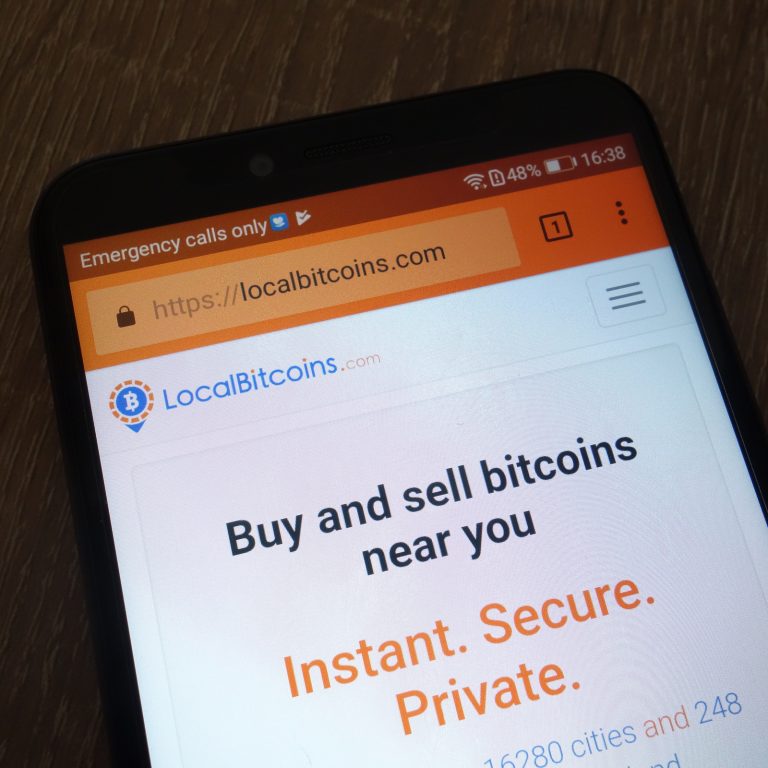
Peer-to-peer trading platform Localbitcoins has notified users that on Jan. 26, at approximately 10:00 UTC, the exchange’s team has detected a security vulnerability. The notification explained that “an unauthorised source was able to access and send transactions from a number of affected accounts.”
Outgoing transactions were temporarily disabled by Localbitcoins while the team investigated the case, and they were re-enabled after a number of measures to address the issue and secure the accounts were taken. “We were able to identify the problem, which was related to a feature powered by a third party software, and stop the attack. At the moment, we are determining the correct number of users affected – so far six cases have been confirmed. For security reasons, the forum feature has been disabled until further notice.” The team also added some security guidance for users: “Your Localbitcoins accounts are currently safe to log in and use – we encourage you to enable two-factor authentication, if you have not yet.”
The announcement by the exchange came after a user complained on Reddit about a phishing attack on the forum.
Chainalysis Goes After Stablecoins
Digital surveillance company Chainalysis has announced the launch of Know Your Transaction (KYT) for stablecoins, an anti-money laundering (AML) compliance solution for monitoring stablecoin transactions from issuance to redemption. The developers say that stablecoin issuers can integrate with the tool via an API to begin monitoring large volumes of activity and identify high risk transactions on an on-going basis. The service is also said to help issuers understand the risk profile of each stablecoin holder and filter them by level of risk exposure to identify those that require the most immediate attention.
“Chainalysis exists to build trust in cryptocurrencies among institutions and users,” said Chainalysis COO Jonathan Levin. “The repeated knock against cryptocurrency is its volatility, and trust in stablecoins could lead the way to increased commercial use. Chainalysis KYT for stablecoins further supports this vision by raising the bar for accountability and providing compliance teams with the technology they need to meet AML requirements.”
The company says that the service is now available for a number of ERC-20 stablecoins, and will become available for additional tokens in the coming months.
What do you think about today’s news tidbits? Share your thoughts in the comments section below.
Images courtesy of Shutterstock.
Verify and track bitcoin cash transactions on our BCH Block Explorer, the best of its kind anywhere in the world. Also, keep up with your holdings, BCH and other coins, on our market charts at Satoshi’s Pulse, another original and free service from Bitcoin.com.
A new survey shows that the cluster of companies working with cryptocurrencies and related technologies in the Swiss Crypto Valley has expanded, despite the onset of what has been dubbed as “crypto winter.” The valley now covers a larger territory in the Alpine confederation and has spilled over into neighboring Liechtenstein.
The falling prices of digital assets in the past months have affected major crypto and blockchain companies with offices in Switzerland and Liechtenstein. The top 50 saw their valuation drop from $44 billion to $20 billion in the fourth quarter of 2018, according to a report produced by Zug-based investment company Crypto Valley Venture Capital (CVVC), PwC, Strategy&, and the Swiss IT consulting firm Inacta.
However, the number of businesses operating in the crypto space that have established presence in the region has increased by around 20 percent – from 629 to 750. That means over 120 new crypto entities have registered there in Q4 2018. The total includes some of the world’s most recognizable names in the industry, four of which are unicorn startups worth billions of dollars.
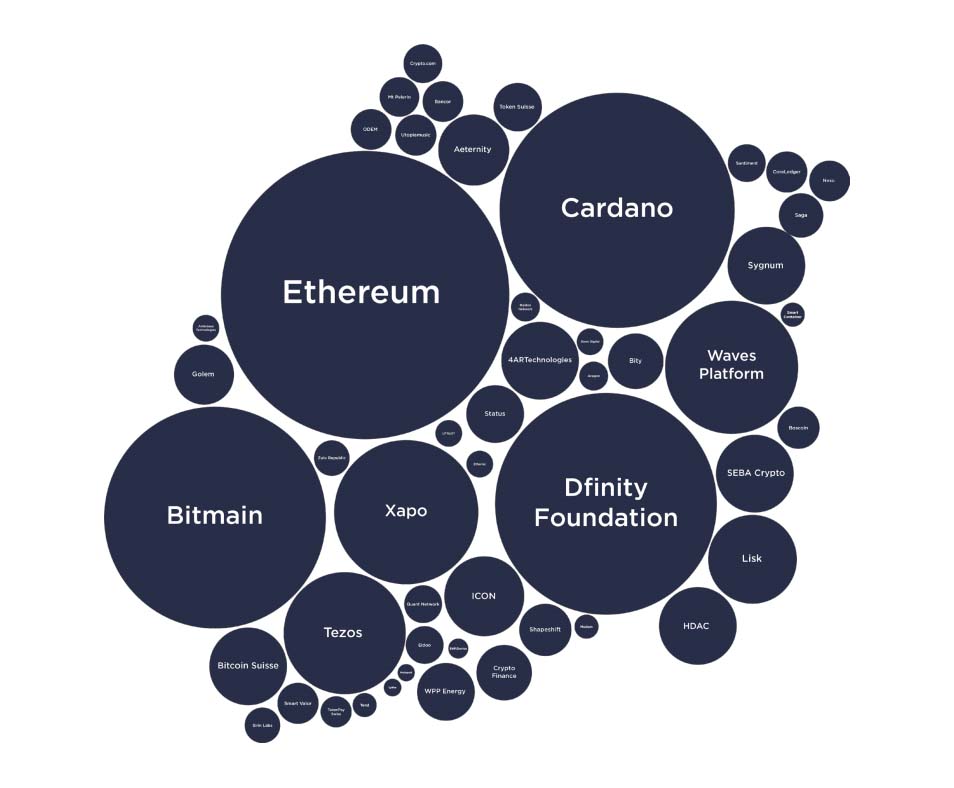
The authors of the study have estimated that the top 50 companies are valued at $400 million each, on average. When the five largest are taken out of the equation, the average figure is still $365 million, which indicates a low concentration. The research shows that there are four entities valued at over $1 billion – Bitmain, Cardano, Dfinity, and Ethereum. At the same time, the average valuation of all 750 companies has been estimated at $27 million.
Visualized market capitalization, Crypto Valley‘s top 50.
3,300 People Employed in the Crypto Cluster
The 50 largest companies have around 480 people working in their offices in Switzerland and Liechtenstein, while the whole sector employs over 3,300 people. These and other numbers in the report indicate that the current situation is ‘business as usual’ for many entities, despite the drop in the market value of most cryptocurrencies.
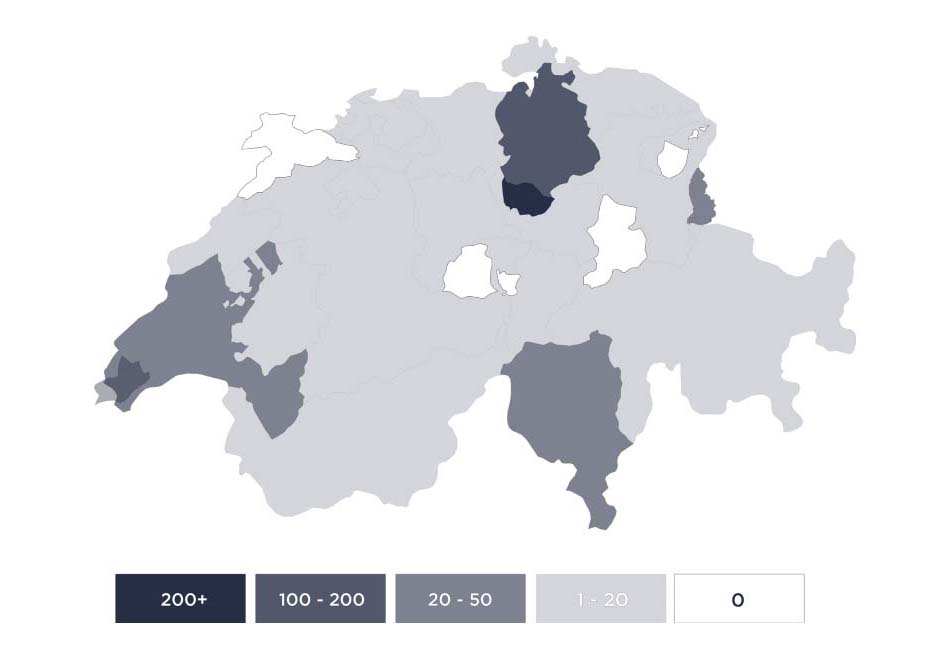
The researchers have also found that the Crypto Valley is expanding geographically. While over half of the companies (51 percent) are based in Zug, other Swiss cantons are now home to the rest. According to the compiled data, 42 of these businesses are registered in Geneva and 39 in Ticino. Liechtenstein is another hotspot with 38 companies from the sector. CVVC maintains an online map that shows where the crypto startups are located.
Companies registered in the Crypto Valley by canton, including Liechtenstein.
A comparison with the numbers from the third quarter of 2018 shows that 15 companies have joined the top 50 during the last three months of the previous year. These are 4 Artechnologies, Boscoin, Hdac, Icon, Mt. Pelerin, Odem, Quant Network, Saga, Santiment, Sygnum, Token Pay Swiss, Nexo, WPP Energy, Utopiamusic, and Zulu Republic. Another 10 startups are candidates to do so in the future.
Switzerland and Liechtenstein, along with Malta, Gibraltar, Estonia, and the Isle of Man, are part of a group of European jurisdictions making efforts to create a crypto-friendly business environment. The expansion of the Swiss Crypto Valley has been facilitated by the country’s decentralized political system and strong traditions in providing financial privacy. Last month, the government in Bern adopted a comprehensive strategy for the development of the crypto sector.
Do you think the Swiss Crypto Valley has become the leading global hub for the crypto industry? Tell us in the comments section below.
Images courtesy of Shutterstock, CVVC.
At Bitcoin.com there’s a bunch of free helpful services. For instance, have you seen ourTools page? You can even lookup the exchange rate for a transaction in the past. Or calculate the value of your current holdings. Or create a paper wallet. And much more.
China’s Center for Information and Industry Development has released its latest ranking of 34 crypto projects. This is the first update for 2019, but it is the ninth update overall. Bitcoin has been upgraded from the previous ranking while the top two positions remain unchanged.
The Center for Information and Industry Development (CCID), under China’s Ministry of Industry and Information Technology, released its ninth crypto project ranking update on Thursday. The center noted that this is the first update this year and 34 crypto projects were evaluated, unchanged from the number ranked in December.
The latest update ranks BTC in the 15th place, slightly upgraded from the 18th place in the previous month’s ranking. BCH rose from the 30th place to the 28th place.
“The evaluation results show that EOS and Ethereum still firmly occupy the top two [positions] of the list,” the center emphasized, adding that the Ethereum Constantinople upgrade is expected to be taken into account in the next evaluation cycle.
Ethereum Classic fell from the 15th place to the 19th place in the latest ranking. The center explained that “Ethereum Classic suffered a sustained 51% attack, which caused widespread concern, and the security of the public chain will remain an important issue that plagues future development.”
All 34 crypto projects were also ranked in three separate categories: basic technology, applicability, and creativity. According to the CCID, “the average value of the underlying technology index has decreased from the previous period,” but the applicability index remains roughly unchanged.
Furthermore, the “average value of the creativity index is significantly lower than the previous period,” the center pointed out. “Due to the influence of Christmas, the code update activity of most public chains has been significantly reduced, resulting in a significant decline in the innovation sub-index compared to the previous period.”
How China Started Ranking Crypto Projects
The CCID describes itself as “a first-class scientific research institution directly under the administration of the Ministry of Industry and Information Technology of China.”
On May 11 last year, shortly before the first ranking was released, the center held a symposium on public blockchain technology assessment in Beijing and unveiled the latest progress of the crypto project assessment work carried out by the CCID (Qingdao) blockchain research institute, an entity established by the CCID. It added that the work was done in collaboration with multiple parties such as the CCID think tank and the China Software Evaluation Center. “The result of this assessment will allow the CCID group to provide better technical consulting services for government agencies, business enterprises, research institutes, and technology developers,” the center clarified.
Quartz reported when the first ranking was released to the public, “Today (May 17), the China Center for Information Industry Development (CCID), a research unit under the country’s industrial ministry, officially launched its monthly ratings index on 28 crypto coins and the blockchains behind them.” The publication elaborated:
The CCID announced the initiative last week, citing the lack of an independent analysis of crypto and blockchain as a guide for governments, enterprises, and research institutes around the world.
What do you think of the latest CCID ranking update? Let us know in the comments section below.
Images courtesy of Shutterstock and the CCID.
Need to calculate your bitcoin holdings? Check our tools section.
Cryptocurrency hardware wallets have become a mainstay within the digital asset economy and over the years these devices have evolved. After designing the first bitcoin hardware wallet on the market, the Prague-based firm Satoshilabs has released a new Trezor product line called the Model T. The following hands-on review details how to get started with the Trezor T cryptocurrency wallet and outlines its primary features.
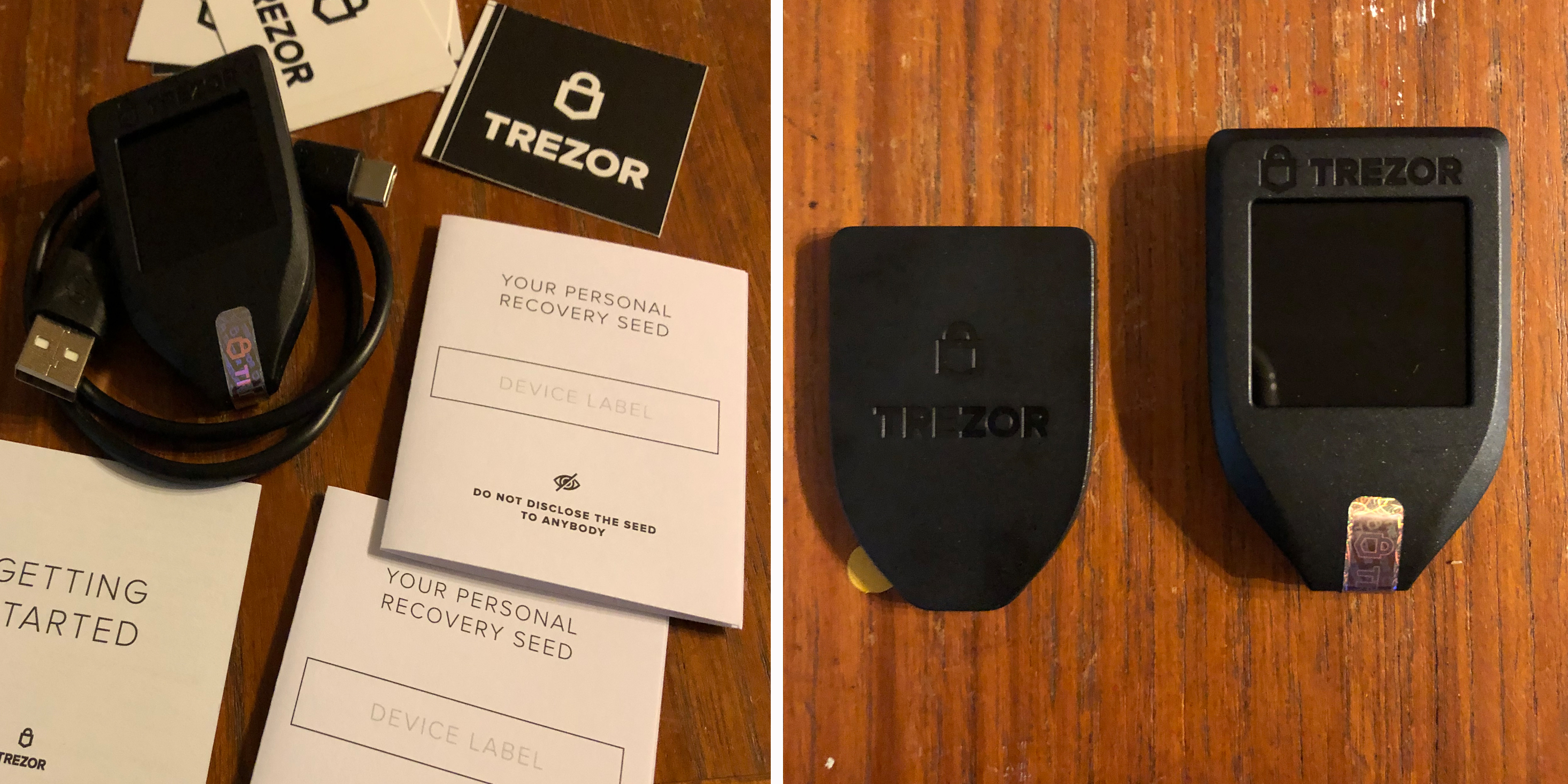
This week I received a Trezor Model T in the mail and decided to provide a rundown of how to set up the hardware wallet. In this review I also note the differences between the new version and the Trezor One. The box is very well packaged compared to the Trezor One I purchased years ago and comes with various accesories. Inside the box, there’s a Trezor T device, a USB-C cord, two recovery seed cards, a magnetic holder for the device, and a bunch of stickers. The machine itself features a RGB LCD touchscreen display and USB communications are enabled only after authentication. The directions inside the box explain that the owner needs to go to the Trezor website to initiate the wallet.
Everything the Trezor Model T comes with and the magnetic wall mount.
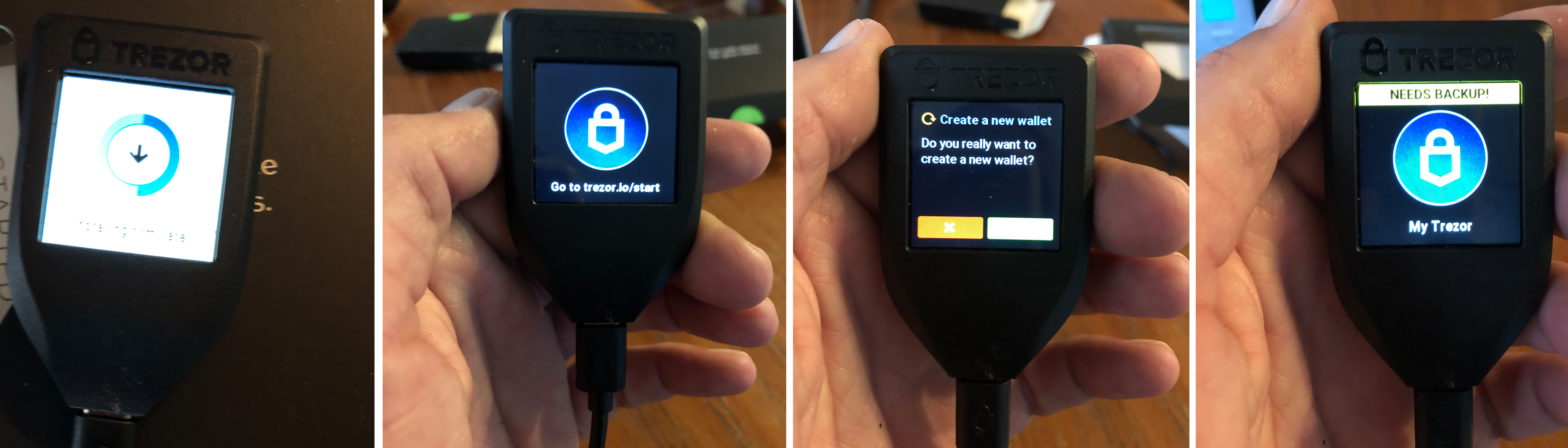
One thing that is noticeable is the amount of pressure needed to insert the USB-C cable. At first, I had issues initiating the firmware because my computer couldn’t recognize the Trezor through the cable. All shipped Trezors come empty and never have firmware installed for security reasons. However, I learned from the folks at Satoshilabs that you need to push the connector in hard enough until you hear it click. After choosing the T version on the website, it takes you to the beta Trezor browser wallet to initiate the device firmware. The setup can be initialized using the main Trezor wallet instead if you don’t want to use the beta version. The T only took two minutes for the firmware to install and from here I was able to begin the wallet setup and backup process.
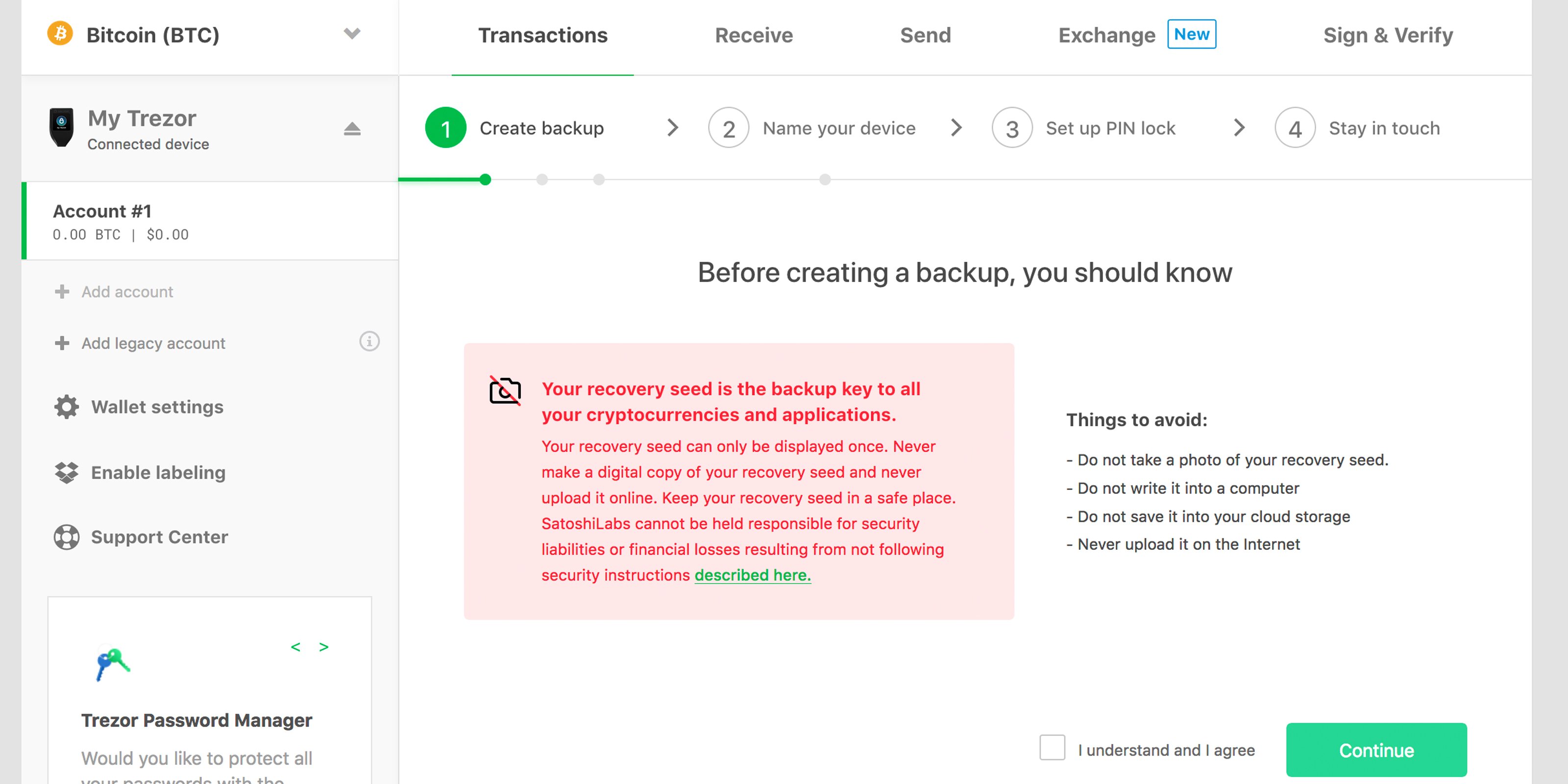
Initiating the firmware, creating a new wallet, and backing up the seed.
Backing up the Seed, Adding a PIN and Naming the Wallet
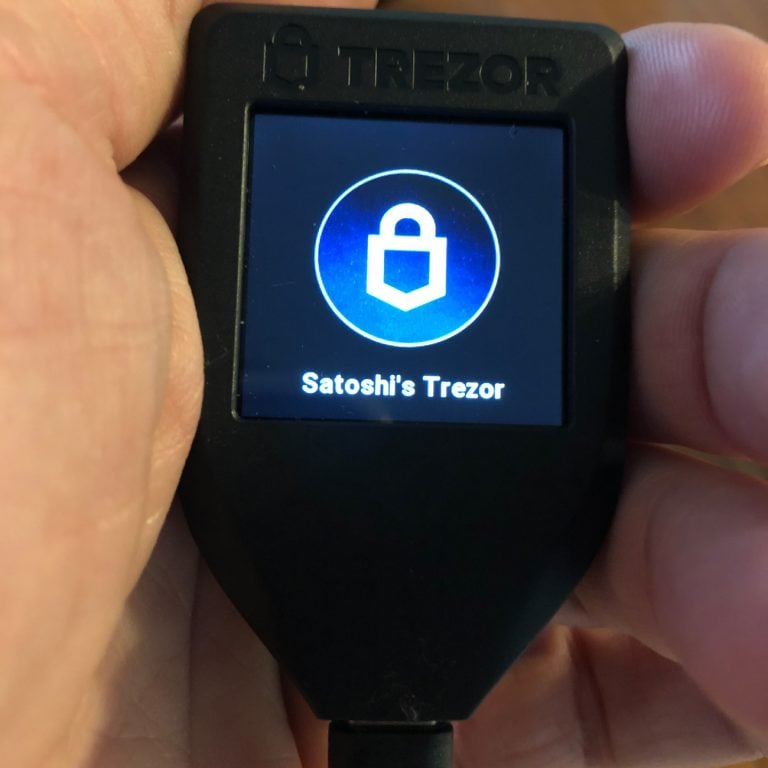
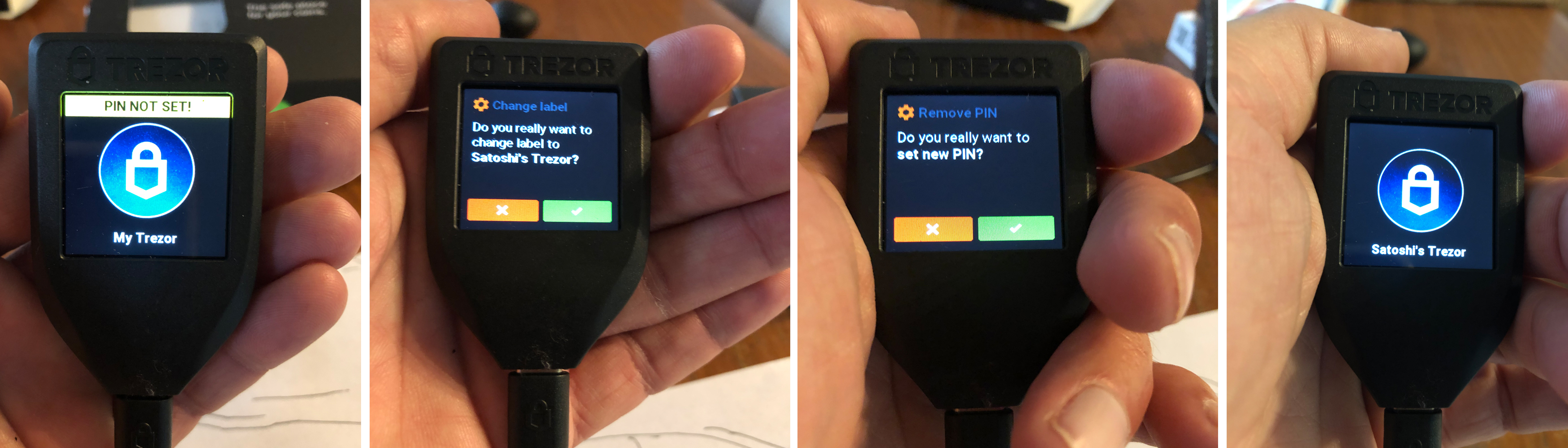
The device screen will warn the user that a backup has not been completed and the wallet browser will initiate the start of this process. From here, after the usual disclaimer about no screenshots and writing the seed down alone, the device screen will reveal a 12-word mnemonic seed phrase. After writing the words down on the seed card supplied in the box, I was prompted to confirm some of the words randomly in order to verify that the seed was written down correctly. Once the device confirms that the owner has written down the phrase, the setup moves on to adding a PIN to the device and a name. Each action needs to be confirmed using the device’s touchscreen. While pondering a name I decided to name my gadget ‘Satoshi’s Trezor’ because, after all, we are all Satoshi. Moving on, the browser wallet asks if you want to add an email and I opted to skip that step.
Setting a PIN and naming the device.
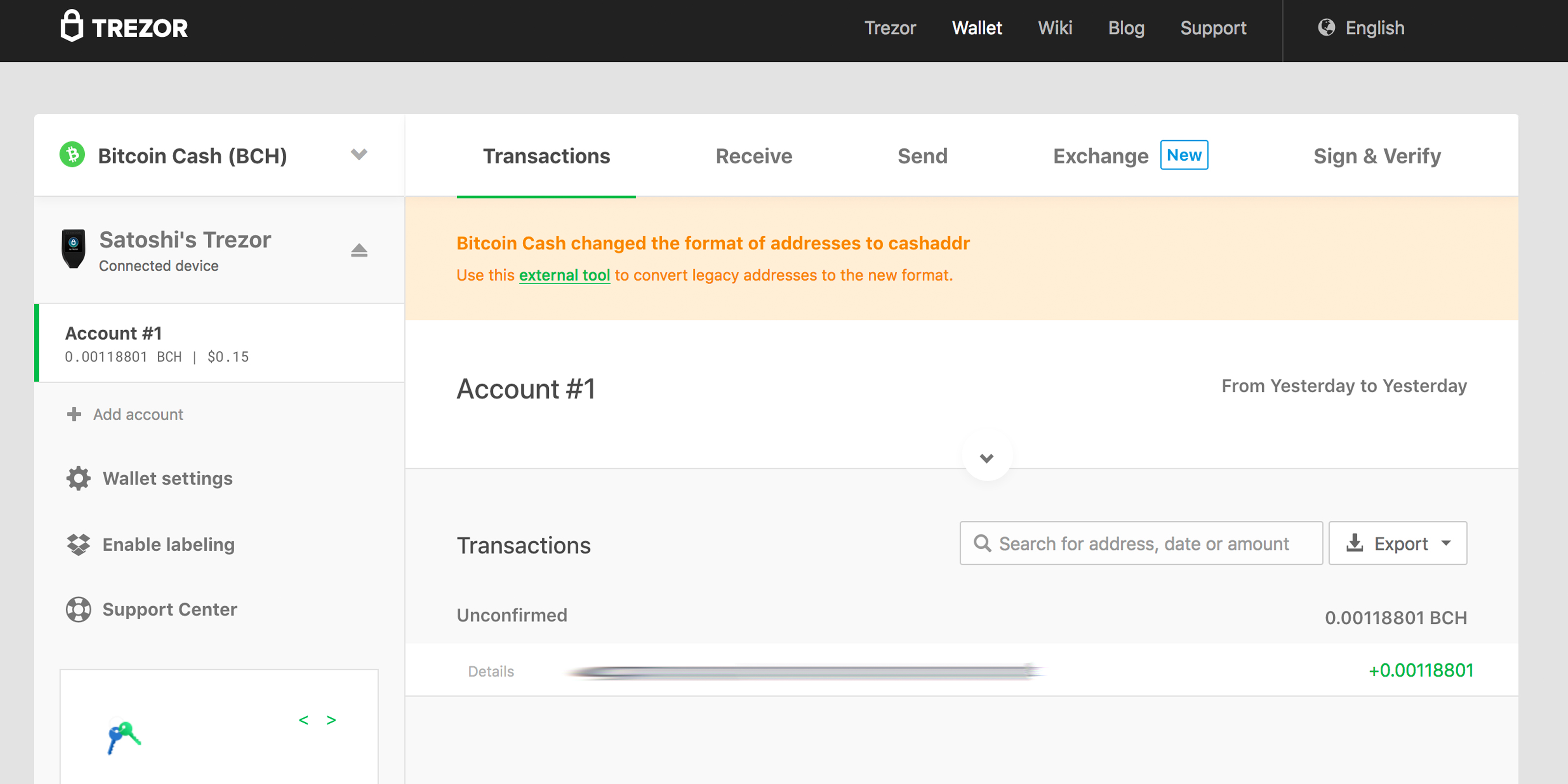
After the wallet was all set up, I sent a small fraction of bitcoin cash (BCH) to the wallet to make sure everything was working correctly. The Trezor T also supports BTC, BTG, DASH, DGB, DOGE, LTC, NMC, VTC, ZEC, ETH, ETC, XLM, XEM, and ADA. Some of the cryptocurrency wallets like ETH, ADA, and XLM take you to a third party wallet which essentially tethers the account to your device. Just like the Trezor One, the Model T can also act as a U2F device for online accounts like Dropbox and Gmail. Additionally, Satoshilabs has added an exchange feature which lets the hardware wallet interact with a third party trading platform so the user can swap coins without leaving the secure confines of the Trezor software.
The Trezor dashboard and all the steps involved with creating a seed backup.
A Model One Evolved
Overall, the Model T worked well but it took me some time getting used to the USB-C cord insertion, even though I use USB-C hardware regularly. The Keepkey cryptocurrency hardware wallet I recently reviewed also has a noticeably tougher USB insert. After getting used to the plug, it became much easier, but you may want to use a longer cord. The LCD touchscreen display is nice but was not so friendly with my fat fingers. The touchscreen takes some time to get used to as well and the screen is used for the wallet’s PIN entry, instead of the onscreen randomizer PIN pad used with the Trezor One.
Sending 15 cents’ worth of bitcoin cash (BCH) to test the wallet.
The device works just as well as my first Trezor wallet, but users will find subtle differences between each one. For example, the Model T comes with a micro-SD slot for advanced features that will be added to the operating system at a later date. Even with the T’s touchscreen, prospective buyers may still decide to purchase version One because it’s significantly cheaper than the Model T and just as secure. The T version is roughly $169, but that doesn’t include DHL shipping costs. One thing for certain is that I will continue to use the Model T hardware wallet, unlike some of the devices by other manufacturers I’ve previously reviewed that are now collecting dust.
What do you think about the Trezor Model T? Let us know what you think about this hardware wallet in the comments section below.
Disclaimer: This editorial should be considered Review or Op-ed material. The opinions expressed in this article are the author’s own. Bitcoin.com does not endorse nor support views, opinions or conclusions drawn in this post. Bitcoin.com is not responsible for or liable for any content, accuracy or quality within the review article. Review editorials are intended for informational purposes only. There are multiple security risks and methods that are ultimately made by the decisions of the user. There are various steps mentioned in reviews and guides and some of them are considered optional. Neither Bitcoin.com nor the author is responsible for any losses, mistakes, skipped steps or security measures not taken, as the ultimate decision-making process to do any of these things is solely the reader’s responsibility. For good measure always cross-reference guides with other walkthroughs found online.
Image credits: Jamie Redman, Trezor, and Satoshilabs.
Have you seen our newwidget service? It allows anyone to embed informative Bitcoin.com widgets on their website. They’re pretty cool, and you can customize by size and color. The widgets include price-only, price and graph, price and news, and forum threads. There’s also a widget dedicated to our mining pool, displaying our hash power.
Venezuela’s economic crisis is impossible to ignore. President Nicolás Maduro’s attempt to withdraw $1.2 billion of the country’s own gold from the Bank of England (BoE) has been rejected. The notion of a sovereign state being denied access to its own wealth is a concept that’s hard for bitcoiners to countenance. One thing is certain: the case for storing wealth in censorship-resistant cryptocurrency is becoming stronger.
In order to understand the Bank of England’s (BoE) decision to deny Venezuela its gold, a brief history lesson is required. How did one of the most oil-rich nations on earth end up on the brink of collapse? Since 2016, political discontent in Venezuela has been fueled by increasing hyperinflation, power cuts, shortages of food and medicine. Gold is a crucial part of Venezuela’s foreign reserves.
One huge turn of events involves the disputed presidency in Venezuela. Maduro was elected in April 2013 after the death of Hugo Chávez.In the meantime, Juan Guaidó has declared himself acting president despite Maduro being re-elected to a second six-year term in May 2018, which most opposition parties boycotted. On Jan. 26, the UK foreign secretary Jeremy Hunt said that the U.K. will also recognise Guaidó as the interim president of Venezuela if fair elections are not announced within eight days.
Hunt tweeted:
1/2 After banning opposition candidates, ballot box stuffing and counting irregularities in a deeply flawed election it is clear Nicolas Maduro is not the legitimate leader of Venezuela
2/2 @jguaido is the right person to take Venezuela forward. If there are not fresh & fair elections announced within 8 days UK will recognise him as interim President to take forward the political process towards democracy. Time for a new start for the suffering ppl of Venezuela
Cryptocurrency has already played an important role in this crisis. To counter escalating hyperinflation in February 2018, Maduro announced the launch of a state-backed cryptocurrency, the petro. During the launch, he is quoted as saying: “Venezuela makes history! Today we take a step forward with the launch of petro as a national currency and platform for strengthening our financial sovereignty.”
Absurd Issues Around BoE Transferring the Gold
The BoE is one of the largest physical gold custodians in the world. Data published by the London Bullion Market Association (LBMA) states that around 7,500 tonnes of gold was held in London in March 2017, the equivalent of 596,000 gold bars. Previously it was reported that the refusal to return the gold was due to insurance related reasons. Now it is evident that the BoE’s decision to withhold the gold is political.In a November article, Reuters quotes an unnamed official as saying:
The plan has been held up for nearly two months due to difficulty in obtaining insurance for the shipment, needed to move a large gold cargo.
The U.K. has legitimate concerns and reasons for not releasing the gold. According to Bloomberg reports, Ricardo Hausmann, a Harvard economics professor and long-time critic of Maduro, has stressed that the first rule of business is to stop his government from liquidating international assets belonging to the country and stealing them.
The Gold Repatriation Trend
Gold repatriation occurs when governments choose to bring home their gold stored outside of their country. Over the years, this has become a growing trend which raises questions as to whether something is brewing that might have compelled them to initiate the move. Fears that certain states might confiscate gold bullion, for example, could be a trigger.
Prior to Venezuela requesting gold bullion back from the BoE, the German central bank completed the move of 674 metric tonnes from the vaults of the Federal Reserve Bank of New York and the Banque de France three years ahead of schedule. Last year Turkey joined the ranks of Germany and Hungary as the latest country to repatriate gold to its soil, according to reports from the country’s media.
The Case for Crypto Increases
Bitcoin is backed by mathematics instead of state governments. It is possible that the recent sanctions and fear around physical gold could have been avoided if wealth had been held in the form of digital assets that can’t be censored or frozen by any third party.
In a recent interview with news.Bitcoin.com, Kai C. Chng, CEO of Digix, an asset tokenization company, explained how precious metals have always been a historic safe haven in times of economic uncertainty and are largely resilient to the fluctuations of international monetary markets. In times of crisis, this could change as people look for alternatives. “Should a global recession impact the purchasing power of traditional currencies, for those who already understand the benefits presented by cryptocurrency, we would expect to see increased interest in owning bitcoin, while those who are currently ill-acquainted with the cryptocurrency market are likely to show new interest in entering the space,“ said Chng.
Today, nearly 90 percent of Venezuelans are living in poverty. It seems Venezuela will remain immersed in a grave political crisis and economic war, with millions of innocent people poised to suffer as governments squander funds. In these desperate times, Bitcoin seems less like a bold experiment and more like a lifeline.
Should the Bank of England return the gold bullion to Venezuela? Let us know in the comments section below.
Images courtesy of Shutterstock.
Need to calculate your bitcoin holdings? Check our tools section.
After obtaining your first bitcoins on an exchange, you’ll want to keep them safe, even if the funds are only sitting there temporarily. One way to keep your crypto secure online is by using two-factor authentication (2FA). Security is of utmost importance when it comes to storing cryptocurrency in an online wallet and 2FA adds another layer of protection over and above a strong password.
The cryptocurrency community is all about advocating proper security techniques, and two-factor authentication (2FA) is one method that’s taught first and foremost to newcomers. 2FA is a subset of multi-factor authentication (MFA), a system that requires the use of two different factors to unlock a combination. For example, if 2FA is applied to a cryptocurrency exchange account you would need to log in with your username and password, but you will also need to enter a 2FA authentication PIN. The authenticator is usually on a secondary device like a mobile phone or a USB key.
Even if you don’t own cryptocurrencies, using 2FA to secure your online life is good practice.
Typically when you sign up for an exchange, you should add 2FA to the account right away for extra security. A great majority of exchanges nowadays also enforce the use of 2FA. However, what’s not usually taught is the fact that nearly every account you own, from social media services to email, should ideally be locked with 2FA, even if you don’t own cryptocurrencies.
There are many examples of why you should add 2FA to not just your exchange account, but to your email and other online accounts as well. Mainly because it is possible for hackers to gain access to the exchange account through the email you signed up with. After all, what point is there in locking the front door if you’ve left the back door open? Hackers could gain access to your email account if it is not secured with 2FA and when they gain possession of your email they could change the exchange account password among other malicious acts.
Two-factor authentication requires people to use a secondary factor like a phone code plus login credentials as well.
A hacker can also change your mobile number to a different phone or a voice over internet protocol (VOIP) line and gain access to your exchange account if you are using SMS style 2FA (a PIN sent by text). When people leave back doors open to social media accounts, hackers can gain access to private information and through social engineering breach cryptocurrency accounts online. Of course, people who hold their private keys or seed phrase offline will be safe, but securing your online life with multi-factor authentication techniques should be a priority. Hackers want your information and are known to scan emails and social media accounts for financial information and details of bitcoin holdings.
The following is a list of 2FA services that provide a free secondary form of authentication for people who want to keep their online accounts secure. Most of the well-known cryptocurrency exchanges support the use of the popular 2FA services mentioned and a majority of email providers and social media accounts support these specific authenticators as well.
Google Authenticator
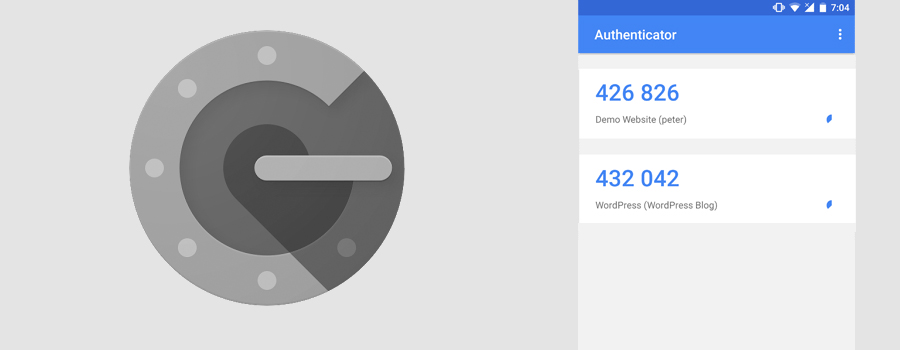
The application Google Authenticator is a reputable service that’s simple to use. The free platform is available for iOS and Android and you can use the service with online accounts such as Dropbox, Facebook, Gmail and a wide variety of cryptocurrency exchanges. A user can add as many codes as they like by either entering it manually or by using the QR reader. However, Google Authenticator requires you to back up the account’s recovery code. Otherwise, if you lose your phone, you risk being locked out of your account.
Microsoft Authenticator
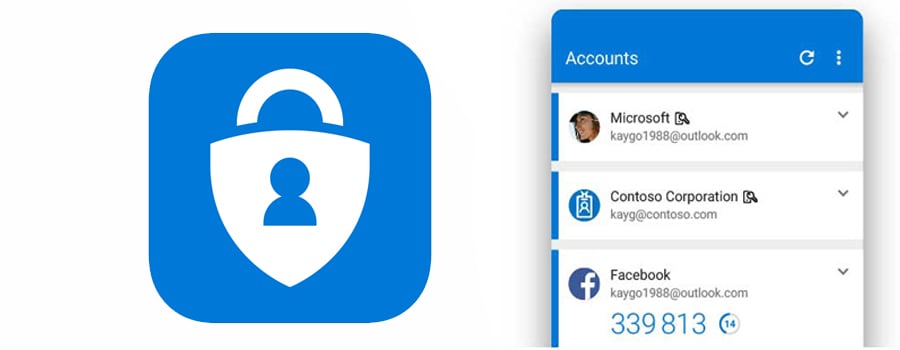
Software corporation Microsoft offers its own free authenticator app for its Windows line of phones, iOS, and Android devices. Similarly to Google’s version, it will allow you to manually enter or scan QR codes tethered to online account keys. Microsoft’s version offers 2FA for many of the same services but also has a one-tap push notification that can be used in place of PINs. Backups need to be saved and secured with Microsoft’s 2FA application. If the mobile device is damaged, lost or stolen the codes can be re-applied to a freshly installed app on a new device.
Authy
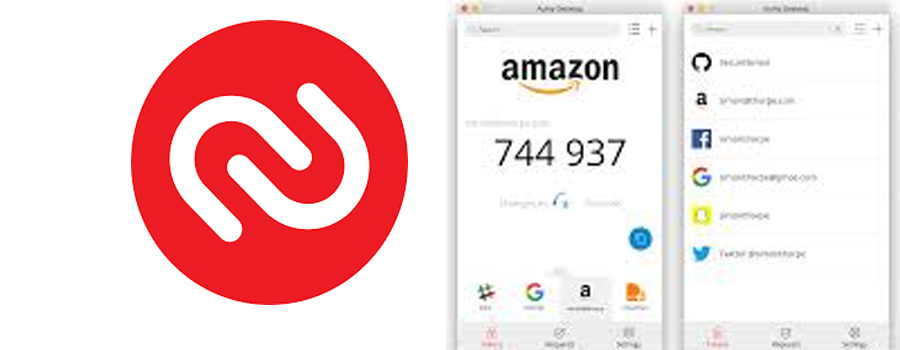
Authy is another popular 2FA application that can be applied to multiple devices. You can add as many accounts as you want and the application also has a master backup. For instance, if Authy is used for 10 accounts and the mobile device is damaged then the owner can simply use the master backup to restore all 10 account 2FA codes. Even with the master it’s still a good idea to save the backup codes in order to restore 2FA account settings individually. Authy works for both iOS and Android devices and the application is free.
Yubikey and a Few Select Hardware Wallets
With some online accounts like Gmail and Dropbox, a hardware-based 2FA solution can be utilized. For instance, the Yubikey is a small USB device that fits into your computer and the user verifies authentication with the press of a button. Certain cryptocurrency hardware wallets like Ledger and Trezor can also act as a 2FA device in a similar manner. Hardware-based 2FA solutions use the FIDO U2F standard which some find superior to other authenticators. Yubikeys and hardware wallets that offer 2FA need to be carried around however and some people find it more convenient to use their phone.
2FA Is Easy to Use and Adds a Layer of Security to Your Online Life
Installing a 2FA service like Authy or Google Authenticator on a phone is straightforward. Basically, you install the 2FA software on your mobile and go to your online account’s security section to retrieve a 2FA code. From there the service should provide you with a QR or alphanumeric code so you can add it to the authenticator service. Make sure you back up this code just in case you need to restore the 2FA service at a later date. Usually, you need to enter the PIN in order to turn the online account’s 2FA on or off. After doing it for the first time, it will activate and you will be required to use the 2FA’s PIN and login credentials every time you log in.
In practice, the 2FA method is a great security measure that you can use for free to protect your online data by adding an additional layer of security. It is far more difficult for a hacker to obtain access to an account if they have to compromise not only the password, but also breach something you have with you at all times like a mobile phone or U2F key. These days, with hackers and malicious actors trying to take our data and steal our funds on a regular basis, 2FA has cemented itself as vital online tool.
Do you usetwo-factor authentication? What services do you recommend? Let us know what you think about this subject in the comments in the below.
Disclaimer: Readers should do their own due diligence before taking any actions related to the mentioned companies or any of its affiliates or services. Bitcoin.com and the author are not responsible, directly or indirectly, for any damage or loss caused or alleged to be caused by or in connection with the use of or reliance on any content, goods or services mentioned in this article. Neither Bitcoin.com nor the author is responsible for any losses, mistakes, skipped steps or security measures not taken, as the ultimate decision-making process to do any of these things is solely the reader’s responsibility.
Have you seen ourwidget service? It allows anyone to embed informative Bitcoin.com widgets on their website. They’re pretty cool, and you can customize by size and color. The widgets include price-only, price and graph, price and news, and forum threads. There’s also a widget dedicated to our mining pool, displaying our hash power.
“Hi everyone, I just put up a new bitcoin exchange. Please let me know what you think.” With those innocuous words, one of the most notorious sagas in Bitcoin’s early history began. The name of the exchange was Mt. Gox and it was to play a pivotal role in Bitcoin’s rise – for a while, at least.
Mt. Gox wasn’t the first bitcoin exchange to launch, yet it actually predates Bitcoin. Jed McCaleb registered the mtgox.com domain in 2007 and ran it as “Magic: The Gathering Online eXchange” for years until reading about Bitcoin in 2010. The programmer was shrewd enough to recognize that a bitcoin exchange would be a better use for his domain, which by that point had lain dormant for years, after its original business proved to be a flop.
When McCaleb announced his newly repurposed platform on the Bitcointalk forum on July 18, 2010, initial reaction was muted. Many forum users who tried the site were unimpressed, and wondered why they might want to use Mt. Gox when they already had Bitcoinmarket.com, the first exchange of its kind. McCaleb had a simple answer to this: Gox was “always online, automated, the site is faster and on dedicated hosting and I think the interface is nicer.” He was to be proven right.
‘Can’t Wait to See Bitcoin Hit $10’
In its early days, Mt. Gox ran into the same problem that had affected Bitcoinmarket.com – Paypal. As one of the few fiat onramps that could be easily integrated, Paypal was a necessary evil for early Bitcoin-based platforms, but it soon began to cause more problems than it solved. “I’m really hoping bitcoin makes a huge dent in [Paypal],” fumed McCaleb. “It annoys me so much that they get 5.9% for running one UPDATE statement in their database.”
As McCaleb refined the site, its liquidity grew and traders warmed to Mt. Gox. “I love your exchange. Best I have seen yet,” enthused one. In August 2010, however, one forum user posed a potential problem to McCaleb: “What happens if someone hacks the website and finds a way to send themselves everyone’s BTC balances?” McCaleb laughed the question off at the time, replying: “Not sure. If it is a bug in bitcoin you will probably have to take it up with satoshi :).”
After running the exchange for eight months, McCaleb posted an announcement on March 6, 2011, titled “Mtgox is changing owners.” It read: “I created mtgox on a lark after reading about bitcoins last summer. It has been interesting and fun to do. I’m still very confident that bitcoins have a bright future. But to really make mtgox what it has the potential to be would require more time than I have right now. So I’ve decided to pass the torch to someone better able to take the site to the next level.” It continued:
MagicalTux has already contributed a lot to the bitcoin community and in many ways he will be better at running the site than I was …. Thanks to everyone that has supported mtgox so far. Can’t wait to see BTC hit $10!
At that, McCaleb was gone, off to focus on a cryptocurrency named ripple. In his place came the new steward of Mt. Gox, Magical Tux. Or as he is better known today, Mark Karpeles.
Images courtesy of Shutterstock.
Bitcoin History is a multipart series from news.Bitcoin.com charting pivotal moments in the evolution of the world’s first and finest cryptocurrency. Read part eight here.
In the first weekend edition of The Daily, crypto exchange Kucoin lists Mimblewimble coin Grin, giving it several trading pairs, and Bakkt releases product details about its upcoming futures contracts. Also, a Chinese investor sues a famous Israeli crypto entrepreneur for alleged fraud, while Malta issues a warning about a get-rich-quick “Bitcoin Revolution” scam.
Kucoin Lists Trading Pairs With Privacy-Centric Grin
Cryptocurrency exchange Kucoin has announced the listing of grin, the recently launched, privacy-focused cryptocurrency which is based on the Mimblewimble protocol. “Grin is now on Kucoin, you can deposit now,” the Singapore-headquartered digital asset platform tweeted, adding that the coin will be tradable with several pairs – bitcoin core (BTC), ethereum (ETH), and the stablecoin tether (USDT). The exchange also said that withdrawals will open at 18:00 (UTC+8) on Saturday, Jan. 26.
Grin (GRIN) is now on KuCoin, you can deposit now. Trading pairs include GRIN/BTC, GRIN/ETH and GRIN/USDT. Buying starts Jan 24, 2019, 17:30 (UTC+8), selling starts Jan 24, 2019, 18:00 (UTC+8) and withdrawal opens Jan 26, 2019, 18:00 (UTC+8).@grinMW#KCS#GRIN#BTC#ETH#USDTpic.twitter.com/8IzidvrN6L
Grin is the second Mimblewimble digital currency launched since the beginning of the year, with Beam being the first. Mimblewimble was originally developed in 2016 to improve the scalability of the Bitcoin network and provide enhanced privacy for its users.
Since its launch, the price of grin has seen considerable volatility and a significant decline following the rapid increase in its supply due to its inflationary design and high issuance curve. According to Coingecko, the coin is trading at $8.27 at the time of writing, after doubling in price in a matter of days. Beam’s start was not an easy one either. Its developers found a critical vulnerability in their wallet soon after the launch of the Beam mainnet, and UTXO bug later caused its blockchain to temporarily grind to a halt.
Bakkt Publishes Bitcoin Futures Specifications
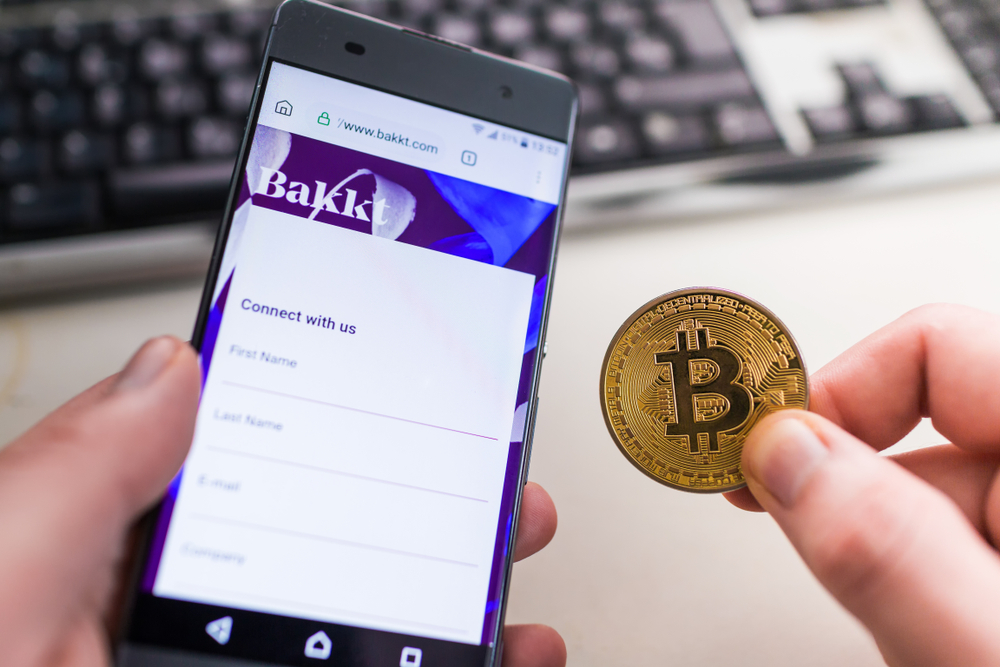
Crypto platform Bakkt, a subsidiary of Intercontinental Exchange (ICE), has released new details about its upcoming Bitcoin futures product. According to the specifications published on ICE’s website, the trading screen product name of the contracts will be “Bakkt BTC (USD) Daily Future” and each contract will be 1 BTC in size. Bakkt will offer one-day, physically delivered futures.
There will be no daily price limit and prices will be quoted in U.S. dollars. The minimum price fluctuation will be $2.50 per coin (contract), which can go down $0.01 per 1 BTC for block trades with a minimum of 10 lots. A position limit of 100,000 lots in any contract date will be applied. A $0.50 combined exchange and clearing fee per side will be charged.
Bakkt futures were initially expected on Jan. 24, but at the end of December, ICE published a notice stating that the launch date “will be amended pursuant to the CFTC’s process and timeline.” The platform is still waiting for regulatory approval from the U.S. Commodities Futures Trading Commission.
Last month Bakkt raised $182.5 million in funding. In mid-January the company announced an agreement to acquire assets from the futures merchant Rosenthal Collins Group. It also recently posted eight vacancies looking to hire blockchain developers among other specialists and executives.
A cryptocurrency investor from China has filed a lawsuit in Tel Aviv against the well-known Israeli crypto entrepreneur Moshe Hogeg. Zhewen Hu alleges Hogeg misappropriated millions of dollars invested in his company STX Technologies Ltd (Stox).
The Chinese citizen, who invested about $3.8 million worth of ethereum in the prediction market platform, is suing Hogeg and Stox for $4.6 million, saying the company’s promises and commitments never materialized.
Stox raised a total of $34 million during its initial coin offering in August 2017 but the lawsuit claims Hogeg invested only $5 million of the ICO funds in the company, The Times of Israel reported. He is accused of using the rest of the money to invest in other ICO projects including Telegram’s token sale.
Malta Warns About Crypto Platform ‘Bitcoin Revolution’
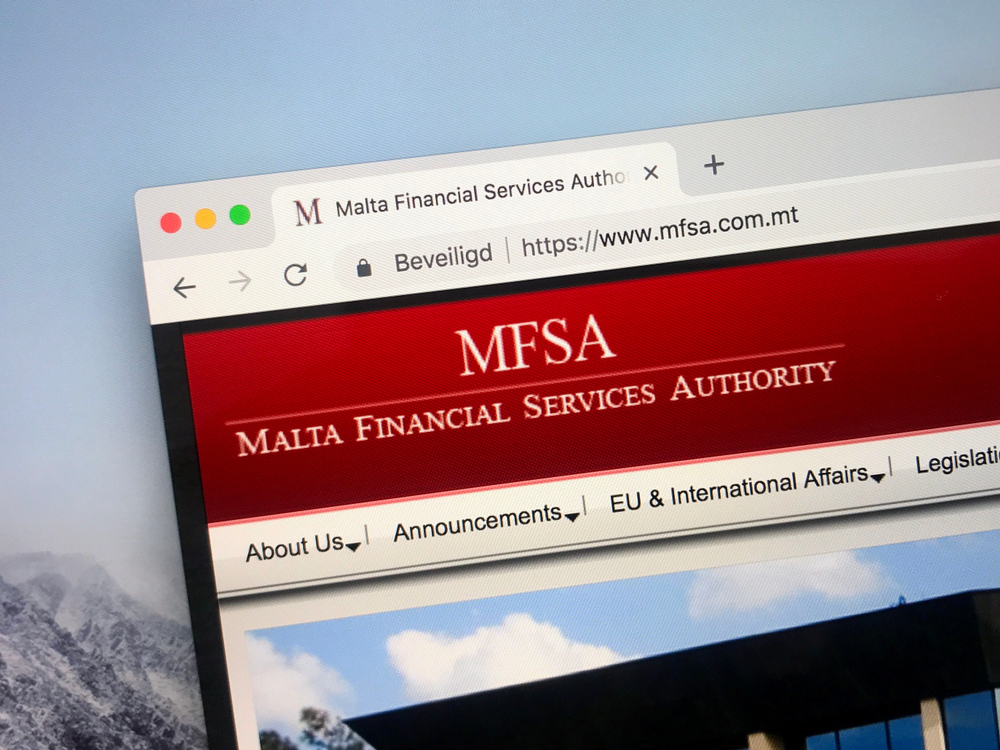
The Malta Financial Services Authority (MFSA) has issued an alert about a crypto investment platform called Bitcoin Revolution. According to the regulator, the entity promotes itself by publishing ads on a number of associated sites and posts on social media using the names of prominent personalities without their consent and announcing profits they supposedly made.
“Bitcoin Revolution is NOT a Maltese registered company NOR licensed or otherwise authorised by the MFSA to provide any investment or other financial services which are required to be licenced or otherwise authorised under Maltese law,” MFSA stated in the alert notice quoted by The Times of Malta. The financial watchdog describes the platform as an international “get-rich-quick” cryptocurrency scam.
What are your thoughts on today’s news tidbits? Tell us in the comments section.
Images courtesy of Shutterstock.
At Bitcoin.com there’s a bunch of free helpful services. For instance, have you seen ourTools page? You can even lookup the exchange rate for a transaction in the past. Or calculate the value of your current holdings. Or create a paper wallet. And much more.
Tidbits is a roundup of talking points from across the cryptosphere. Today, Jesse Powell and Samson Mow both voice their opinions on the custodial ownership of assets through trusted, third parties. Paul Sztorc shows the Bitcoin community that forks are not as frequent as they think and Simon Dixon breaks down his three problems with the banking system.
Recently, Venezuelan President Nicolas Maduro’s regime was denied the withdrawal of $1.2 billion worth of gold out of the Bank of England. Kraken exchange CEO Jesse Powell quickly pointed out that Maduro’s regime never owned their own gold, because they never stored it in their own vaults.
Similarly, Blockstream CSO Samson Mow took the opportunity to point out the similarities between Maduro regime’s gold and the oil that supposedly backs the Petro cryptocurrency. Both are assets that are held in custody by trusted, third parties that cannot be trusted.
And for the people of Venezuela: Not your barrel of oil, not your Petro. https://t.co/T2UiTK5dbQ
Director of research at Tierion and Bitcoin developer Paul Sztorc recently assembled all Bitcoin upgrade events into a pivot table. Interestingly, his findings showed forks were significantly less frequent than what the Bitcoin community initially assumed.
Sztorc goes on to explain that 2010 had about as many protocol forks as all other years. Also, the last normal upgrade was in July 2016, and the only upgrade since then was segwit.
Simon Dixon’s Three Problems With Banking
Banktothefuture CEO Simon Dixon was recently interviewed, and he explained the three increasingly problematic issues with the banking industry. Dixon believes that the banks are both unable and unwilling to solve these three problems.
The first problem occurs when clients deposit money into banks, and the banks become the legal owner of their clients’ money. During this period, the banks are able to use their clients’ funds any way they see fit. The next issue is that the banks decide how to inject their clients’ money into the economy via loans. Therefore, banks control the economy. Lastly, the monetary system is structured in a way that encourages debt rather than savings. Thus, there is innovation on the government level, the banking level and the investment banking level, to entice people, corporations and governments deeper into debt to increase the money supply. Eventually, this debt will need to be repaid, recycled into new debt, or bailed out through quantitative easing. In summary, banks are problematic because they earn money through the debt they create.
What do you think of custodial ownership of assets? Let us know in the comments below.
Images courtesy of Shutterstock.
BitcoinGames is a provably fair gaming site with 99% or better expected returns. Try it outhere.