#USA Kadho debuts offline speech recognition tech that understand kids, Kidsense A.I.

//

Kadho, a company building automatic speech recognition technology to help children communicate with voice-powered devices, is officially exiting stealth today at TechCrunch Disrupt SF 2018 where it’s launching its new technology, Kidsense Edge voice A.I. The company claims its technology can better decode kids’ speech as it was built using speech data from 150,000 children’s voices. The COPPA-compliant solution, which is initially targeting the voice-enabled devices and voice-enabled toys market, is already being used by paying customers.

As anyone with an Echo smart speaker or Google Home can tell you, today’s devices often struggle to understand children’s voices. That’s because current automatic speech recognition technology has been built for adults and was trained on adult voice data.

Kidsense.ai, meanwhile, was built for kids using voices of children from different age groups and speaking different languages. By doing so, it believes it can outperform the big players in the market like Google, Samsung, Baidu, Amazon, and Microsoft, when it comes to understanding children’s speech, the company says.

The company behind the Kidsense AI technology, Kadho, has been around since 2014, and was originally founded by PhDs with backgrounds in A.I. and neuroscience, Kaveh Azartash (CEO) and Dhonam Pemba (Chief Scientist). Chief Revenue Officer, Jock Thompson, is a third co-founder today.

Initially, the company’s focus was on building conversational-based language learning applications for kids.

“But the biggest pain point that we encountered…was that the devices that we were using or apps on – either mobile phones, tablets, robotics, or smart speakers  – they’re not built to understand kids,” explains Azartash. He means the speech recognition technology wasn’t built on kids’ data. “They’re not designed to communicate or understand kids.”

The team realized there was a bigger problem to solve. Teaching kids new language using conversational techniques couldn’t work until devices could actually understand the kids. The company shifted to focus instead on speech recognition technology, using a data set of kids voices (which it did with parents’ consent, we’re told), to build Kidsense.

The initial product was a server-based solution called Kidsense cloud AI in late 2017. But more recently, it’s been working on an embedded version of the same platform, where no audio data from kids is collected, and no data is sent to cloud-based servers. This allows the solution to be both COPPA and GDPR-compliant.

This also means it could address the needs of device makers who have been previously come under fire for their less than secure toys and robotics, like Mattel’s Hello Barbie, or its canceled A.I. speaker Aristotle. The idea today is that toy makers, smart speaker manufacturers, and others catering to the kids’ market will need to be compliant with more stringent privacy laws and, to do so, the processing has to be done on the device, not the cloud.

“All the decoding, all the processing is one on the device,” says Azartash. “So we’re able to offer better efficacy and better accuracy in converting speech to text…the technology does not send any speech data to the server.”

“We’ve figured out how to put this all onto the device in an efficient way using minimal processing power,” adds Thompson. “And because we’re embedded we can charge a flat fee depending on the product anywhere to a subscription model.”

For example, a toy company working with thin margins on a product with a really small lifespan might want a flat fee. But another company may have a product with a longer lifespan that they charge their own customers for on subscription. They may want to be able to update their product’s voice tech capabilities over-the-air. That’s also possible here.

The company says its technology is in several toys, robotics, and A.I. speaker products around the world, but some of its customers are under NDA.

It’s also testing its technology with chip makers and big-name kids’ brands here in the U.S.

On stage, the company also showed off its latest development – dual language speech recognition technology. This is the first technology that can decode two languages in one sentence, when spoken by kids. This is an area smart speakers and their related voice technology are only now entering, within the adult market that is. For example, Google Assistant is preparing to become multilingual in English, French and German this year.

Currently, the company has approximately $1.2 million in revenue from customers on annual contracts and its SaaS model. It’s been operating in stealth mode, but is now preparing to reach more customers.

To date, Kadho has raised $2.5 million from investors including Plug and Play Tech Center, Beam Capital, Skywood Capital, SFK Investment, Sparks Lab, and other angel investors. It’s preparing to raise an additional $3 million before moving to a Series A.

from Startups – TechCrunch https://ift.tt/2QaSx0b

#USA Lori Systems is launching a service with the Kenyan government for last-mile haulage from railroads

//

For Lori Systems chief executive and co-founder Josh Sandler, deals like the one between his company and the Kenyan government to solve last-mile solutions around the national railroad are about far more than just logistics.

Sandler, whose family battled apartheid in South Africa as social workers, township doctors and (more dangerously) as financiers for the Spear of the Nation (the armed wing of the African National Congress), looks at logistics as an economic cornerstone for building more stable and democratic societies in sub-Saharan Africa.

His parents had immigrated to the U.S. in 1990 when Sandler was still a young child to escape the violence that accompanied the negotiations to dissolve South Africa’s apartheid state. Sandler’s father had worked as a doctor in township hospitals, while his mother was a social worker who was setting up a support network for abused children.

A lot of the family was getting arrested and the country was breaking up and people feared a civil war and my dad got a fellowship in America and moved to Florida,” Sandler says. 

But South Africa remained the touchstone for Sandler’s family life and he would often return to visit those activist relatives who remained to help shepherd the country through its early years as a democracy. It was during one visit to the country — when Sandler was working in a refugee camp — that the need for better economic solutions to the region’s problems became clear.

In the aftermath of the economic collapse of Zimbabwe and the long-simmering civil war in the Congo in 2008, refugees from the region were flooding into South Africa — and it triggered a response in the country’s citizens. Xenophobic violence resulted in rioting, looting and the murder of immigrants at camps — and Sandler had gone to volunteer at the shelters that were caring for these refugees.

“I had been debating between investment banking and the peace corps and went with investment banking because there needs to be a macroeconomic solution for this,” Sandler said. “Finding the core challenges from a macro perspective and preventing this from occurring by establishing strong systems and an economy that can prevent… all of these crises.”

So Sandler studied development economics. His work focused on supply chains — specifically working with the Kenyan government to analyze what went into the dramatic cost increases that are attendant with the sale of every good and service in the country. “When you buy a mango on a farm, it’s half a penny and then in the supermarket it’s 80 cents,” said Sandler.

From Kenya, Sandler moved to study Nigeria and worked on problems with supply chain management in pharmaceuticals. “I did a lot of trips and treks back to the continent and what I kept seeing is challenges in the supply chain — part of it is middlemen and part of it is haulage.” Sandler said. “That’s a big issue that’s due to a lack of flexibility and coordination in the system.”

After seeing the elegance of the marketplace model that Uber had set up for ride-hailing and given the penetration of smart and feature phones in Africa, Sandler thought he could do something to create a marketplace for the trucking industry.

“Before, providers were managing individual trucking companies with a difficult marketplace and no transparency,” says Sandler. “By driving that through our system and having more pricing visibility we’re able to bring down the cost of bringing bulk grains to Uganda by 17.3 percent.”

Lori Systems first launched in Kenya and started working with a network of trucking companies. Around that time the company also came to the attention of TechCrunch.

Yes, Lori Systems has been on a TechCrunch stage before — as competitors (and eventual winners) of our inaugural TechCrunch Battlefield competition in Nairobi.

Since appearing on stage at our Nairobi event, Lori has grown quickly. The company counts 70 employees on staff — up from 20 — and now has 70 cargo operators responsible for a network of 2,500 trucks using its service.

The staffing changes at Lori include some big new executive hires, including Andrew Musoke, who has come on board as director of commercial products, and a former director of Maersk, Mehul Bhaat, who will be running operations in East Africa for Lori, Sandler says.

Lori has also expanded internationally — working with fleets in Kenya, Uganda, Rwanda and South Africa while also increasing the types of cargo that its fleet operators are transporting. “We went from just doing grain and fertilizer to now we do all freight bulk,” says Sandler.

Not everything about the TechCrunch experience was positive for Sandler and the company. After their victory, Lori, and Sandler, were subjected to criticism from some African press. “There were really bizarre implications with the underlying tone being white male privilege,” says Sandler. “It’s an important conversation to have around white male privilege… [but] it was coming out on a very personal level on a gossip column.”

The accusations aside, Sandler said the victory in the Startup Battlefield Africa competition validated the company with potential new hires.

As for the opportunity, Sandler says there’s $180 billion in hauling income across the African continent, and very little of it has been optimized with software. Ultimately, if Lori succeeds it will mean lower prices and increased spending power for consumers across Africa.

“If you’re earning a dollar a day and 40 percent or 60 percent is going to logistics that could be going somewhere else, that’s a problem,” Sandler said. It’s exactly the problem that Lori is setting out to solve. 

from Startups – TechCrunch https://ift.tt/2NoVdcf

#USA Robinhood aims at IPO as the fintech startup seeks CFO

//

Now valued at $5.6 billion, zero-fee stock trading app and cryptocurrency exchange Robinhood is starting preparations to go public. Just a year and a half ago, it was still largely under the radar. But then it raised a $110 million Series C at a $1.3 billion valuation in April 2017 and then just a year later scoring a $363 million Series D, both led by Russian firm DST Global. Combined with the growth of its premium subscription for trading on margin called Robinhood Gold, the startup now has the firepower and revenue to make a viable Wall Street debut.

Today during Robinhood CEO Baiju Bhatt’s talk at TechCrunch Disrupt SF, he revealed that his company is on the path to an IPO and has begun its search for Chief Financial Officer. It’s also undergoing constant audits from the SEC, FINRA, and its security team to make sure everything is kosher and locked up tight.

The CFO hire could help the five-year-old Silicon Valley startup pitch itself as the cheaper youthful alternative to E*Trade and traditional stock brokers. They’d also have to convince potential investors that even though cryptocurrency prices are in a downturn, allowing people to trade them for cheaper than competitors like Coinbase is a powerful user acquisition funnel.

Robinhood now has 5 million customers tracking, buying, and selling stocks, options, ETFs, American depositary slips receipts of international companies, and cryptos like Bitcoin and Ethereum. That’s twice as many customers as its incumbent competitor E*Trade despite it having 4000 employees compared to Robinhood’s 250.

The startup has raised a total of $539 million to date from presitigious investors like Andreessen Horowitz, Kleiner Perkins, Sequoia, and Google’s Capital G, allowing it to rapidly role out products before its rivals can react. This rapid rise in valuation can go to some founders’ heads, or crush them under the pressure, but Bhatt cited “friendship” with his co-CEO Vlad Tenev as what keeps him sane.

The startup has three main monetization streams. First, it earns interest on money users keep in their Robinhood account. Second, it sells order flow to stock exchanges who want more liquidity for their traders. And it sells Robinhood Gold subscriptions which range from $10 per month for $2000 in extra buying power to $200 per month for $50,000 in margin trading, with a 5 percent APR charged for borrowing over that. Gold was growing its subscriber count at 17 percent per month earlier this year, showing the potential of giving trades away for free and then charging for extra services.

But Robinhood is also encountering renewed competition as both startups and incumbents wise-up. European banking app Revolut is building a commission free stock trading, and Y Combinator startup Titan just launched its app that lets you buy into a  managed portfolio of top stocks. Finance giant JP Morgan now gives customers 100 free trades in hopes of not being undercut by Robinhood.

Over on the crypto side, Coinbase continues to grow in popularity despite its 1.4 percent to 4 percent fees on trades. It’s rapidly expanding its product offering and the two fintech startups are destined to keep clashing. Robinhood may also be suffering from the crypto downturn, which is likely dissuading the mainstream public from dumping cash into tokens after seeing people lose fortunes as Bitcoin and Ethereum’s prices tumbled this year.

There’s also the persistent risk of a security breach that could tank Robinhood’s brand. Meanwhile, the startup uses both human and third-party software-based systems to moderate its crypto chat rooms to make sure pump and dump schemes aren’t running rampant. Bhatt says he’s proud of making cryptocurrency more accessible, though he didn’t say he felt reponsible for prices plummeting which could mean many of Robinhood Crypto’s users have lost money.

Fundamentally, Robinhood is using software to make the common but expensive behavior of stock trading much cheaper and more accessible to a wider audience. Traditional banks and brokers have big costs for offices and branches, trading execs, and TV commercials. Robinhood has managed to replace much of that with a lean engineering team and viral app that grows itself. Once it finds its CFO, that could give it an efficiency and growth rate that has Wall Street seeing green.

from Startups – TechCrunch https://ift.tt/2Q55kS5

#USA Measuring AI startups by the right yardstick

//

Building a B2B AI startup is hard enough between struggling to obtain training data and fighting with major tech companies to secure talent. Building a B2B AI startup held to the well-established software-as-a-service (SaaS) metrics is even harder. While many AI businesses deliver value via software monetized by a recurring subscription like their SaaS counterparts, the similarities between the two types of businesses end there.

AI startups are a different animal

SaaS products built without data and AI offer generalized solutions to their customers. AI businesses more closely resemble a services business or consultancies because they provide solutions that become tailored to that customer’s specific needs. Like services providers or consultants, an AI product improves as it knows a customer better (as in, as it collects more data from customers with continued usage), and as it serves a broader customer base, from which it can collect best practices and make better predictions over a bigger data set.

Services revenue has been the antithesis of venture-style growth because it yields lower margins and lacks repeatability and scalability; as your services business brings on more customers, you will need to scale headcount accordingly to support those accounts, which keeps margins low. Palantir, a big data analytics unicorn, is one company mired in services demands. Unlike services providers, AI businesses have the potential to deliver that targeted and greater ROI at scale.

AI businesses are not scalable right out of the gate: AI models take time and require data to train. Moreover, not all AI businesses will scale. Here are the metrics we use to tell the difference early on.

AI metrics

Intervention ratio
Hype will make enterprise customers trigger-happy to pilot AI solutions, but at the end of the day, enterprise buyers buy the best solution available to address their problems and don’t care whether that solution comes in the form of SaaS software, a consultancy or an AI product. It is very difficult to build a high-performing MVP version of an AI model without data from customers. In order to demonstrate value right out of the box and be competitive against other vendors, you might automate which processes you can right off the bat using a rules engine, and provide a human operator to perform the rest of the work while simultaneously labeling the collecting data in order to train the AI.

As the AI improves over time, the human operator will offload more of the work and only jump in to intervene when the AI falls below a predetermined accuracy or confidence threshold. This enables you to serve an increasing number of customers with a limited number of staff. Lilt, which provides machine translation for enterprise, uses professional translators in this role. The translation AI automatically translates a text excerpt from one language to another. A human translator goes over the text looking for errors in translation or contextual corrections. As the translation AI improves, the human translator will have to make fewer corrections per translation task. More generally, the ratio of human interventions over total automated tasks should be decreasing.

ROI curve
As with SaaS products, exactly how that compounding AI performance increase is tied to bringing value for the customer is key to the startup’s long-term stickiness. The key difference with AI products is once the AI’s performance ramps up, it could very quickly exhaust all low-hanging fruit opportunities. If the AI cannot continue to provide value to the customer, the difference in value from one renewal cycle to the next may seem stark to the customer, who may decide to not renew.

There are only so many opportunities to take out costs before you are constrained by the laws of physics.

Choosing the right applications of AI to enable long-term payoffs and avoiding hitting a wall with ROI is key. Typically, applications that improve the customer’s bottom line face finite opportunities for improvement, and applications that improve the customer’s top line have no ceiling on opportunities to grow. For example, once an AI improves the operating efficiency of a production line to the point where it is rate-limited by the time it takes for the raw materials to chemically react, the AI can no longer find value for the customer for that specific application.

There are only so many opportunities to take out costs before you are constrained by the laws of physics. An AI that helps customers find new opportunities for revenue like, Constructor.io, which provides AI-powered site search as a service and helps customers such as Jet.com increase cart conversions, will not hit that wall.

You should closely track the cumulative ROI for each customer over time to make sure the curve does not plateau and lead the customer to churn. Sometimes the long-term application is harder to sell because the value is difficult to demonstrate immediately, and you might get a foot in the door with the cost take-out value proposition. Understanding its ROI curve would enable you to design a longer contract period so that the AI has time to ramp on new problems before it exhausts the initial application. To ensure customer retention, you should make sure that the customer ROI increases over time and not plateau or taper off.

Rev-up costs
Deploying an AI product is a complicated process that leaves you at the mercy of each customer’s idiosyncratic tech stack and org chart. AI needs data to train, so an AI product may take more time than a SaaS product to deliver value. Acquiring or creating data for the AI model, integrating the product into the customer’s tech stack and workflows and getting the product to deliver value before the model is sufficiently trained on the customer’s data may significantly impact your own bottom line.

Many sectors have only recently begun to digitize, and valuable data might be in difficult-to-extract formats, such as handwritten notes, unstructured observation logs or PDFs. In order to capture this data, you may have to spend significant manpower on low-margin data preparation services before AI systems can be deployed. Depending on how the data is captured and organized, your deployment engineer may have to build new integrations to a data source before the model can be fully functional.

The way data is structured might also vary from one customer to the next, requiring AI engineers to spend additional hours normalizing the data or converting it to a standardized schema so the AI model can be applied. Over time, these costs may decrease as you build up a library of reusable integrations and ETL pipelines.

Products sold by SaaS companies either work or they don’t. AI performance is not binary; it works less well out of the box and improves with more data. Each application and each customer will accept a different minimum algorithmic performance (MAP). The deployment process should make sure to get the product to that customer’s specific MAP, and you might revert back to Wizard of Oz stop-gap approaches to deliver MAP until the model can perform at MAP on its own.

If you are selling to customers that allow you to pool anonymized data or use a model trained on their data with other customers, the AI product will perform better “out of the box” with each subsequent customer. Inside sales customers, for example, can get immediate suggestions on how to optimally target a sales lead using its sales acceleration platform thanks to that data pooled from its customer network.

AI products incur more significant rev-up costs than a typical SaaS product rollout and may have as much impact on margins as customer acquisition costs (CAC). You should carefully track how much time these rollouts and ramp-ups take, and how much it costs for each new customer. If there are true data network effects, these numbers should decrease over time.

Data moat
Unlike SaaS businesses that compete on new features, AI startups have an opportunity to build long-term defensibility. The AI startups that can scale will kick off a virtuous loop where the better the product performs, the more customers come on board to contribute and generate data, which improves the product’s performance. This reinforcement loop builds a compounding defensibility that was previously unheard of for SaaS businesses.

AI models perform better with more data, but that performance may plateau over time.

It’s too simplistic to merely aim for the largest volume of data. A defensible data strategy takes into account whether the appropriate data is being collected at a pace that is appropriate for the problem at hand. Ask yourselves these questions about your data to determine where you can strengthen your data strategy on the following dimensions:

  • Accessibility: how easy was it to get?
  • Time: how quickly can the data be amassed and used in the model?
  • Cost: how much money is needed to acquire and/or label this data?
  • Uniqueness: is similar data widely available to others who could then build a model and achieve the same result?
  • Dimensionality: how many different attributes are described in a data set?
  • Breadth: how widely do the values of attributes vary, such that they may account for edge cases and rare exceptions?
  • Perishability: will the data be useful for a long time?

AI models perform better with more data, but that performance may plateau over time. You should take care to track the time and volume of data necessary to achieve an incremental unit of value for your customer, to make sure that the data moat continues to grow. In short, how much time, and how much data, would a copycat need to match your level of performance?

SaaS metrics aren’t enough

The higher upfront work necessary to launch an AI business means that most will look more like services businesses or will appear to underperform when they are evaluated under the framework of SaaS metrics. A small subset of AI startups will resemble SaaS businesses from the beginning, before AI is deployed in the product. In order to collect data for their AI models, some businesses first sell SaaS workflow tools and can even achieve meaningful revenue from that workflow tool alone. By SaaS metrics, that company may be blowing the competition out of the water. Without the reinforcement loop generating a compounding volume of data and an increasingly powerful AI over time, however, that company’s product remains vulnerable to copycats and will eventually be commoditized.

AI metrics captures this difference. AI offers the opportunity to deliver the customized and specialized ROI of a services business with the scalability of software, with the ability to defend against copycats. The high start-up costs of this approach to company-building may mean you will realize smaller profits and build the company prioritizing different elements than what has worked before. Vertical AI is so new as a category that many companies are not yet tracking these metrics, so we don’t yet have enough data points to establish benchmarks. In the meantime, these numbers will serve as helpful barometers for you to monitor the health and performance of this new type of company.

from Startups – TechCrunch https://ift.tt/2wQwSTb


#USA MasterClass raises $80M after doubling sales last year

//

MasterClass, the website that brings celebrity-taught classes to the public, like tennis lessons from Serena Williams and photography instruction from Annie Leibovitz, has raised $80 million to expand internationally.

The Series D funding, led by IVP, will also be used to bring more celebrities to MasterClass. The company currently offers 39 classes, with plans to hit 50 by the end of the year.

In the last year, MasterClass has added a writing class with Margaret Atwood, a comedy lesson from Judd Apatow and more. Co-founder and CEO David Rogier told TechCrunch this morning that he hopes to bring Elon Musk, LinkedIn founder Reid Hoffman and J.K. Rowling on board soon.

MasterClass’ sales more than doubled from 2016 to 2017 and are on track to do the same this year. That puts the company on pace to match Udacity and Coursera — a pair of edtech heavyweights — in revenue, according to Rogier, who would not disclose MasterClass’ financials but made the comparison. Udacity has said publicly that it increased revenue to $70 million last year, up from $29 million in 2016. Coursera, for its part, is reportedly “within striking distance of $100 million dollars in annual revenue.”

Udacity was founded in 2011 and garnered a $1 billion valuation in 2015. Coursera, founded in 2012, was valued at $800 million last year. Three-year-old MasterClass declined to disclose a valuation.

To thrust itself ahead of its competitors, MasterClass also recently rolled out a new subscription model that allows customers to pay an annual fee of $180 for access to all MasterClass lessons, which are otherwise $90 each. It’s been a huge success so far, counting for 80 percent of the company’s revenue.

On top of that, MasterClass released its first-ever mobile app this April. Before that, all the company’s growth came from desktop.

“To our investors, that was a shock and a surprise,” Rogier said. “It’s really rare and amazing that you could drive that amount of growth without being on those platforms.”

San Francisco-based MasterClass previously raised $54.5 million in venture capital funding. Rogier says they ultimately decided to raise again once they had the data to show how impactful their classes were for customers.

One-fourth of our students say that taking these classes transformed their life,” he said.

from Startups – TechCrunch https://ift.tt/2wPsEtZ

#USA Fertility startup Future Family switches to a subscription platform

//

Future Family, the startup offering more affordable plans for fertility services like IVF and egg freezing, is switching its model from small loans for these services to subscriptions.

Fertility treatments are out of reach for most middle-income people in the U.S. The typical costs range from $12,000 to $20,000 for IVF, plus another few thousand for the genetic testing involved to ensure the fetus is chromosomally normal. To help, Future Family started out offering monthly payment plans for these services. However, after hearing from customers, the company has decided to switch to a subscription plan where customers can choose from several offerings and tailor a package that fits their needs.

You might be wondering what the difference is: Either you get a loan for the services you want or you sign up to pay a certain amount as a subscription for x many months for the services you want. Either way, you get the services you want with an affordable way to pay for them.

What’s new is the ability to pick the services you want, both upfront and and as you go. So, for example, if you go through egg retrieval and later realize you want to add genetic testing, you can now fold that option into your subscription plan.

“We have now moved from a financing product with concierge, to a full subscription model that offers the flexibility of other consumer subscriptions,” a spokesperson for the company told TechCrunch. “Contrast this with other financing products that have no flexibility and no customization, and do not even include services like genetic testing.”

Future Family was co-founded by former Solar City executive Claire Tomkins after she went through six rounds of IVF and spent more than $100,000 to finally get her baby, so Tomkins had some understanding of what someone might go through and how much they could rack up before seeing results.

In the past year, the company has also added male fertility testing and expanded it’s ‘Touchpoint’ fertility program to include more than 200 clinics, and it has doubled its user base in the last six months. While we don’t have firm numbers on just how many have used the company’s services, it did tell TechCrunch it has helped “tens of thousands of women, men, and couples in all 50 states.”

Subscription packages last over the course of five years and start at $150 per month for egg freezing. What you’ll get with that beginner plan is the procedure itself plus concierge care, fertility planning, clinic matching and on-boarding to the company’s digital health platform. You can see other plans for IVF on the site here.

“Subscription fertility is stress-free fertility. We want to transform people’s fertility experiences from what is currently a costly, isolating and confusing experience, to one that is affordable, easy to navigate, and supported at every step of the journey,” Tomkins said.

from Startups – TechCrunch https://ift.tt/2MQJnrQ

#USA Bumble launches Snooze button to pause dating for a digital detox

//

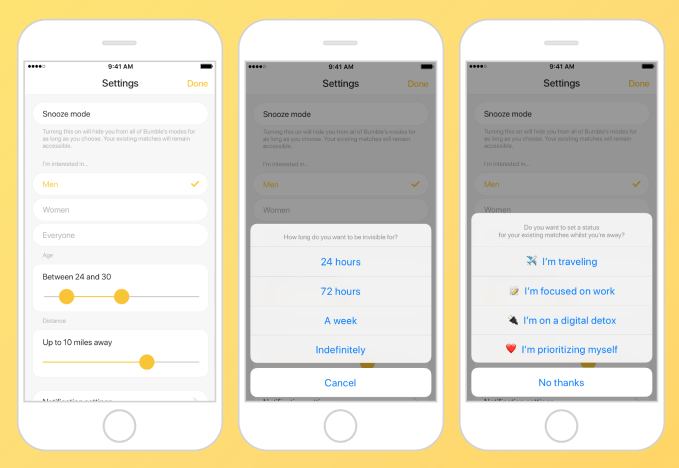
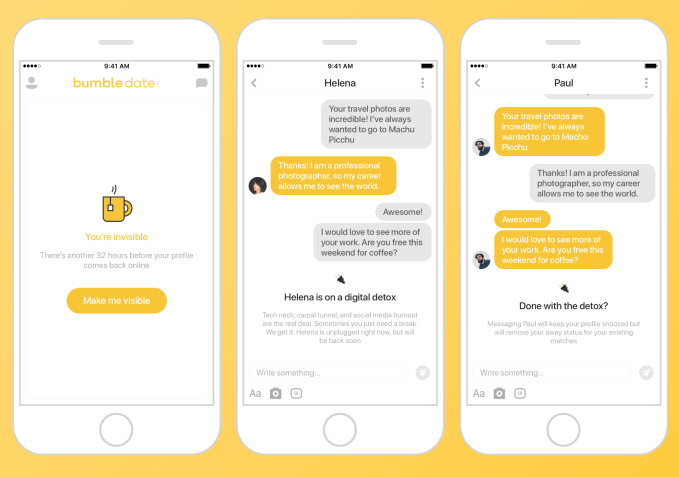
Bumble doesn’t want you to delete your account when you get into a relationship, go on vacation, or just need a break from your phone. So today it’s launching a Snooze button that lets you stop showing up to people swiping through potential matches for a day, three, a week, or indefinitely. You’ll also get to select an away message like “I’m traveling”, “I’m on a digital detox”, “I’m focusing on work”, or “I’m prioritizing myself” that will show up with existing matches you’re chatting with.

The feature could ensure that Bumble’s 40 million registered users aren’t flirting with an empty vacuum if their match goes AWOL from Bumble temporarily. And for users who turn it on, Snooze could reduce their FOMO about potentially missing out on a match or looking like they ignored someone’s message.

“The impact of social media, especially on young women, has the potential to be very harmful and we have a responsibility to give our users the power to disconnect on their own terms whenever they see fit” writes Bumble founder and CEO Whitney Wolfe Herd. “We know Snooze will allow them to come back to us feeling refreshed and more open to new connections.”

Tinder has its own Pause button, but it’s bundled alongside the account deletion button and has less intention and flexibility behind it. You can merely turn it on or off. Without the proper away messages, matches could think you’re just trying to ghost them.

When Bumble and non-Bumble users were recently surveyed, over 60 percent of women ages 18 to 24 said they felt overwhelmed by social media. 60 percent of women surveyd also spend over two hours a day on social media. Bumble’s in-house sociologist Dr. Jessica Carbino writes that “On social media, young women can develop unrealistic perceptions of what they should be or how others see them. These unrealistic expectations may ultimately have negative consequences for their physical and emotional well-being.”

Dating apps are subject to high churn rates as people find long-time partners or age out of different apps. They must do everything they can to keep people on the app to both maximize the potential match pool and their chances of selling premium services to their users. Snooze feels as much like a retention trick as a benevolent offering, but if it means people can take a break from their phones in peace, it’s nice to have.

For more on Snooze and Bumble, check out its CEO’s talk today at TechCrunch Disrupt SF.

from Startups – TechCrunch https://ift.tt/2wO1i8E

#USA Live from Disrupt SF 2018 day two!

//

Yesterday was a blast, but there’s no reason to rest on our laurels. Disrupt SF 2018 Day 2 holds plenty in store for us.

We’ll hear from Priscilla Chan, Dara Khosrowshahi, Reid Hoffman, Doug Leone and many more.

First up, Dieter May from BMW with a global product announcement.

Then, this afternoon, we’ll check out the rest of the Startup Battlefield companies.

The full agenda is right here.

Enjoy!

from Startups – TechCrunch https://ift.tt/2wRzOOK

#USA Location marketing platform Uberall raises further $25M and acquires competitor Navads

//

Berlin-based location marketing startup Uberall has raised a further $25 million in funding — adding to a $25 million Series B raised earlier this year — and acquired competitor Navads. Terms of the acquisition remain undisclosed, with Uberall claiming that the deal makes it the second biggest location marketing platform behind U.S. rival Yext.

Navads is described as an industry leader in listings and location data management, specializing in mobile navigation, autonomous vehicles and voice search. Its technology is used by more than 800 brands across four continents, including global companies such as Shell, BP, and McDonald’s, which Uberall now has access to. Overall, post-acquisition, Uberall covers nearly 700,000 locations for over 1,500 customers globally.

Founded in 2013 by David Federhen, Florian Hübner, and Josha Benner, Uberall offers a Software-as-a-Service for SMEs and larger companies (who have multiple stores) to manage their various location marketing across all of the various platforms, from search and directories, to maps and sat-nav.

These span search engines and local directories such as Google, Where To?, Scoot, 192, Opendi, and Hotfrog, and online maps such as Bing, Google Maps, HERE (ex. Nokia) and Apple Maps. In addition, social products that have a location element are also supported, including Facebook, Foursquare, Yelp, and Instagram, as well as navigation services, such as Uber, Waze, and in-car sat navs (mostly powered through HERE), Navmii, and TomTom.

“We’ve known Navads, and especially the executive team, for a long time. Their customer base, knowledge and network in the global mapping industry will greatly contribute to the impact Uberall has on local businesses,” says Florian Huebner, co-CEO of Uberall, in a statement. “In partnering with them, we manifest our position as a global leader for local marketing and emphasize our presence in the U.S., where Navads has seen considerable growth”.

Meanwhile, to support the acquisition, Uberall has secured an additional $25 million investment as an extension of February’s Series B round. The new capital brings the Series B round to a total of $50 million. Existing investors HPE Growth Capital, Project A, and United Internet all participated in the $25 million extension, which was led by HPE Growth Capital.

from Startups – TechCrunch https://ift.tt/2MRA0YY

#USA European banking app Monese scores $60M Series B led by Kinnevik

//

The large amounts of cash that is being invested in challenger banks in the U.K., whether that be startups with a fully fledged banking license or those using the less burdensome e-money regulations, shows no signs of abating. The latest banking fintech to raise a substantial new round is Monese.

The London and Tallinn-based company, which provides a mobile-only current account targeting customers with a ‘thin’ credit file or who are newly arrived in a country, has secured $60 million in Series B funding. Leading the round is Kinnevik, with participation from PayPal, European investor Augmentum Fintech, and International Airlines Group via its loyalty and data business Avios Group Ltd. Existing investors, including Investec’s INVC Fund, also followed on.

Launched in 2015 and claiming nearly 600,000 sign ups in the U.K. and elsewhere in Europe, Monese consists of a mobile-based current account and accompanying debit card. It offers most of the things you’d expect of a current account, such as account number and cash deposits and withdrawals. In addition, international money transfer and direct debits are supported.

It offers a free tier, with charges for some transactions, as a way of testing the water. Two monthly paid plans, starting from £4.99 per month, offer reduced or free transactions and a number of other perks.

The headline sell is that a Monese account can be opened in as little as 2 minutes, with technology driving the necessary background checks and KYC procedures. This also makes it attractive to recent migrants or other customers that don’t have a full financial history and therefore may find it more cumbersome to apply for an account with a high street bank.

In fact, as explained in a call with Monese founder Norris Koppel late yesterday afternoon, Monese wants to be the default current account option for customers with a thin credit file, from which it can offer a range of best-in-class financial services in partnership with other financial institutions, including incumbent banks and other fintechs.

That’s similar to other challenger banks and fintechs that want to become your financial control centre or hub, although in this instance Koppel is keen to stress that Monese “isn’t trying to kill banks” but wants to work with them.

Koppel also says that because the majority of Monese customers use the banking app as a primary account, including receiving salaries and paying rent, the company will be able to leverage this transaction data to help them better access credit and other financial services without solely relying on traditional credit score companies, such as Experian, which don’t have anything like the full picture.

Meanwhile, with monthly new customers tripling since the end of 2017, and Monese available in 20 European countries, Koppel tells me the watch word for this new round of funding is scale. He says the bigger vision is to have Monese the first banking option in any country a new or existing Monese customer lands in, with local account numbers instantly available.

Related, the company plans to hire an additional 100 employees across its existing U.K. and Estonian offices as well as a third new office in Portugal by the end of the year.

from Startups – TechCrunch https://ift.tt/2wKLtig