#USA Teaching STEM through the wonders of larva harvesting

//

There’s hardly enough room to turn around in Livin Farms’ office. Pretty standard, really, in Central, Hong Kong, where space is at a perpetual premium. It’s a small operation for the HAX-backed startup — there’s space for a few desks and not much more. The startup’s last product, the Hive, stands next to the door. It’s a series of innocuous trays stacked atop one another.

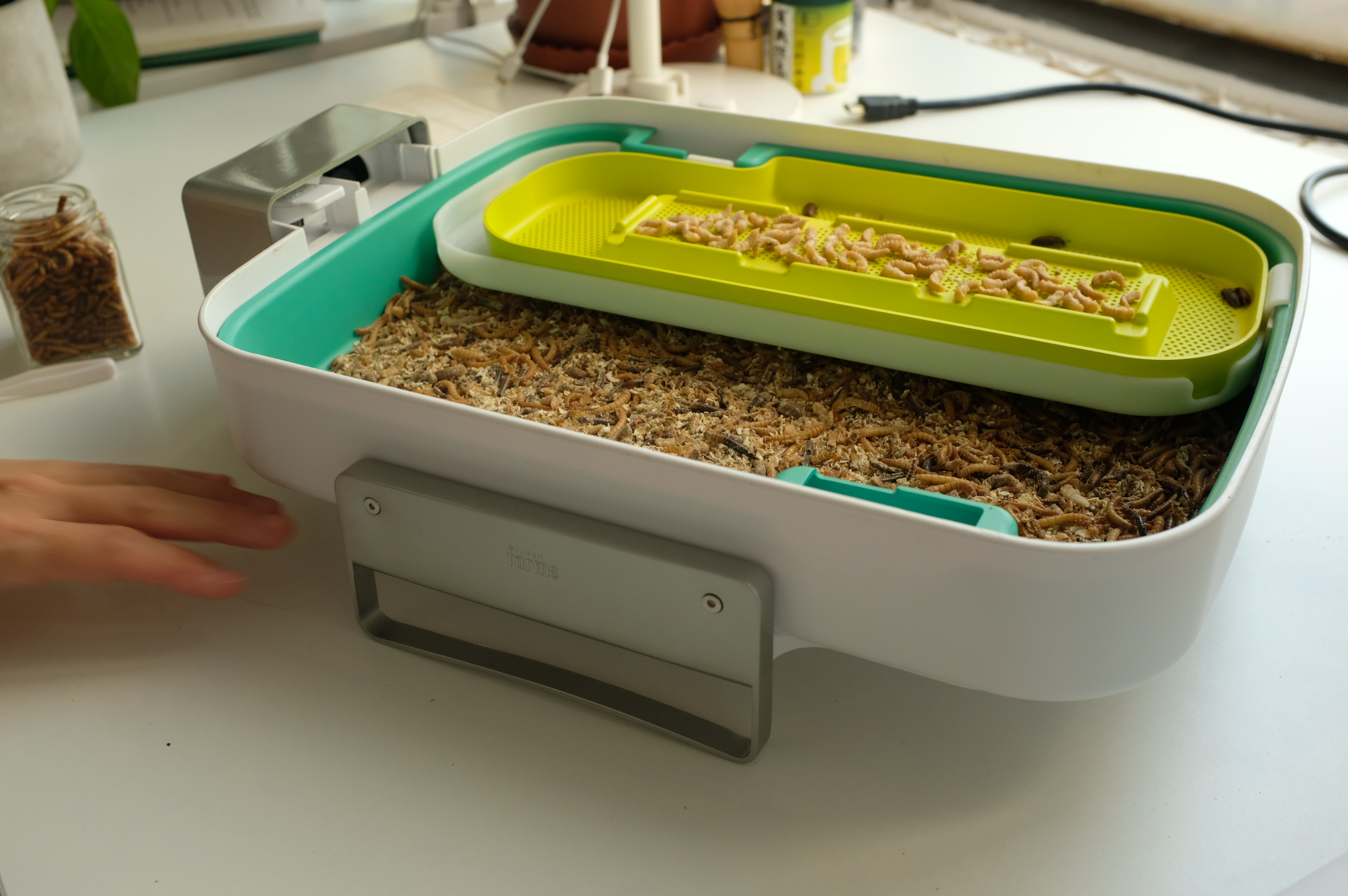
But it’s the Hive Explorer I’m here to see. The small tray sits in the middle of the room. Its top is open, the brightly colored bits of plastic drawing the eye from the moment you step through the door. Its contents pulsate with strange, random rhythms. Upon closer inspection, the browns are whites and blacks are alive, a small bed of mealworms wriggle atop one other, chowing down of the remnants of oats left behind by the team.

Above them, a neon yellow tray houses a trio of fully grown beetles and a couple dozen pupae. The former are constant on the move, butting up against one another and sometimes doing more with aims of continuing the life cycle. The pupae lie around, seemingly lifeless, occasionally twitching out a reminder that there’s still life inside.

The Explorer finds Livin Farms broadening its horizons into the world of STEM education. Where past products were focused on scalable sustainability, the new Kickstarter project is firmly targeted at youngsters. And there’s a fair amount to be learned in the bucket full of beetles. Mortality, for one. Founder Katharina Unger grabs a nearby jar and twists off the cap.

It’s filled to the top with dried mealworms. She pulls one out and pops it in her mouth, handing it to me, hopefully. I follow suit. It’s crispy. Not flavorless, exactly, but not particularly distinct. Maybe a bit salty. Mostly it just feels overwhelmingly morbid, showing down on on a little larva as its brothers continue to feast a few inches away.

Protein source of the future, now, to quote The Mountain Goats. Livin Farms also produces a unflavored larva-based powder and a surprising tasty granola as a kind of proof concept for its sustainable high-protein foodstuffs. The mission hits home here in one of the world’s most densely packed places.

[She gave me some to take home, if anyone’s hungry.]

The Explorer also offers youngsters a peak at what many consider the future of sustainable farming — assuming food manufacturers are ever able to break through the stigma of eating insects. Kids are encourage to harvest the larva to avoid overpopulation with a bit of dry roasting. The box serves as a relatively odor-free form of composting. Feeding the bugs simply entails tossing excess foodstuffs into the bin. The little buggers will tear through it, leaving a thin powder of waste in a tray below.

The setup also features a heat plate to keep the worms warm and a fan to regulate humidity, assuring that settings are ideal for the beetles to do their thing. Livin Farms is also opening up the controls to the system via Swift, in an attempt to bring a coding component to the system.

The Explorer went live on Kickstarter this week. Early bird pledges can pick up a the box of worms for ~$113.

from Startups – TechCrunch https://ift.tt/2zp2f8u

#USA CVCompiler is an robot that fixes your resume to make you more competitive

//

Machine learning is everywhere now, including recruiting. Take CVCompiler, a new product by Andrew Stetsenko and Alexandra Dosii. This web app uses machine learning to analyze and repair your technical resume, allowing you too shine to recruiters at Google, Yahoo, and Facebook.

The founders are marketing and HR experts who have a combined fifteen years experience in making recruiting smarter. Stetsenko founded Relocate.me and GlossaryTech while Dosii worked at a number of marketing firms before settling on CVCompiler.

The app essentially checks your resume and tells you what to fix and where to submit it. It’s been completely bootstrapped thus far and they’re working on new and improved machine-learning algorithms while maintaining a library of common CV fixes.

“There are lots of online resume analysis tools, but these services are too generic, meaning they can be used by multiple professionals and the results are poor and very general. After the feedback is received, users are often forced to buy some extra services,” said Stetsenko. “In contrast, the CV Compiler is designed exclusively for tech professionals. The online review technology scans for keywords from the world of programming and how they are used in the resume, relative to the best practices in the industry.”

The product was born out of Stetsenko’s work at GlossaryTech, a Chrome extension that helps users understand tech terms. He used a great deal of natural language processing and keyword taxonomy in that product and, in turn, moved some of that to his CV service.

“We found that many job applications were being rejected without even an interview, because of the resumes. Apparently, 10 seconds is long enough for a recruiter to eliminate many candidates,” he said.

The service is live now and the team expects the corpus of information to grow and improve over time. Until then, why not let a machine-learning robot tell you what you’re doing wrong in trying to get a job? That is, before it replaces you completely.

from Startups – TechCrunch https://ift.tt/2Bo9AXy

#USA Quantum Machines raises $5.5M to build control and operational layer for quantum computers

//

Quantum Machines, an Israeli startup launched by three Ph.D. physicists, wants to build the operational and control layer for quantum computing. Today, it announced a $5.5 million seed investment led by TLV ventures with participation from Battery Ventures.

The three principals have been studying quantum computing for a decade and they understand that to commercialize it, it’s going to require a complete solution. Right now the majority of the research is centered on increasing the number qubits at the processor level. Co-founder and CEO Itamar Sivan says in order to advance the technology, it’s going to take an operational and control layer to make it all work, and that is where the founders decided to concentrate the company’s efforts, he said.

Sivan explained that there is a point where the classical computers we use today and the quantum computers of the future will have to work together to pass data and interpret commands. He described three layers in a quantum computing stack. The first is the quantum processor. Next is a classical computing control layer with classical electronics you would find on any computer today. Finally, there is the software layer where you program a classical algorithm that has to be passed to the quantum processor.

He says that some companies are trying to build full stacks, but the bulk of research as been concentrated on building quantum processors. Quantum Machines decided to focus on one part of the stack. “We have come to the conclusion that there must be a company laser-focused on a vertically integrated control solution that includes the classical hardware and software,” Sivan said.

“The power of quantum computers stems from their complexity and richness, though it is also this complexity which makes them incredibly difficult to control and operate— this is the problem our company is attempting to solve,” he added in a statement.

The company is currently working on prototype hardware to build this layer and is working with several Beta customers at the moment. It’s early days for the company, but the seed money should help them accelerate that vision and get a product to market more quickly.

from Startups – TechCrunch https://ift.tt/2DAW3x6

#USA Berlin-based Wind Mobility raises $22M for its e-scooter rental service

//

Wind Mobility, a Berlin-based mobility startup that offers “dockless” e-scooter (and electric bicycle) rentals, has raised $22 million in seed funding, throwing its hat into the European competitor to Bird and Lime ring.

It follows recent raises by Sweden’s VOI ($50 million Series A led by Balderton) and Germany’s Tier (€25 million Series A led by Northzone). All three companies are attempting to be pan-European from the get-go.

In other words, you wait all year for the ‘Bird or Lime of Europe’ to appear and three contenders get funded at once. And that’s before we mention Taxify’s entrance into e-scooter rentals or Delivery Hero and Team Europe founder Lukasz Gadowski’s reported plans to enter the space, having picked up backing from the mobility arm of Target global.

Meanwhile, despite being U.S. companies, Bird and Lime have received substantial investment from three of Europe’s top venture capital firms. Index and Accel have backed Bird, and Atomico has backed Lime.

But I digress…

Investing in Wind Mobility’s rather large seed round is Chinese Source Code Capital, and Europe’s HV Holtzbrinck Ventures. The company says the investment will be used for global expansion and to further develop its e-scooter product. Wind current operates its e-scooter rental service in various cities in Spain, France, and the U.S., and its dockless bicycle rental service Byke in Germany.

Notably, Wind is currently developing its first proprietary model of electric scooters specifically designed for the sharing market, which co-founder and CEO Eric Wang tells me will become a significant differentiator going forward.

“Currently, almost all the scooters on the market are from Ninebot, which is designed for personal use rather than sharing,” he says. “Our own scooters are specifically designed for sharing: longer battery range, swappable battery, more capability to climb hills, sturdy and more fit for sharing. We can also tailor our scooters to the requirement of certain cities. This gives us an edge in continuing to adopt to customer needs and regulatory requirements”.

Alongside this, Wind Mobility has developed a proprietary “IoT technology and communication module” that it says gives it better location accuracy of its scooters. The system is also capable of delivering over-the-air updates to the Wind communication module to control certain functionality of its scooters remotely.

For example, it can tell a scooter light to flash via a tap on the Wind app so that users and operational personnel can spot the scooter more easily at night. “We can change the speed limit of the fleet in each city or certain scooters via our servers. We also limit the speed to zero via the communication module once a scooter is taken outside of the operating area,” adds Wang.

Like other European players in the space, Wind says it works in co-operation with local governments, with the goal of solving mobility problems and reducing congestion in urban areas.

“The scooter market in Europe is still relatively new,” says the Wind CEO. “The bigger competition is still to convert more users from using cars to using scooters along with public transportation. We are at the forefront of this transformation. We look forward to working with cities and authorities to serve this growing demand”.

from Startups – TechCrunch https://ift.tt/2DC3iVP

#USA Our 3 favorite startups from Morgan Stanley’s 2nd Multicultural Innovation Lab Demo Day 

//

The Morgan Stanley Multicultural Innovation LabMorgan Stanley’s in-house accelerator focused on companies founded by multicultural and female entrepreneurs, hosted its second Annual Showcase and Demo Day.  The event also featured companies from accelerators HearstLab, Newark Venture Partner Labs and PS27 Ventures.  (Note: I was formerly employed by Morgan Stanley and have no financial ties.)

The showcase represented the culmination of the program’s second year, which followed an initial five company class that has already seen two acquisitions.  Through the six-month program, Morgan Stanley provides early-stage companies with a wide range of benefits including an equity investment from Morgan Stanley, office space at Morgan Stanley headquarters, access to Morgan Stanley’s extensive network, and others.  Applications are now open for its third cohort of companies with the application window closing on January 4th, 2019.

The 16 presenting startups, all led by a female or multicultural founder, offered solutions to structural inefficiencies across a wide array of categories including fintech, developer tools, and health.  Though all of the companies offered impressive presentations and strong value propositions, here are three of the companies that stood out to us.

Hatch Apps

In hopes of democratizing software and app development, Hatch Apps provides a platform that allows users and companies to build iOS, Android and web applications without any code through pre-built templates and custom plug-and-play functions.  In essence, Hatch Apps provides a solution for application building similar to what Squarespace or Wix provide for websites.

In the modern economy, every company is in one way or another a tech or tech-enabled company.  Now the demand for strong engineers has made the fight for talent increasingly competitive and has made engineering quite costly, even when only needed for simple tasks. 

For an implementation and subscription fee, Hatch Apps allows companies with less sophisticated engineering DNA to reduce entering costs by launch native apps on their own, across platforms, and often on faster timelines than those seen through third-party developers.  Once an app is launched, Hatch Apps provides customers with detailed analytics and allows them to send targeted push notifications, export data and make in-app changes that can automatically go live in app stores.

The company initially took a bootstrapping approach to financing and raised funds by selling a 2016 election-themed “Cards Against Humanity”-style game created on the platform.  Since then, Hatch Apps has already received funding from the Y Combinator Fellowship, Morgan Stanley, and a number of other investors.

FreeWill

While estate planning is a topic many don’t like to think about, it’s a critical issue for managing cross-generational wealth. But will drafting can often be very complex, time-consuming, and costly, requiring hours of legal consultation and coordination between various parties.

Founded by two former classmates at Stanford Business School, FreeWill looks to simplify the estate planning process by providing a free online platform that automates will drafting, in a similar function to what TurboTax does for taxes.  Using FreeWill, users can quickly set allocations for their estate and select personal recipients, charitable donations, executor specifications, and other ancillary requests.  The platform then creates a finalized legal document that is legally valid in all 50 states, which users can also quickly make changes to and replace without incurring expensive legal costs.

FreeWill is able to provide the platform to consumers for free due to the proceeds it receives from its non-profit customers, who pay to be featured on the platform as a partner organization.  FreeWill offers a compelling value proposition for partnering companies.  By acting as a channel to funnel user donations to listed organizations, FreeWill has been able to drive a 600% increase in charitable giving to partner organizations on average.  FreeWill also provides partner organizations with backing analytics that allow non-profits to track bequests and donors through monthly reports. 

FreeWill currently boasts an impressive roster of 75 paying non-profit partners that include American Red Cross, Amnesty International and many others.  In the long-run hopes to be the go-to solution financial and legal end of life planning for investment advisors, life insurance and employee benefits providers.

Shoobs

Shoobs is looking to be the go-to platform for local “urban” events, which the company defined as events centered on local nightlife, comedy and concerts in the hip-hop, R&B, and reggae genres to name a few.  But unlike the genre-agnostic, transaction-focused event management platforms that can make the space seem pretty crowded, Shoobs focused on providing genre-specific even discovery.  Shoobs matches urban event goers with artists of their choice and related smaller scale events that can be harder to discover, acting as a form of curation, quality control and discovery.

For event organizers, Shoobs helps provide digital ticketing and promotion services, with event recommendation capabilities that target the most promising potential customers.  Through its offering to event organizers, Shoobs is able to monetize its services through ticket sale commission, advertising and brand partnerships.

Since its initial launch in London, Shoobs notes it has become one of the top urban events platforms in the city, with an extensive base of recurring registered users and event organizers.  After previously working with AEG for its London launch, Shoobs is looking to expand stateside with the help of organizers like Live Nation.  Shoobs joins a long list of promising Y Combinator alumni companies with YC also acting as one of Shows initial investors

Other presenting companies included:

Morgan Stanley Multicultural Innovation Lab

  • BeautyLynk “is an on-demand hair and makeup service provider, specializing in customizable services for women.”
  • Broadway Roulette “is an events marketplace that pairs consumers with surprise cultural events, beginning with Broadway theater.”
  • CariClub “is an enterprise software platform to connect young professionals with nonprofit opportunities.”
  • COI Energy Services “is an integrated platform for electric utilities and business users to optimize and manage energy usage.”
  • CoSign “is an API and application that allows anyone to create, distribute and monetize visual content.”
  • Goalsetter “is a goals-based gifting, savings, and investing platform designed for children.”
  • myLAB Box “offers customizable at home health-test kits and relevant telemedicine consultations / prescription services.”

Hearst Labs

  • Priori “is a global legal marketplace changing the way in-house teams find, hire, and manage outside counsel.”
  • TRENCH “is an online fashion marketplace that makes use of the unworn items in every woman’s closet.”

Newark Venture Partners Labs

  • Floss Bar “is a new type of preventive brand for oral health care. The company offers high-quality, routine dental care across flexible locations at thoughtful prices.”
  • Upsider “is a software solution allowing recruiters to leverage AI technology to identify a comprehensive set of candidates who align with their business and role requirements, resulting in a more strategic understanding of the best possible talent for the job.”

PS27 Ventures

  • BlueWave Technologies “is a cleantech company and the creators of the BlueWave™ Cleaning System — a water free, detergent free, and chemical free plasma device that cleans items that are extremely hard or impossible to clean with a washer and dryer.”
  • OnPay Solutions “focuses exclusively on business-to-business payments. They create payment software and offer payment web services to enhance efficiency and productivity for Accounts Payable and Accounts Receivable.”

from Startups – TechCrunch https://ift.tt/2TymCsD


#USA Piano teams up with True[x] to combine advertising and paywalls

//

Nearly every online publisher has launched or announced a paywall — but of course, even the ones who are successful won’t convince every reader, or even the majority of readers, to sign up. Now Piano and True[x] say they’ve found more effective way to monetize the rest of the audience, without threatening crucial subscription revenue.

Piano is a company that’s built a range of publisher tools, including paywall and subscription management. True[X], meanwhile, is an adtech company that was acquired by 21st Century Fox a few years ago.

Piano’s global head of business development Jonas Rideout said the collaboration will allow publishers to present different messages to different audience members. This is something that Piano has been working on already, but by working with True[x] specifically, it can present readers with the option to (temporarily) circumvent the paywall by watching a premium video ad.

According to Rideout, this takes advantage of Piano’s “out of the box segmentation,” which assesses reader loyalty based on things like how often they visit a site, where they’re coming from and how many pages they visit. It probably makes more sense to ask the most loyal readers to subscribe (since they’re the most likely to convert), but there’s another subset of readers who may be interested in the content, but aren’t actually going to pay — at least, not yet.

Those are the ones who will have the option to see an ad, so the publisher is still making money, and they’re also keeping the reader engaged in case they want to subscribe down the road.

“Maybe 1 to 3 percent of that audience is going to subscribe, but you’re worried about cooking your golden goose [by giving them a way to get around the paywall],” said Chris Shively, True[x]’s director of global business development. “Now you can actually provide that other 97 percent of the audience with a different experience. They’re getting to enjoy the product while you’re getting a significantly higher CPM.”

Ad Age Piano

Shively declined to specify how well these ads monetize, except to say that they’re priced “significantly higher” than a standard display or video ad. He also said, “It’s very important to us that the user has a choice” — so even if you’re given the ad option, you can still choose to subscribe instead.

And to be clear, these ads aren’t an indefinite free pass. It’s a metered system, where the publisher can let the reader through the paywall a set number of times before they really do have to pay.

Piano and True[x] have already been testing this out with Ad Age, where they found that the visitors asked to view a video ad were significantly more likely to register later on. Among readers who watched the ad, there was a 17x increase in the current conversion rate, but even if you look at readers who were given the option and didn’t watch it, they were 3x more likely to register than those who were only presented with the registration option.

Rideout also noted that not every Piano publisher makes money through subscriptions (in fact, TechCrunch is a publisher that uses Piano for non-paywall purposes). So he said the team has been talking about “how else this could be applicable,” like helping publishers drive readers to signup for giveaways or to provide some of their data.

“It’s not just paid content sites — there are opportunities for other types of content,” he said.

from Startups – TechCrunch https://ift.tt/2DPLqaW

#USA Cloud communications platform Agora closes $70M Series C to create new developer tools

//

Part of Agora’s team. The cloud communications startup has offices in Santa Clara and Shanghai.

Agora, a developer of cloud communication APIs, will create products for new markets and verticals after raising a $70 million Series C led by Coatue Management. Existing investors SIG, Morningside Capital and Shunwei Capital also returned for the round, which brings Agora’s total funding so far to $125 million.

The startup’s APIs are used by customers, including The Meet Group, Xiaomi, Hike Messenger and Momo, to insert voice, video and group calling or broadcasting features into their apps. Agora claims it recently surpassed two billion installations of its SDKs and routes through its 200 distributed data centers around the world an average of 10 billion minutes of live communications each month.

The company is raising capital at a relatively fast pace to support its growth goals. Agora’s last funding announcement was made five months ago, when Agora said it had added a $30 million extension to its Series B, bringing that round to a total of $50 million.

The company was started in 2014 by CEO Tony Zhao, who was a founding engineer at online communication platform WebEx, acquired by Cisco in 2007, and former CTO of Chinese live-streaming video platform YY. Headquartered in Santa Clara, Calif., with offices in Shanghai, Agora is a relatively new entrant to a market that includes competitors like Twilio and Tokbox.

Agora’s core product is an SDK that enables developers to insert into their apps voice, video and group calling, as well as interactive broadcasting features, but it also recently added SDKs designed specifically for game developers and Facebook’s React Native framework.

from Startups – TechCrunch https://ift.tt/2RYAnyQ

#USA With investors knocking, PlayVS opens the door to a $30M Series B

//

PlayVS, the company bringing esports infrastructure to high schools across the country, has today announced the close of a $30.5 million Series B financing. The round was led by Elysian Park Ventures, the investment arm of the L.A. Dodgers, with participation from five existing investors including New Enterprise Associates, Science Inc., Crosscut Ventures, Coatue Management and WndrCo.

New investors also joined in on the round, including Adidas (the company’s first esports investment), Samsung NEXT, Plexo Capital, as well as angel investors such as Sean “Diddy” Combs, David Drummond, DST Global partner Rahul Mehta, Michael Dubin and others.

It’s certainly worth noting that PlayVS raised a $15 million Series A just six short months ago. Founder and CEO Delane Parnell explained that this Series B was an opportunistic raise, as the company received a lot of inbound from investors to get a slice of the next round.

“This gives us much more stability and runway so that we can hire more senior employees and leadership,” said Parnell. “It also gives us a bit of a war chest to let the team go out and work their strategies.”

Alongside the raise, PlayVS also announced new game partnerships, bringing Rocket League and SMITE into the company’s portfolio. Rocket League and SMITE join League of Legends, which was added to the platform two months ago.

PlayVS launched early this year with a relatively novel approach to the esports world. Instead of focusing on the current esports space, PlayVS realized that there was a huge opportunity to bring infrastructure to the esports landscape in high school. As more and more esports careers are created through investment by colleges (via scholarships) and esports orgs, PlayVS gives students a place to show off their skills and get in front of recruiters.

The first step in the process was establishing a partnership between PlayVS and the NHFS, which is essentially the NCAA of high school sports. Through that partnership, PlayVS handles team schedules, district league schedules, coaching clinics, referees, and sets up an in-person live spectator event for the State Championship at the end of the year.

Right now, the company is in the midst of its Season Zero, testing out the platform with a small number of states — Connecticut, Georgia, Kentucky, Massachusetts, and Rhode Island — in preparation for the official Inaugural Season, which will begin in 2019. Today, PlayVS is adding Alabama (AHSAA), Mississippi (MISSHSAA), and parts of Texas (TCSAAL) to the program.

But the growth of the company is largely dependent on states and school districts, which is why PlayVS is announcing the launch of Club Leagues. Club Leagues is identical to the PlayVS sports league product, except there is no State Championship at the end. Still, students who do not yet have access to the official PlayVS sports league can create teams, join up, and play matches.

Eventually, Parnell says, the company will phase out Club Leagues as soon as official sport leagues are available to those players.

from Startups – TechCrunch https://ift.tt/2ziktIZ

#USA HyperSurfaces turns any surface into a user interface using vibration sensors and AI

//

Imagine any surface, such as a wooden table, car door or glass wall, could be turned into a user interface without the need for physical buttons or a touch screen. That’s the ambition of HyperSurfaces, the London startup originally behind the Mogees line of music devices and software, which today is unveiling what it claims is a major breakthrough in UI technology.

Dubbed “HyperSurfaces,” the new technology, for which the company has four related patents pending, combines vibration sensors and the latest developments in machine learning/AI to transform any object of any material, shape and size into an intelligent object able to recognise physical interactions.

Equally important is that once trained for a particular object, the HyperSurfaces neural network-trained algorithms are able to run on dedicated microchips that don’t require connection to the cloud for processing. This means that gestures can be instantly recognised and in turn trigger specific commands entirely locally and at much lower cost.

The idea, co-founder and CEO Bruno Zamborlin tells me, is to merge “the physical and the data worlds” in a more seamless way than has been previously possible, ridding us of unnecessary keyboards, buttons and touch screens.

“The HyperSurfaces algorithms belong to the current state of the art in deep learning research,” he explains. “On top of this, the computational power of microchips literally exploded over the last years allowing for machine learning algorithms to run locally in real-time whilst achieving a bill of material of just a few dollars. These applications are possible now and were not possible 3 or 5 years ago”.

Zamborlin says it is difficult to imagine what the applications of HyperSurfaces technology might end up being, in a similar way as it was difficult to imagine all of the applications a mobile phone could enable ten years ago. The most immediate ideas include the possibility of creating technological objects made of materials that until now haven’t been associated with technology at all, such as wood, glass, and different kinds of metal etc.

“Imagine a new wave of 3D wooden IoT devices,” he says, only half jokingly.

This could result in a wooden kitchen table becoming the controller for your living room smart lights and smart thermostat. Or perhaps your home’s floor becomes an advanced security system able to accurately distinguish the steps of a thief from those of your cat. HyperSurfaces has also already seen a lot of interest from car manufacturers.

“Other initial applications will probably include accommodating the desire of car manufactures to eliminate buttons and switches from their car doors and cockpits creating a brand new experience for the user,” adds Zamborlin. “We are used to flat plastic surfaces, but this won’t be a requirement anymore”.

HyperSurfaces team

To get this far — the video demos are very impressive and can’t help but fire your imagination — HyperSurfaces (then called Mogees) raised $1.1 million in seed funding about a year ago and has been head down ever since. This included Zamborlin recruiting a team of top AI scientists and completely re-focusing on research and development. “They are all from Goldsmiths [University of London], like myself, where we specialise in the niche of AI for real-time interaction,” he says.

from Startups – TechCrunch https://ift.tt/2Ki6BCN

#USA ‘Cloud canteen’ startup Feedr raises £1.5M to provide office workers with a healthier lunch

//

Feedr, a food tech startup that delivers healthy and personalised meals to office workers as an alternative to companies setting up their own canteens, has picked up just over £1.5 million in pre-Series A funding.

The round is led by London early-stage venture capital firm Episode 1. Also participating is Brent Hoberman’s Founders Factory, and angel investors Errol Damelin (Wonga founder and renowned fintech investor), Richard Glynn (former Ladbrokes CEO and Founder of Alinsky Partners), and David Pritchard (founder of OpenTable Europe).

Launched in 2016 by Riya Grover and Lyz Swanton, Feedr describes itself as an “intelligent lunch platform” or “cloud canteen”. The startup essentially operates a two-sided marketplace that connects healthy food suppliers with office workers at companies, in addition to arranging delivery.

To do this, Feedr publishes a “unique rotating menu” every day and asks workers to choose what they want to eat by 10.30am. It then pools those orders and sends them to the food suppliers it works with, who are mostly artisan and independent food producers, ready for delivery at lunch time.

The technology behind Feedr handles logistics planning, in terms of predicting and helping to manage demand for each meal on offer from specific suppliers. There is also a large emphasis on personalised recommendations based on the preferences of individual customers and their order history.

Food suppliers include Deliciously Ella, Farmstand, We Grill, Potage, and Maple & Fitz. Feedr works with a number of sub-contracted platforms to do the deliveries.

In a call, Feedr CEO Riya Grover told me the food tech startup has thus far mainly employed a B2B2C strategy by working directly with companies who want to offer their own “cloud canteen” as a perk provided to employees and as part of an employee wellness strategy. This sees each company that signs up with Feedr subsidise the cost of items on the menu so that workers can have a fresh healthy lunch daily for under £5, or cover the cost entirely.

To date, Feedr has fed employees at over 400 companies including AirBnB, Etsy, DHL, and PwC.

Grover also talked up Feedr’s tech that she says enables “dynamic menu building,” something she likened to a Netflix for food. When an employee selects a meal, Feedr feeds back these choices to its algorithm to create a more data-informed menu going forward. In other words, menu choices become more personalised the more employees use Feedr.

More broadly, Grover says Feedr is aiming to cater to three trends: on-demand food delivery, as pioneered by the likes of Deliveroo and Uber Eats; employee wellbeing as part of a company’s recruitment, retention and broader HR strategy; and the way consumers are becoming more accustomed to greater choice and healthier options.

Meanwhile, I’m told the funding round will be used by Feedr to invest in its technology to improve the online user experience, expand the choice of healthy meals and build out the machine learning that powers personalization. The company also plans to increase its sales force and expand outside of London.

Adds Damien Lane, Partner at Episode 1 Ventures: “Feedr’s strong brand values address the rise of the conscious consumer with a greater awareness of ingredient quality, artisanal producers, food provenance and the impact of food consumption on health. The team brings incredible execution skills with a passion for shaping healthier futures”.

from Startups – TechCrunch https://ift.tt/2qWdLDJ