#USA ‘Cloud canteen’ startup Feedr raises £1.5M to provide office workers with a healthier lunch

//

Feedr, a food tech startup that delivers healthy and personalised meals to office workers as an alternative to companies setting up their own canteens, has picked up just over £1.5 million in pre-Series A funding.

The round is led by London early-stage venture capital firm Episode 1. Also participating is Brent Hoberman’s Founders Factory, and angel investors Errol Damelin (Wonga founder and renowned fintech investor), Richard Glynn (former Ladbrokes CEO and Founder of Alinsky Partners), and David Pritchard (founder of OpenTable Europe).

Launched in 2016 by Riya Grover and Lyz Swanton, Feedr describes itself as an “intelligent lunch platform” or “cloud canteen”. The startup essentially operates a two-sided marketplace that connects healthy food suppliers with office workers at companies, in addition to arranging delivery.

To do this, Feedr publishes a “unique rotating menu” every day and asks workers to choose what they want to eat by 10.30am. It then pools those orders and sends them to the food suppliers it works with, who are mostly artisan and independent food producers, ready for delivery at lunch time.

The technology behind Feedr handles logistics planning, in terms of predicting and helping to manage demand for each meal on offer from specific suppliers. There is also a large emphasis on personalised recommendations based on the preferences of individual customers and their order history.

Food suppliers include Deliciously Ella, Farmstand, We Grill, Potage, and Maple & Fitz. Feedr works with a number of sub-contracted platforms to do the deliveries.

In a call, Feedr CEO Riya Grover told me the food tech startup has thus far mainly employed a B2B2C strategy by working directly with companies who want to offer their own “cloud canteen” as a perk provided to employees and as part of an employee wellness strategy. This sees each company that signs up with Feedr subsidise the cost of items on the menu so that workers can have a fresh healthy lunch daily for under £5, or cover the cost entirely.

To date, Feedr has fed employees at over 400 companies including AirBnB, Etsy, DHL, and PwC.

Grover also talked up Feedr’s tech that she says enables “dynamic menu building,” something she likened to a Netflix for food. When an employee selects a meal, Feedr feeds back these choices to its algorithm to create a more data-informed menu going forward. In other words, menu choices become more personalised the more employees use Feedr.

More broadly, Grover says Feedr is aiming to cater to three trends: on-demand food delivery, as pioneered by the likes of Deliveroo and Uber Eats; employee wellbeing as part of a company’s recruitment, retention and broader HR strategy; and the way consumers are becoming more accustomed to greater choice and healthier options.

Meanwhile, I’m told the funding round will be used by Feedr to invest in its technology to improve the online user experience, expand the choice of healthy meals and build out the machine learning that powers personalization. The company also plans to increase its sales force and expand outside of London.

Adds Damien Lane, Partner at Episode 1 Ventures: “Feedr’s strong brand values address the rise of the conscious consumer with a greater awareness of ingredient quality, artisanal producers, food provenance and the impact of food consumption on health. The team brings incredible execution skills with a passion for shaping healthier futures”.

from Startups – TechCrunch https://ift.tt/2qWdLDJ

#USA The WT2 in-ear translator arrives in January, with real-time feedback coming soon

//

Timekettle was eager to show us the progress it’s made on the WT2 since it first showed us its wearable translation device at TechCrunch Shenzhen, this time last year. Unlike their 3D printed state at last year’s event, the crowdfunded earpieces are now ready to ship.

They’ve already started going out to early backers and will begin shipping in January to those who pre-order now. The hardware is quite solid. The set up looks a bit like an oversized AirPods case that snaps together magnetically. The idea is to pull it apart and hand one side to the person you want to talk to.

You choose the language via the app and each of you put one in your ear. The two translators are indistinguishable, but for a small line (the “eyebrow”) above the light up word bubble logo used to identify the second unit.

It’s a clever take on wearable translators like the lukewarmly received Google Pixel Buds. The idea is create a translation product that allows wearers to actively engage one another through eye contact and body language — which remain important insight even when you don’t share a language.

It’s a interesting point of friction, however. In plenty of situations, it’s probably a bridge to far to ask a stranger to jam your earpiece in their ear. For, say, business situations, on the other hand, it could ultimately prove a useful tool.

For the former, the company’s got other methods to interact with the product, including app-based communication. There’s also a mode more akin to a walkie-talkie, in which the speaker taps the logo to talk. This bit was design to help avoid picking up ambient noise.

Overall, I was pretty impressed with the experience. The translation isn’t perfect, as evidenced by the above transcript from my conversation with the company’s CEO. But given the ambient noise, a somewhat spotty cellular connection and the fact that my conversation partner insisted on walking around, the WT2 performed admirably.

At present, the translations are somewhat delayed. The earpiece waits for you to finish speaking for a few seconds and then offers the translation in the other ear (as well as yours, to help you learn the language, apparently). The company told me that it plans to offer closer to real-time translation around launch.

from Startups – TechCrunch https://ift.tt/2Kj9EKW

#USA iHeartMedia to acquire radio adtech company Jelli

//

Radio giant iHeartMedia announced today that it’s reached an agreement to acquire Jelli, a company bringing programmatic ad-buying to radio broadcasters.

In fact, iHeartMedia was already working with Jelli to allow businesses to use progrmamatic tools to buy advertising on the company’s 850 broadcast radio stations. iHeartMedia also invested in Jelli’s most recent funding round.

As a result of the deal, the Jelli team in Silicon Valley will become iHeartMedia’s main adtech operation, and it will still be led by CEO Michael Dougherty. At the same time, iHeartMedia says Expressway by Katz, the programmatic ad exchange created using Jelli technology, will be run independently by Katz Media Group.

In a statement, iHeartMedia CEO Bob Pittman said:

At iHeart we believe marketing is both math and magic. The math is our rich data and insights about our users and how they relate to our partners’ products and services — and the magic is the incredible creative ideas we bring to our partners, such as our iconic music events, award shows, influencers, podcasts, social reach and our unique on air promotions. Jelli allows us to do something no other company can do — advertisers can now buy and use our broadcast assets, reach and impact just as they use the major digital players. We now offer heavy data and heavy creative innovation all in one place.

The financial terms of the acquisition were not disclosed. Jelli’s other investors include Relay Ventures, Intel Capital, First Round Capital and Universal Music Group, and according to Crunchbase, it raised more than $40 million total.

iHeartMedia, meanwhile, filed for bankruptcy in March, though it looks like it’s now preparing to leave Chapter 11 protection.

from Startups – TechCrunch https://ift.tt/2DLlvkD

#USA Move over Le Creuset? A new cookware startup founded by and for millennials is getting down to business

//

Sometimes, it’s hard to imagine a product or industry that a new e-commerce startup hasn’t tried to remake already, from slippers to mattresses, from luggage to lipstick.

Yet two childhood friends in New York have seemingly struck on a fresh idea: taking on the stodgy and often expensive world of cookware, where one’s options out of college are usually limited to a few pieces of Calphalon or Farberware or, in the best-case scenario, some Le Creuset, the premium French cookware manufacturer founded back in 1925 and known for its vibrant colors, including Marseille, Cerise, and Soleil.

In fact, what the pair are building with their 10-month-old startup, Great Jones, appears to be a Le Creuset for the next generation: a handful of cookware items, including a cast-iron Dutch oven, that come in an array of colorful, if comparatively more muted, tones. Think Broccoli and Mustard.

The cookware is also more affordable than Le Crueset, which charges upward of $300 for a similar Dutch oven, compared with $145 for Great Jones’s new product. In fact, Great Jones’s full collection, which also includes a stainless steel stock pot, a stainless sauce pot, a stainless deep saute and a ceramic nonstick skillet, retails for $395.

Cookware is a smart sector to chase. According to the market consultancy IBIS World, the so-called “kitchen and cookware stores” industry has been growing steadily, reaching revenue of $17 billion last year.

One of the big questions for Great Jones will be whether its offerings hold up, and whether its customers find them compelling enough to recommend to others. After all, the old adage tends to hold up that you get what you pay for. And most new products take off because of favorable word of mouth, not merely because they’re Instagrammable.

Great Jones’s 28-year-old founders — Sierra Tishgart, previously a food editor at New York Magazine, and Maddy Moelis, who worked in customer insights and product management at a variety of e-commerce companies, including Warby Parker and Zola — seem to have thought these things through. Indeed, in a recent Forbes profile, they say they conducted extensive interviews with chefs and cookbook authors in their network in order to establish, for example, how to design a comfortable handle.

They also smartly made certain that their introductory offerings come in a range of metals. As even so-so cooks know, stainless steel is ideal for browning and braising; durable nonstick coatings make preparing delicate foods, including eggs and pancakes, less nightmarish.

In the meantime, Great Jones has easily captured the press’s imagination with what they are cooking up — a sign, perhaps, that the industry is ready for a refresh. In addition to Forbes, Great Jones also received recent coverage in The New York Times and Vogue — valuable real estate that most months-old startups can only dream of landing.

Great Jones has also raised outside funding already, including $2.75 million that it closed on last month led by venture capital firm General Catalyst, with participation from numerous individual investors.

Now the company just needs to convince its target demographic that it should ditch the older, established brands that may not feel particularly modern but are known to be durable, easy to clean, dishwasher safe and not insanely heavy (among the other things that keep people from throwing their pots in the garbage).

Great Jones also has plenty of newer competition to elbow out of the way if it’s going to succeed.

As the Times piece about the company notes, just a few of the other startups that are suddenly chasing the same opportunity include Potluck, a five-month-old, New York-based startup that sells a $270 “essentials bundle” that features 22 pieces, including utensils; Misen, a four-year-old, Brooklyn-based startup that sells cookware and chefs knives; and Milo, a year-old, L.A.-based startup that’s solely focused on Dutch ovens, to start.

According to Crunchbase, Misen has raised $2 million, including through a crowdfunding campaign; Milo has raised an undisclosed amount of seed funding.

from Startups – TechCrunch https://ift.tt/2DQOYJQ

#USA Today in brighter crypto news: SEC says tokens are securities

//

Crypto news got a little boost last week after a dark month of crashes, stablecoins and birthdays. The SEC ruled that two ICO issuers, CarrierEQ Inc. and Paragon Coin Inc., were in fact selling securities instead of so-called utility tokens.

“Both companies have agreed to return funds to harmed investors, register the tokens as securities, file periodic reports with the Commission, and pay penalties,” wrote Pamela Sawhney of the SEC. “These are the Commission’s first cases imposing civil penalties solely for ICO securities offering registration violations.”

From the release:

Airfox, a Boston-based startup, raised approximately $15 million worth of digital assets to finance its development of a token-denominated “ecosystem” starting with a mobile application that would allow users in emerging markets to earn tokens and exchange them for data by interacting with advertisements. Paragon, an online entity, raised approximately $12 million worth of digital assets to develop and implement its business plan to add blockchain technology to the cannabis industry and work toward legalization of cannabis. Neither Airfox nor Paragon registered their ICOs pursuant to the federal securities laws, nor did they qualify for an exemption to the registration requirements.

This behavior — a sort of “damn the torpedoes” for the fintech set — was all the rage at the beginning of the year as no clear guidance was available for filing security tokens — essentially pieces of company equity — versus utility tokens which were, in theory, used within the company ecosystem. In fact, ICOed companies contorted themselves into all sorts of knots to appear to fit their “utility token” within the torturous confines of securities law.

“We have made it clear that companies that issue securities through ICOs are required to comply with existing statutes and rules governing the registration of securities,” said Stephanie Avakian, co-director of the SEC’s Enforcement Division. “These cases tell those who are considering taking similar actions that we continue to be on the lookout for violations of the federal securities laws with respect to digital assets.”

The SEC fined both companies $250,000 each. Future ICOs, at least in the U.S., would do well to keep this in mind.

from Startups – TechCrunch https://ift.tt/2DLNpgh

#USA Today in brighter crypto news: SEC says tokens are securities

//

Crypto news got a little boost last week after a dark month of crashes, stablecoins, and birthdays. The SEC ruled that two ICO issuers, CarrierEQ Inc. and Paragon Coin Inc., were in fact selling securities instead of so-called utility tokens.

“Both companies have agreed to return funds to harmed investors, register the tokens as securities, file periodic reports with the Commission, and pay penalties,” wrote Pamela Sawhney of the SEC. “These are the Commission’s first cases imposing civil penalties solely for ICO securities offering registration violations.”

From the release:

Airfox, a Boston-based startup, raised approximately $15 million worth of digital assets to finance its development of a token-denominated “ecosystem” starting with a mobile application that would allow users in emerging markets to earn tokens and exchange them for data by interacting with advertisements. Paragon, an online entity, raised approximately $12 million worth of digital assets to develop and implement its business plan to add blockchain technology to the cannabis industry and work toward legalization of cannabis. Neither Airfox nor Paragon registered their ICOs pursuant to the federal securities laws, nor did they qualify for an exemption to the registration requirements.

This behavior – a sort of “damn the torpedoes” for the Fintech set – was all the rage at the beginning of the year as no clear guidance was available for filing security tokens – essentially pieces of company equity – versus utility tokens which were, in theory, used within the company ecosystem. In fact ICOed companies contorted themselves into all sorts of knots to appear to fit their “utility token” within the torturous confines of securities law.

“We have made it clear that companies that issue securities through ICOs are required to comply with existing statutes and rules governing the registration of securities,” said Stephanie Avakian, Co-Director of the SEC’s Enforcement Division. “These cases tell those who are considering taking similar actions that we continue to be on the lookout for violations of the federal securities laws with respect to digital assets.”

The SEC fined both companies $250,000 each. Future ICOs, at least in the U.S., would do well to keep this in mind.

from Startups – TechCrunch https://ift.tt/2DLNpgh

#USA Today in brighter crypto news: SEC says tokens are securities

//

Crypto news got a little boost last week after a dark month of crashes, stablecoins, and birthdays. The SEC ruled that two ICO issuers, CarrierEQ Inc. and Paragon Coin Inc., were in fact selling securities instead of so-called utility tokens.

“Both companies have agreed to return funds to harmed investors, register the tokens as securities, file periodic reports with the Commission, and pay penalties,” wrote Pamela Sawhney of the SEC. “These are the Commission’s first cases imposing civil penalties solely for ICO securities offering registration violations.”

From the release:

Airfox, a Boston-based startup, raised approximately $15 million worth of digital assets to finance its development of a token-denominated “ecosystem” starting with a mobile application that would allow users in emerging markets to earn tokens and exchange them for data by interacting with advertisements. Paragon, an online entity, raised approximately $12 million worth of digital assets to develop and implement its business plan to add blockchain technology to the cannabis industry and work toward legalization of cannabis. Neither Airfox nor Paragon registered their ICOs pursuant to the federal securities laws, nor did they qualify for an exemption to the registration requirements.

This behavior – a sort of “damn the torpedoes” for the Fintech set – was all the rage at the beginning of the year as no clear guidance was available for filing security tokens – essentially pieces of company equity – versus utility tokens which were, in theory, used within the company ecosystem. In fact ICOed companies contorted themselves into all sorts of knots to appear to fit their “utility token” within the torturous confines of securities law.

“We have made it clear that companies that issue securities through ICOs are required to comply with existing statutes and rules governing the registration of securities,” said Stephanie Avakian, Co-Director of the SEC’s Enforcement Division. “These cases tell those who are considering taking similar actions that we continue to be on the lookout for violations of the federal securities laws with respect to digital assets.”

The SEC fined both companies $250,000 each. Future ICOs, at least in the U.S., would do well to keep this in mind.

from Startups – TechCrunch https://ift.tt/2DLNpgh

#USA BuzzFeed News launches a paid membership program (and yes, there’s a tote bag)

//

BuzzFeed News is giving readers a new way to support its journalism — by paying a monthly or yearly fee.

BuzzFeed might not seem like the most obvious publication to ask readers for financial support, as it doesn’t really have the high-minded appeal of (say) NPR or The New Yorker. However, the company has been working to establish a separate identity for its team focused on real journalism (as opposed to the quizzes and other entertainment for which BuzzFeed is known). In fact, it launched a separate website for BuzzFeed News a few months ago.

In August, BuzzFeed News started giving readers a way to make one-off donations of between $5 and $100. It says the average donation was more than $20, with some readers asking for a way to support the organization on an ongoing basis.

So today, it’s launching a recurring membership program. For $5 a month, readers will receive members-only emails highlighting the latest scoops and taking them behind the scenes of BuzzFeed reporting. For $100 a year, they’ll also receive a BuzzFeed News tote bag.

BuzzFeed memberships

The memberships are available internationally, but you can only get a tote bag if you’re in the United States.

BuzzFeed reportedly missed its revenue target last year by as much as 20 percent, so it’s not surprising that the company is looking beyond advertising for ways to make money. However, in an email to the BuzzFeed team, Global News Director Lisa Tozzi said, “A membership program takes time to build, and we don’t expect it to be a huge portion of BuzzFeed’s revenue in 2019. That’s why we’re investing in it now and hope to see it contribute more to our work over time.”

And if you’re worried that this might be setting the stage for a paywall or meter on BuzzFeed News stories, Tozzi said flatly, “This is not a prelude to any sort of paywall.”

from Startups – TechCrunch https://ift.tt/2S0fxzd

#USA Wonolo, a staffing platform for blue-collar and labor contractors ‘left behind by Silicon Valley,’ raises $32M

//

A recent survey found that around 20 percent of all jobs in the US are held by contractors — people who take on work based on a particular project or fixed-term period, not as full-time, permanent employees. We’ve definitely seen that trend play out in Silicon Valley, both among the knowledge workers building tech products, and among the on-demand startups that rely on contractors to transport goods and people, clean homes and more. But it is also happening elsewhere.

Today, a startup called Wonolo, which has built a platform for workers to connect with businesses that need to staff up quickly specifically in labor-based roles in areas like retail, manufacturing and shipping — or, as it describes itself “other industries left behind by Silicon Valley’s future of work technologies” — has raised $32 million to meet the blue-collar demand.

The company says it now has 300,000 users registered on its platform, and it connects would-be workers with companies that include Coca-Cola, Papa Johns, and Uniqlo. Employees can post jobs “in seconds” with jobs filled “in minutes”, with payment processed after a job is complete (pricing is not disclosed). Wonolo also vets workers before onboarding them to the platform.

The Series C round was led by Bain Capital, with participation from DAG Ventures, Sequoia Capital, Base10, AMN Healthcare, and Cendana. Because VCs appear to be flush with money at the moment — Bain, for example, closed a $1 billion fund just last week — they are pumping a lot of it into the startups that look the most promising. Wonolo last raised money only seven months ago — a more modest $13 million led by Sequoia.

This latest round, the company said, will be used to expand its own staff (not clear if these will be contracted or salaried staff), as well as continue to expand its business.

The timing is important here. As of this week, we are now officially in the holiday period, which typically sees a seasonal bump in business that leads to the need for more temporary workers.

Companies hiring contractors might have in the past turned to staffing agencies to help fill that need — one kind of competitor for Wonolo.

These days, the rise of tech and an increasing prevalence of the contractor model has brought in a second track of competition — from Silicon Valley. Shiftgig is another startup that has created an efficient platform for would-be contractors to post their availability, and would-be employers to snap them up. (As a point of comparison, Shiftgig had some 15,000 workers and 1,500 companies/employers registered on its platform as of its last funding.) Uber has been trialling Uber Works for service contractors (wait staff, security, and so on). There is Flexy in the UK. And I wouldn’t be surprised at all if we see Amazon eventually turning its own temporary and contract staffing efforts into a wider business, given the pattern it has taken so many other products that it built first for its own internal use.

In that wider context, it’s not clear what Wonolo’s valuation is at the moment, but according to PitchBook the company had a modest post-money valuation of just under $48 million in April of this year. That would put Wonolo, at a conservative number, at just $80 million, but I’m guessing that the calibre of the backers, the rapidity of the funding rounds, and the size of the business speaks to that figure being higher. (Wonolo has now raised $60 million in total.)

Contract employment becoming more common comes with a number of tradeoffs. For the increased flexibility, and potentially strong income because you are filling an urgent need, you will often get less benefits with these roles, and far less job security. On the other hand, contract roles can become a very useful stopgap or top-up for people who either are between permanent roles, or simply want to take on more hours to bump their income (hopefully not at the expense of their health or home life).

“When we founded Wonolo in 2014, we had a two-part goal of solving the underemployment epidemic for Americans while simultaneously eliminating the temporary staffing shortage large brands face,” said Yong Kim, CEO and co-founder at Wonolo, in a statement. “Over the past four years, we have scaled our business model and built a thriving marketplace that connects hundreds of thousands of underemployed workers with the jobs they need. Bain Capital Ventures is providing us with the opportunity to put Wonolo’s technology into the hands of major Fortune 500 companies to help upend traditional staffing models.”

Wonolo cites stats from the Bureau of Labor Statistics that found that “the number of open positions in the United States exceeded the number of job seekers for the first time on record.” Specifically, five million Americans were found to be “underemployed,” where they were working less than 30 hours per week. A marketplace like Wonolo’s potentially helps those people top up their hours elsewhere.

“Wonolo is reinventing the way people find hourly work. Their technology platform creates more flexibility for underemployed workers and fills hiring needs for understaffed companies insanely fast and at a disruptively lower cost,” said Jamison Hill, senior principal at Bain Capital Ventures, in a statement. “We are excited to support the Wonolo team in pursuing their grand mission of bringing flexible and fulfilling work to everyone.” Hill is joining Wonolo’s board with this round.

Interestingly, while it seems that contract employment is a model that is here to stay, Wonolo appears to be focused also on giving people the experience and connections to eventually try to catapult themselves into more full-time positions.

“We thought we could address [the idea of being able to deal with unpredictability] better than temp staffing, and we realized the antidote was flexibility on the worker side,” co-founder AJ Brustein told us in April of this year. “We could match them with these jobs that would unpredictably pop up. When we dug into it, we realized flexibility was something that was just completely lacking for workers. We took a very different approach to the way that people will often recruit talent for staffing agencies or their own employees. We are looking at character traits.”

from Startups – TechCrunch https://ift.tt/2RZ3131

#USA Peer tutoring platform Knack raises $1.5M from Charles Hudson, Jeff Vinik

//

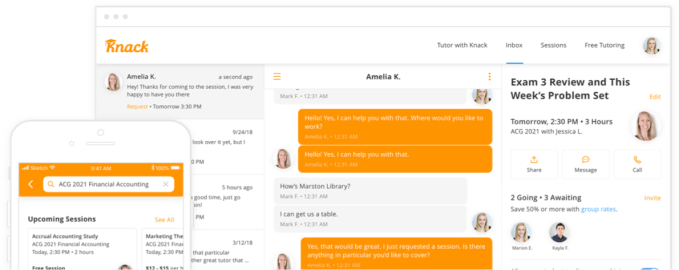
Knack, a peer tutoring platform aimed at college students, is taking a different approach than some online tutoring marketplaces have in the past. As a result, the Florida-based startup has raised a $1.5 million seed round co-led by Charles Hudson’s Precursor Ventures and Tampa Bay Lighting owner and Fenway Sports Group Partner, Jeff Vinik.

Other investors in the round include Bisk Ventures, the corporate venture-arm of Bisk Education; Arizona State University Enterprise Partners; Doug Feirstein, founder of Hired, uSell, and LiveOps; former State of Florida CFO Alex Sink; Tom DiBenedetto of Fenway Sports Group; PAR Inc.; and Elysium Venture Capital.

While many tutoring marketplaces have focused on only connecting students with others who could help them with their studies, Knack has instead also been focusing on adding institutional partners as its customers.

Today, it works with more than 50 colleges across the U.S., like seed investor ASU, which is licensing Knack to modernize their student support services and increase access to supplemental help for students.

“Although most universities already have on-campus tutoring centers,” explains company co-founder and CEO Samyr Qureshi, “Knack partners with institutions as a technology-enabled supplemental solution, filling in the gaps by increasing course and topical coverage for nuanced courses that campus learning centers may not be able to cover due to budgetary and resource constraints,” he says.

In addition, Knack is also now working with corporate employer sponsors like PwC and ConnectWise, which want to engage with high-potential students from Knack’s  campus networks.

“We’re focusing on the full life cycle of learning from ‘I need some help on Knack’ to ‘I can offer help through Knack’ to ‘my skills built and showcased through Knack helped me land a job,’” notes Qureshi.

The CEO says he was inspired to work in the edtech space because, as a first-generation immigrant, education has been at the forefront of his life. His mother brought Qureshi and his sister to the U.S. to allow them to pursue college degrees.

During his own time in school, Qureshi both sought tutoring and provided tutoring, which led him to believe that one of the best ways to learn was from a peer.

In 2016, the startup applied to the University of Florida’s Business Plan Competition and took home first place, winning a $25,000 cash prize. That opened the door to venture capital, and its first pre-seed round of funding.

While institutions and businesses are the focus in terms of monetization, Knack still caters directly to students today. Those who need help with their coursework can use Knack to book tutoring, and those who want to offer their skills can create a tutoring profile with basic info, like their bio, courses, rates and availability.

The platform then handles all the logistics, including searching, matching, scheduling, tracking, billing and rating and reviewing.

Knack takes a 20 percent service fee on this tier of its service. University partners are on a SaaS-based annual platform, and Employer partners are charged a sponsorship amount depending on their targeting criteria.

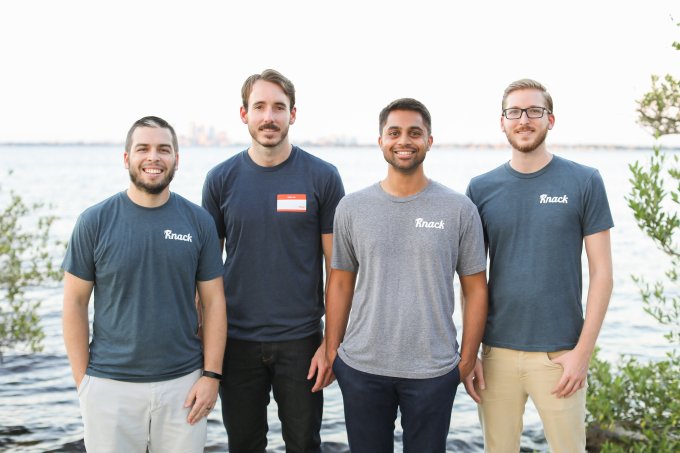
The team of eight is based in Tampa, Florida and plans to use the seed funding for sales and marketing, as well as making some key engineering hires, the CEO says.

from Startups – TechCrunch https://ift.tt/2A4R6cy