Auctor Raises $20M Led by Sequoia Capital to Build the AI System of Action for the Enterprise Software Implementation Market

Auctor Raises $20M Led by Sequoia Capital to Build the AI System of Action for the Enterprise Software Implementation Market


Auctor Raises $20M Led by Sequoia Capital to Build the AI System of Action for the Enterprise Software Implementation Market

Enterprise software implementations fail because of fragmented institutional knowledge and tools. Auctor fixes that with one unified system built for the work itself.

New York, April 15, 2026 (GLOBE NEWSWIRE) — Hundreds of billions are spent on software implementation each year*, yet 50 percent of projects fail to meet deadlines, and one out of every six exceeds budgets by over 200 percent**.

Today, Auctor, the AI-native system of action for the entire software implementation lifecycle, emerges from stealth. It enables professional services teams and system integrators to deliver faster, more consistently, and smarter with every project.

Auctor Founders (L to R) Matthew Blackburn (CTO), William Sun (CEO), and Sky Ng-Thow-Hing (CPO).

Auctor has raised a total of $20 million, including a Series A led by Sequoia Capital with participation from M12, Microsoft’s Venture Fund, HubSpot Ventures, Workday Ventures, OneStream, Y Combinator, Tercera, and Dig Ventures.

William Sun, the Co-Founder and CEO of Auctor, said, “Enterprise software has transformed how every industry operates, but it only creates value when it’s actually implemented well. That’s why we built Auctor: one system for the entire lifecycle, so humans can focus on the high-judgment work clients need, while Auctor handles the rest.”

Professional services and implementation teams still rely on a patchwork of meetings, spreadsheets, documents, and internal knowledge to manage discovery, scoping, solutioning, and delivery. As a result, requirements, decisions, and context are fragmented across systems and stakeholders, with no single source of truth. This fragmentation leads to misalignment, rework, margin erosion, and delayed time-to-value for customers.

“As HubSpot moves upmarket, faster and smarter implementations aren’t just nice to have, they’re essential. Auctor is built specifically to solve that problem, giving system integrators and services teams an AI-native platform that brings together critical project context and turns weeks of manual work into minutes. We’re excited to support a team that’s creating an entirely new category and solving a problem that matters for our partners and customers,” says Adam Coccari, Managing Director at HubSpot Ventures.

Auctor’s AI-native system of action is purpose-built for how implementation work actually runs in practice. It curates execution-ready artifacts like rough orders of magnitude, resource plans, process flows, user stories, and more – already aligned and ready for delivery.

As a result, users and teams always know what was decided, why it was decided, and how it impacts the rest of the engagement. Most importantly, Auctor helps companies standardize what great looks like, turning their best work into repeatable, reusable practices across every project. 

Auctor is already seeing top teams across leading software ecosystems fundamentally change how they run implementations. Customers are driving upwards of 80% efficiency gains across discovery and design, improving margins and even shifting toward fixed-fee models. 

“The improvement in collaboration and delivery quality has been immediate. As we continue to scale globally, Auctor is becoming a core enabler of how we operate,” said Dan Buffham, CIO of Valiantys, Atlassian’s largest global partner, which serves 65 Fortune 500 companies. 

Auctor integrates with your tools and turns discovery into structured outputs.

The results extend across the entire implementation lifecycle. One team used Auctor to respond to an RFP (request for proposal) over a single weekend with just one  person, secured the opportunity, and closed it within two days — work that previously required weeks and multiple team members. Separately, a principal consultant at a large enterprise software company produced a comprehensive manufacturing scoping guide in roughly 10 minutes, replacing a three-week manual effort.

The market dynamics driving Auctor’s growth are structural. 

Implementation firms are caught between a talent model that doesn’t scale and a competitive environment that won’t wait. Senior consultants are spread too thin. Junior staff lack institutional knowledge. Mid-project swaps mean someone is always ramping up. The firms that figure out how to run leaner without sacrificing quality will take market share from those that don’t. 

For system integrators stuck in margin-constrained models where delivery costs scale linearly with headcount, the math is straightforward: Auctor can unlock multiple points of EBITDA margin by fundamentally changing the way of operating.

Julien Bek, partner at Sequoia Capital, who recently wrote a viral thought leadership piece (Services: The New Software), says, “For every dollar spent on software, six are spent on services. Auctor is building the agentic operating system for software implementation to go after those six dollars.” 

James Wu, Partner, M12, Microsoft’s Venture Fund: “Enterprise software implementation has always been a problem of coordination, where critical context lives in silos, scattered documents, and ad‑hoc processes. Auctor isn’t just making implementations more efficient but redefining how large organizations coordinate and govern change across both humans and agents. Auctor is the first AI-native platform that can preserve institutional context and adapt dynamically across complex software ecosystems. That clarity of ambition to becoming the system that orchestrates implementation end‑to‑end is what drew us in at M12.”

Jamie Moon, VP, Corporate Development, OneStream: “As companies pivot for the AI era, they are rethinking the solutions they need to transform operations and stay competitive. Auctor is a strong example of how AI can reduce the manual burden and complexity associated with enterprise software deployment in today’s agentic environment. We’re proud to support their vision through our investment and help accelerate the next wave of innovation in enterprise AI.” 

* Source: Gartner IT Spending Forecast, February 2026
** HBR, Why Your IT Project Might Be Riskier Than You Think, and BCG, Most Large-Scale Tech Programs Fail—Here’s How to Succeed

Media images can be found here

About Auctor
Auctor is the AI-native system of action for the entire software implementation lifecycle. It enables professional services teams and system integrators to deliver faster, more consistently, and smarter with every project.

Despite the massive scale and growing complexity of enterprise software, the way implementations are executed has remained largely unchanged. Auctor is built for how this work actually happens. It curates execution-ready artifacts like rough orders of magnitude, resource plans, process flows, user stories, and much more. 

Auctor is already being adopted by leading teams across major enterprise software ecosystems, where it is fundamentally changing how implementation work is executed. Teams using Auctor are driving upwards of 80% efficiency gains across phases like discovery and design, improving margins, and even enabling a shift toward more predictable, fixed-fee delivery models.

For more information please visit https://www.getauctor.com/ or follow via LinkedIn and X

CONTACT: For further information, please contact the Auctor press office on founders@getauctor.com. 

Auctor Raises $20M Led by Sequoia Capital to Build the AI System of Action for the Enterprise Software Implementation Market

Auctor Raises $20M Led by Sequoia Capital to Build the AI System of Action for the Enterprise Software Implementation Market


Auctor Raises $20M Led by Sequoia Capital to Build the AI System of Action for the Enterprise Software Implementation Market

Enterprise software implementations fail because of fragmented institutional knowledge and tools. Auctor fixes that with one unified system built for the work itself.

New York, April 15, 2026 (GLOBE NEWSWIRE) — Hundreds of billions are spent on software implementation each year*, yet 50 percent of projects fail to meet deadlines, and one out of every six exceeds budgets by over 200 percent**.

Today, Auctor, the AI-native system of action for the entire software implementation lifecycle, emerges from stealth. It enables professional services teams and system integrators to deliver faster, more consistently, and smarter with every project.

Auctor Founders (L to R) Matthew Blackburn (CTO), William Sun (CEO), and Sky Ng-Thow-Hing (CPO).

Auctor has raised a total of $20 million, including a Series A led by Sequoia Capital with participation from M12, Microsoft’s Venture Fund, HubSpot Ventures, Workday Ventures, OneStream, Y Combinator, Tercera, and Dig Ventures.

William Sun, the Co-Founder and CEO of Auctor, said, “Enterprise software has transformed how every industry operates, but it only creates value when it’s actually implemented well. That’s why we built Auctor: one system for the entire lifecycle, so humans can focus on the high-judgment work clients need, while Auctor handles the rest.”

Professional services and implementation teams still rely on a patchwork of meetings, spreadsheets, documents, and internal knowledge to manage discovery, scoping, solutioning, and delivery. As a result, requirements, decisions, and context are fragmented across systems and stakeholders, with no single source of truth. This fragmentation leads to misalignment, rework, margin erosion, and delayed time-to-value for customers.

“As HubSpot moves upmarket, faster and smarter implementations aren’t just nice to have, they’re essential. Auctor is built specifically to solve that problem, giving system integrators and services teams an AI-native platform that brings together critical project context and turns weeks of manual work into minutes. We’re excited to support a team that’s creating an entirely new category and solving a problem that matters for our partners and customers,” says Adam Coccari, Managing Director at HubSpot Ventures.

Auctor’s AI-native system of action is purpose-built for how implementation work actually runs in practice. It curates execution-ready artifacts like rough orders of magnitude, resource plans, process flows, user stories, and more – already aligned and ready for delivery.

As a result, users and teams always know what was decided, why it was decided, and how it impacts the rest of the engagement. Most importantly, Auctor helps companies standardize what great looks like, turning their best work into repeatable, reusable practices across every project. 

Auctor is already seeing top teams across leading software ecosystems fundamentally change how they run implementations. Customers are driving upwards of 80% efficiency gains across discovery and design, improving margins and even shifting toward fixed-fee models. 

“The improvement in collaboration and delivery quality has been immediate. As we continue to scale globally, Auctor is becoming a core enabler of how we operate,” said Dan Buffham, CIO of Valiantys, Atlassian’s largest global partner, which serves 65 Fortune 500 companies. 

Auctor integrates with your tools and turns discovery into structured outputs.

The results extend across the entire implementation lifecycle. One team used Auctor to respond to an RFP (request for proposal) over a single weekend with just one  person, secured the opportunity, and closed it within two days — work that previously required weeks and multiple team members. Separately, a principal consultant at a large enterprise software company produced a comprehensive manufacturing scoping guide in roughly 10 minutes, replacing a three-week manual effort.

The market dynamics driving Auctor’s growth are structural. 

Implementation firms are caught between a talent model that doesn’t scale and a competitive environment that won’t wait. Senior consultants are spread too thin. Junior staff lack institutional knowledge. Mid-project swaps mean someone is always ramping up. The firms that figure out how to run leaner without sacrificing quality will take market share from those that don’t. 

For system integrators stuck in margin-constrained models where delivery costs scale linearly with headcount, the math is straightforward: Auctor can unlock multiple points of EBITDA margin by fundamentally changing the way of operating.

Julien Bek, partner at Sequoia Capital, who recently wrote a viral thought leadership piece (Services: The New Software), says, “For every dollar spent on software, six are spent on services. Auctor is building the agentic operating system for software implementation to go after those six dollars.” 

James Wu, Partner, M12, Microsoft’s Venture Fund: “Enterprise software implementation has always been a problem of coordination, where critical context lives in silos, scattered documents, and ad‑hoc processes. Auctor isn’t just making implementations more efficient but redefining how large organizations coordinate and govern change across both humans and agents. Auctor is the first AI-native platform that can preserve institutional context and adapt dynamically across complex software ecosystems. That clarity of ambition to becoming the system that orchestrates implementation end‑to‑end is what drew us in at M12.”

Jamie Moon, VP, Corporate Development, OneStream: “As companies pivot for the AI era, they are rethinking the solutions they need to transform operations and stay competitive. Auctor is a strong example of how AI can reduce the manual burden and complexity associated with enterprise software deployment in today’s agentic environment. We’re proud to support their vision through our investment and help accelerate the next wave of innovation in enterprise AI.” 

* Source: Gartner IT Spending Forecast, February 2026
** HBR, Why Your IT Project Might Be Riskier Than You Think, and BCG, Most Large-Scale Tech Programs Fail—Here’s How to Succeed

Media images can be found here

About Auctor
Auctor is the AI-native system of action for the entire software implementation lifecycle. It enables professional services teams and system integrators to deliver faster, more consistently, and smarter with every project.

Despite the massive scale and growing complexity of enterprise software, the way implementations are executed has remained largely unchanged. Auctor is built for how this work actually happens. It curates execution-ready artifacts like rough orders of magnitude, resource plans, process flows, user stories, and much more. 

Auctor is already being adopted by leading teams across major enterprise software ecosystems, where it is fundamentally changing how implementation work is executed. Teams using Auctor are driving upwards of 80% efficiency gains across phases like discovery and design, improving margins, and even enabling a shift toward more predictable, fixed-fee delivery models.

For more information please visit https://www.getauctor.com/ or follow via LinkedIn and X

CONTACT: For further information, please contact the Auctor press office on founders@getauctor.com. 

Orbital sets date for first test mission to put AI data centers in low Earth orbit

Orbital sets date for first test mission to put AI data centers in low Earth orbit


Orbital sets date for first test mission to put AI data centers in low Earth orbit

Orbital is building and operating AI data centers in space, using solar power and radiative cooling to remove the energy and cooling constraints that limit terrestrial AI infrastructure. Backed by funding from a16z Speedrun, the company plans to launch its first test mission in 2027 and is opening Factory-1, its R&D facility in Los Angeles.

Los Angeles, CA, April 14, 2026 (GLOBE NEWSWIRE) — The demand for AI compute is surging, but the bottleneck is no longer chips, it’s the power required to run them. Orbital was founded on the belief that the only way to scale compute and unlock future progress on artificial intelligence is to stop competing for power on Earth and generate it in orbit.

Today, the company announced funding from a16z Speedrun to support Orbital-1, the company’s first test mission on its aim of deploying data centers in space. “Speedrun backs founders to explore ambitious ideas — the harder the problem, the better,” said Andrew Chen, General Partner, a16z speedrun. “Orbital is taking on AI’s biggest constraint with a bold and radical idea.”

Orbital is designing and manufacturing a constellation of satellites to operate in low Earth orbit, each housing a cluster of NVIDIA-powered servers. Each satellite is powered by solar arrays and cooled by radiating heat directly into space. In orbit, solar power is available 24/7 in sun-synchronous orbit and stronger, with no weather, no night, and no dependence on the power grid. 

“AI progress is being constrained by the grid,” said Euwyn Poon, CEO and founder of Orbital. “Data center economics are dominated by electricity and cooling, and both are getting harder. In orbit, solar power is continuous and cooling is fundamentally different. Orbital is building compute infrastructure that removes the energy ceiling and scales with AI’s potential.”

Orbital’s compute infrastructure is designed around a specific technical insight. Training large AI models requires thousands of GPUs tightly coupled, communicating at near-zero latency. That architecture does not translate to satellites. Inference is different. Each request is handled independently, and capacity can be distributed across many nodes. Orbital is focused on inference, where orbital compute can scale as a constellation and serve workloads in parallel.

Orbital’s first satellite, Orbital-1, is scheduled to launch on a SpaceX Falcon 9 in April 2027. Its primary goal is to validate sustained GPU operation in orbit, test radiation hardening, and run AI inference workloads commercially in space post-validation. The company is also in the process of filing with the FCC to deploy a constellation of satellites for orbital AI compute infrastructure.

Orbital was founded by Euwyn Poon, a Cornell-educated engineer and lawyer who previously founded Spin, the micromobility company acquired by Ford. At Spin, Poon built and deployed hundreds of thousands of small electric vehicles across 100 cities and scaled the business to over $100 million in revenue. After exiting Spin, he began investing in AI infrastructure and saw the impending constraint clearly. “The energy ceiling on AI isn’t theoretical, it’s a real constraint that will impede the advancement of intelligence,” said Poon. “This is the solution.”

Media images can be found here

About Orbital
Orbital builds and operates GPU data centers in low Earth orbit. Each satellite houses a small cluster of NVIDIA Space-1 Vera Rubin GPUs, powered by solar arrays and cooled by radiating heat directly into space. The first satellite, Orbital-1, launches April 2027 on a SpaceX Falcon 9. For more information please visit https://orbital.inc/

CONTACT: For further information please contact the Orbital press office via Bilal Mahmood on b.mahmood@stockwoodstrategy.com or +447714007257

Orbital sets date for first test mission to put AI data centers in low Earth orbit

Orbital sets date for first test mission to put AI data centers in low Earth orbit


Orbital sets date for first test mission to put AI data centers in low Earth orbit

Orbital is building and operating AI data centers in space, using solar power and radiative cooling to remove the energy and cooling constraints that limit terrestrial AI infrastructure. Backed by funding from a16z Speedrun, the company plans to launch its first test mission in 2027 and is opening Factory-1, its R&D facility in Los Angeles.

Los Angeles, CA, April 14, 2026 (GLOBE NEWSWIRE) — The demand for AI compute is surging, but the bottleneck is no longer chips, it’s the power required to run them. Orbital was founded on the belief that the only way to scale compute and unlock future progress on artificial intelligence is to stop competing for power on Earth and generate it in orbit.

Today, the company announced funding from a16z Speedrun to support Orbital-1, the company’s first test mission on its aim of deploying data centers in space. “Speedrun backs founders to explore ambitious ideas — the harder the problem, the better,” said Andrew Chen, General Partner, a16z speedrun. “Orbital is taking on AI’s biggest constraint with a bold and radical idea.”

Orbital is designing and manufacturing a constellation of satellites to operate in low Earth orbit, each housing a cluster of NVIDIA-powered servers. Each satellite is powered by solar arrays and cooled by radiating heat directly into space. In orbit, solar power is available 24/7 in sun-synchronous orbit and stronger, with no weather, no night, and no dependence on the power grid. 

“AI progress is being constrained by the grid,” said Euwyn Poon, CEO and founder of Orbital. “Data center economics are dominated by electricity and cooling, and both are getting harder. In orbit, solar power is continuous and cooling is fundamentally different. Orbital is building compute infrastructure that removes the energy ceiling and scales with AI’s potential.”

Orbital’s compute infrastructure is designed around a specific technical insight. Training large AI models requires thousands of GPUs tightly coupled, communicating at near-zero latency. That architecture does not translate to satellites. Inference is different. Each request is handled independently, and capacity can be distributed across many nodes. Orbital is focused on inference, where orbital compute can scale as a constellation and serve workloads in parallel.

Orbital’s first satellite, Orbital-1, is scheduled to launch on a SpaceX Falcon 9 in April 2027. Its primary goal is to validate sustained GPU operation in orbit, test radiation hardening, and run AI inference workloads commercially in space post-validation. The company is also in the process of filing with the FCC to deploy a constellation of satellites for orbital AI compute infrastructure.

Orbital was founded by Euwyn Poon, a Cornell-educated engineer and lawyer who previously founded Spin, the micromobility company acquired by Ford. At Spin, Poon built and deployed hundreds of thousands of small electric vehicles across 100 cities and scaled the business to over $100 million in revenue. After exiting Spin, he began investing in AI infrastructure and saw the impending constraint clearly. “The energy ceiling on AI isn’t theoretical, it’s a real constraint that will impede the advancement of intelligence,” said Poon. “This is the solution.”

Media images can be found here

About Orbital
Orbital builds and operates GPU data centers in low Earth orbit. Each satellite houses a small cluster of NVIDIA Space-1 Vera Rubin GPUs, powered by solar arrays and cooled by radiating heat directly into space. The first satellite, Orbital-1, launches April 2027 on a SpaceX Falcon 9. For more information please visit https://orbital.inc/

CONTACT: For further information please contact the Orbital press office via Bilal Mahmood on b.mahmood@stockwoodstrategy.com or +447714007257

Helical raises $10M for virtual AI lab that operates at pharma scale to make in-silico discovery reproducible

Helical raises $10M for virtual AI lab that operates at pharma scale to make in-silico discovery reproducible


Helical raises $10M for virtual AI lab that operates at pharma scale to make in-silico discovery reproducible

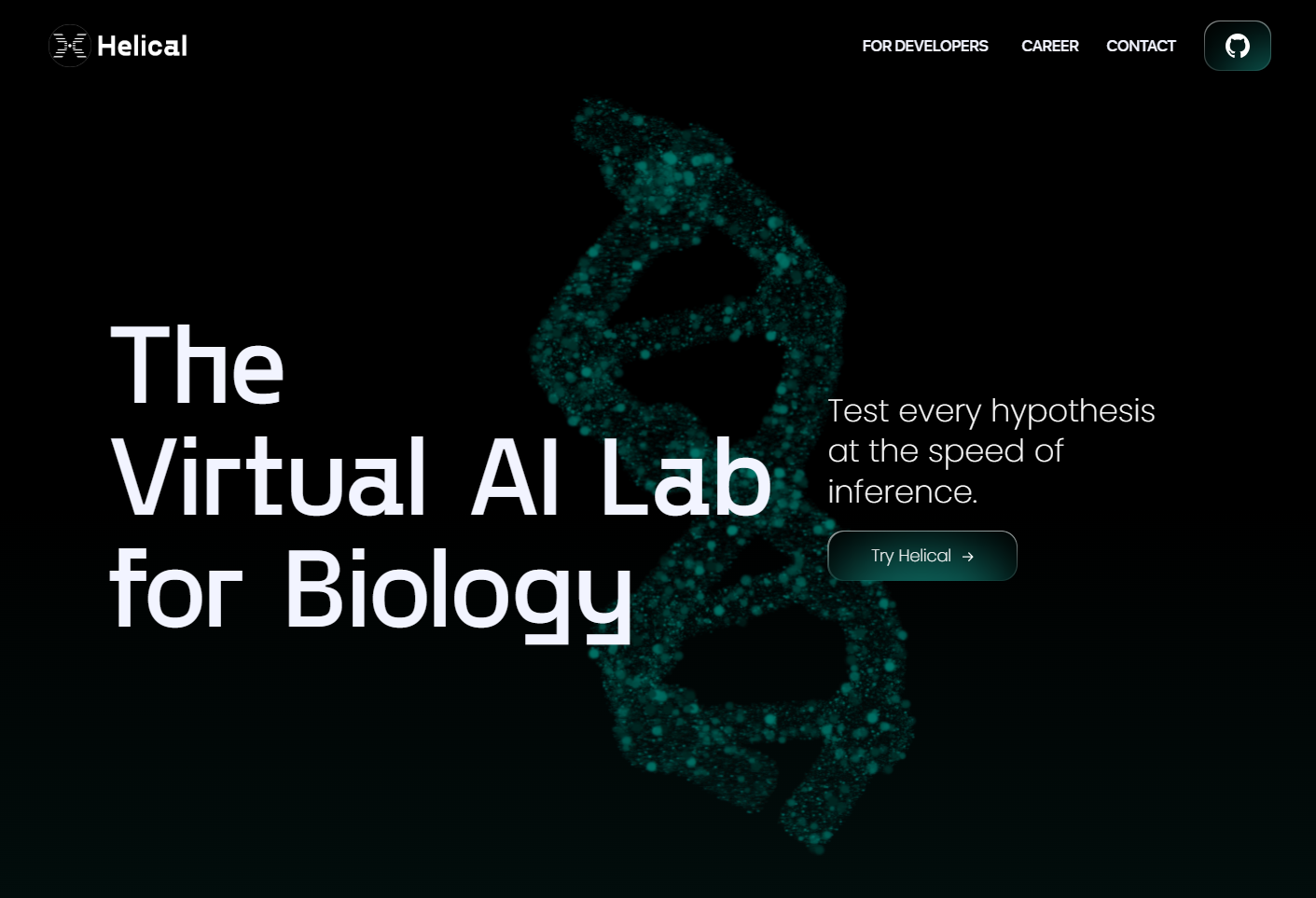
The Helical virtual AI lab for pharma, an application layer that turns biological foundation models into decision-ready, reproducible in-silico discovery workflows.

London, April 14, 2026 (GLOBE NEWSWIRE) — Pharma has no shortage of ideas. It has a shortage of throughput. Roughly 50 new drugs are approved each year despite more than 10,000 known diseases, and every promising hypothesis still collides with the same constraint: slow, expensive physical experimentation. Biological foundation models have opened the door to a new mode of discovery, where scientists can test hypotheses computationally before committing to the wet lab. Helical was built to make that shift real inside modern pharma R&D.

Today, the company announced a $10 million seed round led by redalpine with participation from Gradient, BoxGroup, Frst and notable angels including Aidan Gomez (CEO Cohere), Clement Delangue (CEO HuggingFace) and Mario Goetze (pro soccer player).

Team Helical.

The timing reflects a gap that has emerged as bio foundation models have taken off. Pharma teams are excited about the model layer, but many efforts stall because the work between a model output and a scientific decision is still fragmented. New architectures are emerging constantly, while bench scientists and ML engineers operate in silos. As a result, teams often recreate one-off notebooks and analyses that are difficult to reproduce or transfer across programs. What pharma has needed is an application layer that turns powerful models into systems scientists can run, trust, and defend.

Helical is the virtual AI lab for pharma, designed to turn bio foundation models into reproducible discovery systems so every scientist can test hypotheses in-silico at the speed of inference. The platform has two product surfaces — the Virtual Lab for biologists and translational scientists, and the Model Factory for ML engineers and data scientists — built on the same data, the same models, and the same results. By putting both sides in the same system, Helical closes the gap between computational predictions and biological decision-making, so teams that traditionally worked in silos can collaborate on the same evidence.

“The models alone don’t discover drugs. The system does” said Rick Schneider, co-founder of Helical. “Pharma teams need a system that turns foundation models into workflows scientists can run, validate, and defend. We built Helical to make in-silico science reproducible at pharma scale, so teams can go from hypothesis to decision in days instead of months.”

Helical was founded in early 2024. The company was created by three school friends who took different paths into the same problem. Rick Schneider built tech at Amazon and later helped the German enterprise Celonis scale in France and Japan. Maxime Allard led data science teams at IBM before pursuing a PhD focused on reinforcement learning and robotics. Mathieu Klop became a cardiologist and genomics researcher. When bio foundation models emerged, the trio saw the chance to build the missing application layer that would let pharma teams move from model experimentation to reproducible, production discovery.

Helical is already in production with multiple top-20 global pharma companies, including a public collaboration with Pfizer on predictive blood-based safety biomarkers. Across deployments in target identification, biomarker discovery, and therapeutic design, teams have compressed discovery timelines from years to weeks and expanded organically from single indications into adjacent therapeutic areas.

The broader industry context is increasingly unforgiving. R&D spending exceeds $300 billion annually, timelines stretch beyond a decade, costs to bring a drug to market now exceed $2 billion on average, and more than 90 percent of candidates entering clinical trials fail. AI has been positioned as the answer, but many efforts stall in pilot because predictions alone are not enough. Discovery teams need outputs grounded in biological evidence, delivered through a system that makes decisions reproducible and explainable, not another black-box ranking. 

“We are at a unique point in time where biological foundation models and general language reasoning models are converging.” Said Daniel Graf, General Partner at redalpine. “We backed Helical because we strongly believe they have what it takes to build the pharma AI orchestration platform that will drive this transition from siloed AI models to integrated virtual AI labs.”

Looking ahead, Helical plans to deepen deployments across more therapeutic areas and programs with existing clients, expand to additional top-20 pharma organizations, and continue building the compounding evidence layer that improves performance across diseases. The company’s mission is to make every scientist able to test hypotheses at the speed of inference and to turn in-silico discovery into a reliable engine for R&D throughput.

Media images can be found here

About Helical
Helical is the virtual AI lab for pharma, designed to turn bio foundation models into reproducible discovery systems so every scientist can test hypotheses in-silico at the speed of inference. The platform has two product surfaces — the Virtual Lab for biologists and translational scientists, and the Model Factory for ML engineers and data scientists — built on the same data, the same models, and the same results. By putting both sides in the same system, Helical closes the gap between computational predictions and biological decision-making, so teams that traditionally worked in silos can collaborate on the same evidence.

CONTACT: For further information please contact the Helical press office via Bilal Mahmood on b.mahmood@stockwoodstrategy.com or +447714007257

Helical raises $10M for virtual AI lab that operates at pharma scale to make in-silico discovery reproducible

Helical raises $10M for virtual AI lab that operates at pharma scale to make in-silico discovery reproducible


Helical raises $10M for virtual AI lab that operates at pharma scale to make in-silico discovery reproducible

The Helical virtual AI lab for pharma, an application layer that turns biological foundation models into decision-ready, reproducible in-silico discovery workflows.

London, April 14, 2026 (GLOBE NEWSWIRE) — Pharma has no shortage of ideas. It has a shortage of throughput. Roughly 50 new drugs are approved each year despite more than 10,000 known diseases, and every promising hypothesis still collides with the same constraint: slow, expensive physical experimentation. Biological foundation models have opened the door to a new mode of discovery, where scientists can test hypotheses computationally before committing to the wet lab. Helical was built to make that shift real inside modern pharma R&D.

Today, the company announced a $10 million seed round led by redalpine with participation from Gradient, BoxGroup, Frst and notable angels including Aidan Gomez (CEO Cohere), Clement Delangue (CEO HuggingFace) and Mario Goetze (pro soccer player).

Team Helical.

The timing reflects a gap that has emerged as bio foundation models have taken off. Pharma teams are excited about the model layer, but many efforts stall because the work between a model output and a scientific decision is still fragmented. New architectures are emerging constantly, while bench scientists and ML engineers operate in silos. As a result, teams often recreate one-off notebooks and analyses that are difficult to reproduce or transfer across programs. What pharma has needed is an application layer that turns powerful models into systems scientists can run, trust, and defend.

Helical is the virtual AI lab for pharma, designed to turn bio foundation models into reproducible discovery systems so every scientist can test hypotheses in-silico at the speed of inference. The platform has two product surfaces — the Virtual Lab for biologists and translational scientists, and the Model Factory for ML engineers and data scientists — built on the same data, the same models, and the same results. By putting both sides in the same system, Helical closes the gap between computational predictions and biological decision-making, so teams that traditionally worked in silos can collaborate on the same evidence.

“The models alone don’t discover drugs. The system does” said Rick Schneider, co-founder of Helical. “Pharma teams need a system that turns foundation models into workflows scientists can run, validate, and defend. We built Helical to make in-silico science reproducible at pharma scale, so teams can go from hypothesis to decision in days instead of months.”

Helical was founded in early 2024. The company was created by three school friends who took different paths into the same problem. Rick Schneider built tech at Amazon and later helped the German enterprise Celonis scale in France and Japan. Maxime Allard led data science teams at IBM before pursuing a PhD focused on reinforcement learning and robotics. Mathieu Klop became a cardiologist and genomics researcher. When bio foundation models emerged, the trio saw the chance to build the missing application layer that would let pharma teams move from model experimentation to reproducible, production discovery.

Helical is already in production with multiple top-20 global pharma companies, including a public collaboration with Pfizer on predictive blood-based safety biomarkers. Across deployments in target identification, biomarker discovery, and therapeutic design, teams have compressed discovery timelines from years to weeks and expanded organically from single indications into adjacent therapeutic areas.

The broader industry context is increasingly unforgiving. R&D spending exceeds $300 billion annually, timelines stretch beyond a decade, costs to bring a drug to market now exceed $2 billion on average, and more than 90 percent of candidates entering clinical trials fail. AI has been positioned as the answer, but many efforts stall in pilot because predictions alone are not enough. Discovery teams need outputs grounded in biological evidence, delivered through a system that makes decisions reproducible and explainable, not another black-box ranking. 

“We are at a unique point in time where biological foundation models and general language reasoning models are converging.” Said Daniel Graf, General Partner at redalpine. “We backed Helical because we strongly believe they have what it takes to build the pharma AI orchestration platform that will drive this transition from siloed AI models to integrated virtual AI labs.”

Looking ahead, Helical plans to deepen deployments across more therapeutic areas and programs with existing clients, expand to additional top-20 pharma organizations, and continue building the compounding evidence layer that improves performance across diseases. The company’s mission is to make every scientist able to test hypotheses at the speed of inference and to turn in-silico discovery into a reliable engine for R&D throughput.

Media images can be found here

About Helical
Helical is the virtual AI lab for pharma, designed to turn bio foundation models into reproducible discovery systems so every scientist can test hypotheses in-silico at the speed of inference. The platform has two product surfaces — the Virtual Lab for biologists and translational scientists, and the Model Factory for ML engineers and data scientists — built on the same data, the same models, and the same results. By putting both sides in the same system, Helical closes the gap between computational predictions and biological decision-making, so teams that traditionally worked in silos can collaborate on the same evidence.

CONTACT: For further information please contact the Helical press office via Bilal Mahmood on b.mahmood@stockwoodstrategy.com or +447714007257

Primepoint Closes $10M Seed Round to Advance Intelligence Platform that Reads and Understands Construction Drawings

Primepoint Closes $10M Seed Round to Advance Intelligence Platform that Reads and Understands Construction Drawings


Primepoint Closes $10M Seed Round to Advance Intelligence Platform that Reads and Understands Construction Drawings

The AI-Native Tool Built By Veterans from Meta, Microsoft, Google, and Webcor Has Garnered Funding From Investors Navitas Capital, Penny Jar Capital, NextView Ventures, GS Futures, Aglaé Ventures and Angel Investor Dr. Yann LeCun

SAN MATEO, Calif., April 13, 2026 (GLOBE NEWSWIRE) — Primepoint has closed a $10M seed round to advance its proprietary AI platform, co-founded by AI-veterans Lubomir Bourdev, PhD, and Hamid Palo, to understand construction drawings, reading linework, tags, and cross-document references across an entire project set. The San Mateo-based company received funding in two portions: an initial $4M co-led by Penny Jar Capital and NextView Ventures, followed by a $6M sum led by Navitas Capital, and participation from Penny Jar Capital, NextView Ventures, GS Futures and Aglaé Ventures. The round also includes contributions from AI pioneer Dr. Yann LeCun, Executive Chairman at AMI Labs and former Chief AI Scientist at Meta, widely recognized as one of the founding fathers of modern deep learning.

Primepoint’s proprietary AI knowledge graph automatically connects every drawing element to its corresponding schedule, specification, and project document, down to the tag level, and does the first pass of the work a construction team spends hours doing, with precise, traceable results that customers have come to trust. Designed to link information across an entire construction set and augment project manager expertise, Primepoint’s platform analyzes the hundreds of drawings that go into construction projects and eliminates the need for manual revisions and reconciliations against specs, RFIs, and submittals. Every result is traceable to the exact drawing detail or specification reference behind it. The tool transforms static PDFs into a seamless interactive drawing experience powered by an underlying knowledge graph, allowing project teams to easily gain visibility into project status, changes, and needs.

“As early investors in PlanGrid, Navitas is familiar with the power of digital drawings on construction sites, but the Primepoint demo blew us away,” expressed Mike Heller, Principal at Navitas Capital. “This world-class team has ushered in a new age – with a platform that connects information across drawings and related documents in a way that feels like magic but is grounded in serious AI research, and can save the industry hundreds of billions of dollars in rework, delays, manual reviews, cost overruns, and beyond.”

Primepoint’s AI assistant, Marvin, is available throughout the platform to answer project questions in natural language, with responses grounded in project documents rather than generalized training data. The platform integrates with existing construction tools, including Procore, Autodesk Construction Cloud, and other major project management systems, and is built to meet enterprise security and data standards. Customer data is never used to train external or shared AI models.

Dr. Bourdev is a founding member of Facebook AI Research and a pioneer of modern computer vision. He built the original object recognition system deployed on every photo and video on Facebook and Instagram, and later co-founded WaveOne, a deep learning video compression company acquired by Apple in 2023. He has authored more than 100 patents and has over 100,000 citations. Hamid Palo is a product visionary and early-stage operator who joined Trello as employee #5, helping scale it into a globally adopted platform, and later leading its transition to enterprise. He’s a proven builder of high-impact products, known for turning ambitious ideas into category-defining experiences at companies like Atlassian and Uber. Now an AI founder, Palo is focused on creating the next generation of intelligent tools to solve complex collaboration problems at scale.

Primepoint additionally taps into the industry expertise of VP of Strategy Kamran Azarbal, who spent more than a decade at Webcor, progressing from field engineer to project director on multi-billion dollar commercial projects. His firsthand experience navigating droves of construction drawings and documents sets the foundation for the tool to produce precise, reliable results that alleviate a key pain point for construction teams: vital insights are buried in piles of drawing revisions.

“Technical drawings for large-scale construction projects are extraordinarily complex, and deeply interconnected with other drawings, specifications, and project documents,” said Lubomir Bourdev, Co-founder and CEO of Primepoint. “What we are building enables teams to quickly surface discrepancies in drawings earlier in the construction process, saving time, effort, and money by doing the first chunk of work, not just providing answers,” added Hamid Palo, Co-Founder and CPO of Primepoint.

“In construction, the energy is high at the start of the project, and everyone is eager to collaborate, but that fades quickly when clients, design teams, and trade partners face endless paperwork, contracts, RFIs, submittals, and reports,” said Kamran Azarbal, VP of Strategy at Primepoint. “We step in to handle the administrative burdens and allow project teams to quickly identify and address the critical risks impacting their projects.”

The platform’s initial deployments included an Aeronautical University Campus in Arizona, with early industry partner Sundt Construction instrumental in shaping the platform. This year, Primepoint will expand its rollout with Sundt to additional projects that include a data center, higher education, and residential construction.

“Primepoint actually took the time to truly understand the specific challenges in construction management and then built a solution from scratch, taking into account our existing workflows, without the constraints of legacy systems holding us back,” said Eric Cylwik, Director of Innovation at Sundt Construction. “This isn’t just an AI chat-agent wrapper like others. It actually works with how the industry works.”

With the new funding, Primepoint plans to expand its platform capabilities and grow its customer base among large commercial general contractors across the United States. Those interested in learning more can visit primepoint.ai.

About Primepoint
Primepoint is a construction intelligence platform built specifically to read, connect, and act on construction drawings. Powered by proprietary AI with deep construction expertise, the platform automates the workflows project teams perform every day, from constructability review, RFI drafting, and submittal analysis, to drawing navigation, with precise, traceable results grounded in project documents. Founded in 2024 and headquartered in San Mateo, California, Primepoint serves large commercial general contractors and is built to meet the security requirements of enterprise construction organizations. To learn more, visit primepoint.ai.

Media Contact
Layla Van Buren
MicDrop Agency
layla@themicdropagency.com

Sigma Automate Emerges from Stealth with $2.75M in Funding to Close the Enterprise IT Automation Gap

Sigma Automate Emerges from Stealth with $2.75M in Funding to Close the Enterprise IT Automation Gap


Sigma Automate Emerges from Stealth with $2.75M in Funding to Close the Enterprise IT Automation Gap

AI-native platform empowers IT and DevOps teams to automate critical workflows across multiple industries, including retail, logistics, and healthcare

ATLANTA, April 09, 2026 (GLOBE NEWSWIRE) — Sigma Automate, Inc. (Sigma), a pioneer in AI-native IT automation, today announced it has emerged from stealth with a $2.75M round led by Glasswing Ventures, with participation from high-profile angel investors. The company launches with a rapidly growing roster of both Fortune 1000 enterprise and mid-market customers, validating the market’s urgent need for its AI-native platform that delivers a simplified, code-free approach to managing complex IT infrastructure.

With Gartner predicting that 90% of organizations will adopt a hybrid cloud approach by 2027, enterprise IT teams are being forced to manage increasing operational complexity across on-premise, cloud, and virtual desktop environments. As these environments continue to expand, IDC notes that IT teams face mounting management challenges that can undermine security posture and threaten uptime. Yet, the automation needed to control that complexity has largely been built for code-first DevOps teams, requiring specialized engineers to create and maintain scripts, integrations, and workflows. Most enterprise IT organizations lack that level of in-house automation expertise, leaving a widening gap between the security and reliability that enterprises require and the automation they can realistically deploy. Sigma Automate was built to close that gap with an AI-native platform that enables IT administrators to automate operations, security, and disaster recovery without writing code.

A highly experienced team leads Sigma Automate with deep backgrounds in infrastructure software. Co-Founder and CEO Richard Shaaya has led IT Operations and Cyber Security teams for large-scale enterprises, including The Home Depot, WellStar Health System, Corning, and Volkswagen. Co-Founder and CTO, Ben Barbour, is an expert in AI systems architecture. Before joining Sigma, Ben spearheaded the development of biometric and AI-powered SaaS platforms used by global insurers and health firms at Lapetus Solutions. Co-Founder and COO Greg Arnette brings extensive entrepreneurial experience, having been a founding CTO at Sonian (acquired by Barracuda) and IntelliReach (acquired by Wipro).

“Existing solutions are failing administrators: they are too complicated, too costly, and too hard to adopt,” said Richard Shaaya, CEO and Co-Founder of Sigma Automate. “Sigma is the execution engine for agentic AI in IT, enabling accessible automation for infrastructure, cost optimization, and security enforcement through a no-code, intuitive visual platform.”

Bridging the Skills Gap with AI

The Sigma Automate platform is purpose-built to serve the majority of enterprises that require non-DevOps automation solutions. By leveraging AI and a visual workflow builder, Sigma enables IT teams to onboard, deploy, and automate in minutes rather than days.

Key features of the Sigma Automate platform include:

  • No-Code Orchestration: A visual builder that allows teams to construct complex workflows without scripting.
  • Autonomous Self-Healing: AI capabilities that detect issues and trigger instant remediation to prevent downtime.
  • Patch Management & Security Benchmarks: Simplify patch deployment and continuous security enforcement to reduce risk, strengthen compliance, and keep systems consistently up to date.
  • Compliance & Drift Remediation: Automated configuration drift detection and one-click security remediation to mitigate cyber risks caused by misconfigurations.

Proven Traction and Team

The Sigma Automate platform is deployed across multiple verticals, including retail, logistics, and healthcare. The platform is actively generating revenue and has already demonstrated its ability to reduce critical downtime from days to minutes.

SiteOne Landscape Supply, one of the largest wholesale distributors of landscaping products in the United States, with over 5,000 employees, turned to Sigma Automate to modernize how its infrastructure team manages thousands of virtual machines across multiple data centers. The infrastructure team needed a faster, more reliable approach to managing and automating without adding headcount or complexity. “Sigma has fundamentally simplified how we manage our IT infrastructure. What used to take multiple tools and manual effort is now automated end-to-end, allowing our team to focus on the business instead of maintaining systems,” said Eric Baldwin, Senior Infrastructure Manager at SiteOne.

“Enterprise IT teams have long been buried in complexity, juggling hybrid infrastructure across cloud, on-prem, and virtual desktops with no clear path forward,” said Rick Grinnell, Founder and Managing Partner, Glasswing Ventures. “The organizations that will pull ahead are those willing to rethink automation and infrastructure management from the ground up. Richard, Ben, Greg, and the Sigma team are doing exactly that, transforming what has historically been an operational burden into a genuine competitive advantage.”

About Sigma Automate

Sigma Automate is an AI-native, no-code automation platform that eliminates the complexity barrier in enterprise IT. Headquartered in Atlanta, GA, Sigma empowers IT and DevOps teams to automate critical infrastructure, security, and disaster recovery tasks without writing code. By combining enterprise-grade power with consumer-grade simplicity, Sigma Automate helps organizations close the IT skills gap and accelerate digital transformation. For more information, visit sigma-automate.com.

About Glasswing Ventures

Glasswing Ventures is a first-capital-in venture capital firm dedicated to building the future of enterprise and security through AI and Frontier Technology. The firm combines deep domain expertise, decades of building, operating, and investing experience, and the guidance of world-class advisory councils to identify and partner with exceptional founders at their earliest stages and help them scale. The firm is committed to backing the AI-native and Frontier Tech platforms and products that will transform markets, establish new categories, and power the next generation of enduring global companies. Visit Glasswing Ventures for more information.

Media Contact: Richard Shaaya | CEO | richard@sigma-automate.com | 586-838-6071

Sigma is the execution engine for agentic AI in IT, enabling accessible automation for infrastructure, cost optimization, and security enforcement through a no-code, intuitive visual platform.

HardTech Project Launches Funding Program for Hardware Startups

HardTech Project Launches Funding Program for Hardware Startups


HardTech Project Launches Funding Program for Hardware Startups

Program will provide no-cost manufacturing, marketing and fundraising support to selected startups

WELLESLEY, Mass., April 08, 2026 (GLOBE NEWSWIRE) — Hardware startups are undercapitalized, partly because investors need to evaluate complex manufacturing, supply chain and scaling risks before deciding to invest. A new initiative from the HardTech Project aims to change that by helping promising hardware startups reduce those risks and strengthen their path to funding. Applications are being accepted now.

The HardTech Project Funding Program will provide a select group of startups with no-cost access to:

  • Manufacturing expertise
  • Business support
  • Marketing guidance
  • Fundraising resources

These resources will help companies demonstrate production readiness and establish credibility with potential investors. The HardTech Project is collaborating with FORGE, a nonprofit helping innovators with physical products navigate the journey from prototype to full scale commercialization, and Carlton PR & Marketing, a boutique marketing agency with deep ties to the Massachusetts innovation ecosystem.

The Massachusetts Technology Collaborative is supporting the program with a grant built to strengthen the hardware innovation ecosystem and improve hardtech companies’ access to capital.

“Hardware innovation is critical to economic growth, but many hardtech companies struggle to secure funding,” said HardTech Project CEO Laila Partridge. “Investors need confidence in a startup’s ability to execute and scale. This will give startups the resources they need to answer investor questions, making them more attractive investment options.”

Eligible startups must have:

  • A working prototype incorporating mechanical and electronic hardware components
  • Demonstrated market validation
  • Funding needs tied to defined growth milestones
  • Willingness to work with Massachusetts-based manufacturers or suppliers
  • Openness to using crowdfunding as part of a 2026 financing strategy

“This initiative gives hardware founders access to the right expertise at the right time,” added Partridge.

Learn more and apply here. Deadline: midnight April 24, 2026.

About HardTech Project
Hardtech innovation is more important than ever, but it’s no secret that investors are leery of what they see as risky deals. Solving this problem requires de-risking manufacturing and technical uncertainties at scale. The HardTech Project is focused on reducing hardware investment risk to attract more capital to hardware innovation.

The HardTech Project provides startups and potential investors with third-party validation on the cost and timing of the startups’ productization processes, as well as assurance that the startup has access to the right manufacturing expertise. Learn more: hardtechproject.com.

CONTACT: Media Contact:
Bobbie Carlton
Bobbie@carltonprmarketing.com
781-718-7619

HardTech Project Launches Funding Program for Hardware Startups

HardTech Project Launches Funding Program for Hardware Startups


HardTech Project Launches Funding Program for Hardware Startups

Program will provide no-cost manufacturing, marketing and fundraising support to selected startups

WELLESLEY, Mass., April 08, 2026 (GLOBE NEWSWIRE) — Hardware startups are undercapitalized, partly because investors need to evaluate complex manufacturing, supply chain and scaling risks before deciding to invest. A new initiative from the HardTech Project aims to change that by helping promising hardware startups reduce those risks and strengthen their path to funding. Applications are being accepted now.

The HardTech Project Funding Program will provide a select group of startups with no-cost access to:

  • Manufacturing expertise
  • Business support
  • Marketing guidance
  • Fundraising resources

These resources will help companies demonstrate production readiness and establish credibility with potential investors. The HardTech Project is collaborating with FORGE, a nonprofit helping innovators with physical products navigate the journey from prototype to full scale commercialization, and Carlton PR & Marketing, a boutique marketing agency with deep ties to the Massachusetts innovation ecosystem.

The Massachusetts Technology Collaborative is supporting the program with a grant built to strengthen the hardware innovation ecosystem and improve hardtech companies’ access to capital.

“Hardware innovation is critical to economic growth, but many hardtech companies struggle to secure funding,” said HardTech Project CEO Laila Partridge. “Investors need confidence in a startup’s ability to execute and scale. This will give startups the resources they need to answer investor questions, making them more attractive investment options.”

Eligible startups must have:

  • A working prototype incorporating mechanical and electronic hardware components
  • Demonstrated market validation
  • Funding needs tied to defined growth milestones
  • Willingness to work with Massachusetts-based manufacturers or suppliers
  • Openness to using crowdfunding as part of a 2026 financing strategy

“This initiative gives hardware founders access to the right expertise at the right time,” added Partridge.

Learn more and apply here. Deadline: midnight April 24, 2026.

About HardTech Project
Hardtech innovation is more important than ever, but it’s no secret that investors are leery of what they see as risky deals. Solving this problem requires de-risking manufacturing and technical uncertainties at scale. The HardTech Project is focused on reducing hardware investment risk to attract more capital to hardware innovation.

The HardTech Project provides startups and potential investors with third-party validation on the cost and timing of the startups’ productization processes, as well as assurance that the startup has access to the right manufacturing expertise. Learn more: hardtechproject.com.

CONTACT: Media Contact:
Bobbie Carlton
Bobbie@carltonprmarketing.com
781-718-7619