

Author Archives: Startup365
#Asia #Japan DJ Selects: Why Men Need Women Founders
//
Ari Horie has always had a different approach to supporting women entrepreneurs.
She doesn’t talk about “empowering” women and sensitivity training is not in her toolkit. Ari is showing the startup world that incorporating some of the problem-solving skills and leadership techniques favored by women improves their chance of success.
Women having a leading role in entrepreneurship is not the socially responsible thing to do. It is the most profitable thing to do. Ari’s been on stage with some of the most powerful men in Japan including Prime Minister Abe and Hiroshi Mikitani of Rakuten, and her message is starting to take hold.
Entrepreneurship provides a much more level playing field than any other kind of business, and we should not be surprised that a lot of women excel here, and they often do it by doing things differently from their male competitors.
Startups that plan to survive need to use all the tools at their disposal, and Ari explains exactly how this is happening.
from Disrupting Japan: Startups and Innovation in Japan https://ift.tt/33gForN
#UK Pioneering breast cancer business clinches £32m Series B
//

Cambridge startup business Azeria Therapeutics has secured a blockbusting £32 million Series B financing to expand the global reach of its technology.The ubiquitous and highly supportive Syncona injected £29.5m of the cash alongside existing investor the CRT Pioneer Fund.
Azeria was founded in 2017 by Sixth Element Capital, manager of the CRT Pioneer Fund and Cancer Research UK’s Commercial Partnerships team. The objective was to build a world-class pioneer factor oncology company, developing breakthrough treatments for hormone resistant breast cancer patients.
It was based on the work of leading expert in the field, Professor Jason Carroll at the Cancer Research UK Cambridge Institute, University of Cambridge, UK, whose scientific insights have led to a new approach to target FOXA1 driven cancer. The company is based at the CRUK Cambridge Institute.
FOXA1 is an essential pioneer factor which has been shown to be pivotal in the tumour growth, progression and maintenance of oestrogen receptor positive luminal breast cancer. This is an area of significant unmet patient need where approximately 30 per cent of patients progress to late stage endocrine resistant disease and where there is potential for new treatments to have significant impacts for patients not addressed by existing therapeutics.
Extensive target validation and drug discovery work to date supports the lead programme, with a plan to take the programme into the clinic over the course of the Series B funding. Azeria is seeking to develop the programme to commercialisation and to explore a pipeline of further programmes in oncology.
Azeria received initial investment of £5.5m in Series A financing from the CRT Pioneer Fund, which focuses on early stage investments in highly innovative oncology programmes. Syncona is the largest investor in the CRT Pioneer Fund and will now participate directly in the next stage of growth and development. Magda Jonikas and Martin Murphy of Syncona will join the Azeria board.
Stephen Myatt, CEO at Azeria Therapeutics said: “Azeria is the product of more than 10 years of research by Professor Carroll at Cancer Research UK’s Cambridge Institute and was created to accelerate research and development into pioneer factors, a completely new target class in oncology including FOXA1.”
Martin Murphy, Chief Executive of Syncona Investment Management Limited, said: “Azeria is an exciting company and a perfect fit for Syncona’s long term strategy building globally leading healthcare companies.
“Based on unique, proprietary scientific insight, with a world class academic founder and high-quality team, the company has an opportunity to develop and commercialise treatments which could make a significant difference for patients.
“The Sixth Element team did an excellent job in identifying and investing in this science to take it to the point where it became an exciting and appropriate opportunity for Syncona.”
from Business Weekly https://ift.tt/2pLgzqu
Les Plaisirs Fruités – fruits de saison en entreprise

Top 5 Monuments Architecturaux à Montréal
Vous voulez aller à Montréal et vous vous demandez quoi visiter là-bas? Vous êtes au bon endroit, nous vous parlerons de toutes les attractions! Montréal est l’une des plus anciennes villes canadiennes et abrite de nombreux monuments historiques et architecturaux. Le centre-ville est construit avec des bâtiments respectables du 19ème siècle, ornés de colonnes, de stucs et de portiques. Montréal est parfois appelée Paris canadien. Il y a vraiment beaucoup de rues étroites, complètement atypiques pour les villes du continent Nord-américain.
Comme dans la capitale française, Montréal a aussi son quartier Latin, dont le café est animé par la vie littéraire et musicale. Sauf cela, cette ville est vraiment le capital de divertissements. Il y a ici des vrais casinos qui sont très populaires parmis les touristes. Si vous pensez sérieusement de vous rendre dans l’une des salles de jeux, vous pouvez vous sentir peureusement, surtout si c’est la première fois. Afin d’éviter le stress et pour jouer avec plus de la certitude, nous vous recommandons de visiter le site de casino de Montréal en ligne pour vous familiariser avec son fonctionnement en général. Il faut ajouter que Montréal est l’un des principaux centres culturels du Canada, il abrite de nombreux musées différents, où vous pourrez découvrir l’histoire, la culture et l’art de ce pays.
1. Habitat 67

Habitat 67 a été construit pour l’Exposition universelle de 1967 par Moshe Safdi, un architecte canadien d’origine israélienne. L’immeuble est situé sur la rive du fleuve Saint-Laurent à Montréal, la plus grande ville du Québec au Canada. Le nom de la maison (habitat) se traduit pour une raison par “habitat naturel” : la disposition chaotique des blocs permet d’ajouter des jardins sur les toits à l’espace de vie, de fournir de l’air frais et de la lumière solaire. Habitat 67 était un experiment : l’architecte a étudié la possibilité de construire des logements de qualité dans des zones urbaines densément peuplées et a décidé d’utiliser des blocs modulaires pour réduire les coûts de construction. Habitat 67 a été construit à partir de 354 modules identiques fabriqués en usine (“boîtes”), reliés entre eux par des câbles en acier. Les appartements se différencient par leur forme et leur taille, chaque appartement étant composé de 1 à 4 “boîtes” de 56 m², assemblées en différentes combinaisons.
2. Biosphère de Montréal

La Biosphère de Montréal est un musée insolite, dont l’exposition est consacrée à l’environnement humain et à l’eau dans tous ses états. La structure ressemble à une grosse boule, qui se compose de nombreuses parties reliées entre elles. Chacun d’eux ressemble à un composé moléculaire spécial appartenant à une classe spéciale de formes dites allotropiques de tout carbone connu. Actuellement, ils sont appelés fullerènes, du nom de l’architecte Richard Buckminster Fuller. Une fois qu’il a développé le projet de ce musée étonnant, la taille du musée – la biosphère – fait admirer le plan du concepteur. Le diamètre du dôme, fait d’acier léger mais solide, est de 76 mètres, et la hauteur – jusqu’à 62 mètres ! Le musée de Montréal divise l’espace en sept niveaux. Un escalier roulant de 37 mètres de long permet de déplacer les touristes autour de cette structure étonnante.
3. Centre Commerce Mondial de Montréal

Le Centre Commerce Mondial est un centre commercial populaire situé dans le quartier des affaires de Montréal et possède des qualités architecturales exceptionnelles. Le Centre Commerce Mondial de Montréall a ouvert ses portes en 1992 et a immédiatement gagné la popularité auprès des visiteurs. La conception du bâtiment a été réalisée par le célèbre bureau d’architectes “Arkop”, dont les spécialistes ont donné au centre un aspect très élégant. Dans l’atrium spacieux du bâtiment se trouve une ancienne fontaine, créée par le célèbre sculpteur français Dieudonnus-Bartolomus Gibal. De plus, le centre est décoré d’un morceau massif du célèbre mur de Berlin. Le Centre abrite de nombreux magasins, boutiques et restaurants, attirant des dizaines de milliers de visiteurs. C’est un paradis pour tous les acheteurs. De plus, l’immeuble offre un accès direct à la ville souterraine, un centre commercial unique situé juste sous les rues de Montréal.
4. Casino de Montréal

Le Casino de Montréal a ouvert ses portes en 1993 et est situé dans l’un des trois bâtiments reliés entre eux, dont deux ont été construits pour l’exposition internationale “Expo67”. Les salles du casino sont équipées de 3200 machines à sous et 115 tables pour les jeux de société et les loteries. Le casino de Montréal est réputé pour son design inhabituel : les plafonds sont assez bas et les fenêtres sont nombreuses. Et les amateurs de détente avec un verre et une cigarette seront déçus, car les deux sont strictement interdits ici. Il y a aussi trois établissements gastronomiques pour les visiteurs du casino : le bistro italien Via Fortuna, le café Le Buffet et le luxueux restaurant L’Entremies. Le casino est ouvert 24h/24 et 7j/7. L’entrée est gratuite. Le stationnement est aussi gratuit pour les visiteurs. Toutes les conditions sont réunies pour les personnes handicapées.
5. Olympic Stadium

Le Stade olympique est le plus grand stade du Canada. C’est la fierté de l’ensemble du Comité olympique depuis 1976. C’est au Stade Olympique que se déroulaient les compétitions d’athlétisme et les matchs de football. Mais le point culminant du stade est la possibilité de concourir ici pour les représentants des sports équestres, pour lesquels des conditions spéciales sont extrêmement nécessaires. Le nom du stade est “The Big O”, parce que son toit est construit en forme de donut – le symbole du Stade Olympique de Montréal. De plus, le bâtiment se distingue également par une énorme tour inclinée de 175 mètres sur le toit. Ce stade est une œuvre d’architecture extraordinaire. Grâce au funiculaire qui monte au sommet de la tour, les visiteurs peuvent profiter d’une belle vue sur le Parc Olympique. Les côtés sud et est du parc offrent une vue magnifique sur le village olympique, le Biodôme et le jardin botanique toujours en fleurs à Montréal. Le stade attire de plus en plus de spectateurs chaque année. Mais jusqu’à présent, aucun concours n’a attiré autant de visiteurs que le groupe Pink Floyd, qui a réuni 78 000 fans le 6 juillet 1977.
Sagesse Santé rend la diététique accessible à tous

Khatabook raises $25M to help businesses in India record financial transactions digitally and accept online payments

European early-stage VC firm ‘Project A’ on Europe’s startup scene taking the next step
//
Project A, the Berlin-based VC, just raised a new $200 million fund (€180 million) to continue backing European startups at Seed and Series A stage.
In addition, the firm — whose investments include WorldRemit, Catawiki, Voi and Uberall — announced it will now have a presence in London and Stockholm in order to put people on the ground in what it says are “two of its favorite ecosystems.”
What better time, therefore, to catch up with the team at Project A, where we talked investment thesis, why Stockholm and London, and the increasing interest in Europe from U.S. LPs and VCs. Other subjects we touched on include diversity in venture, and, of course, Brexit!
TechCrunch: You last raised a fund in 2016, totaling €140 million, what changes have you noticed since then with regards to the types of companies you are seeing and the European ecosystem as a whole?
Uwe Horstmann: Entrepreneurs definitely matured a lot over the last few years. We see more and more of serial founders who combine drive with experience delivering great results. We also noticed an increase in more tech / product-centric and in B2B models.
This doesn’t come as a surprise as the market for consumer-oriented models started developing much earlier and is now reaching its limits after a few years. Many entrepreneurs gained experience in the Old Economy or have been consulting companies for a few years, learned about the struggle with products and processes first-hand and developed solutions specifically tailored to the industry’s needs.
We also notice a rise in professionalism in company setups and a higher ambition level in founding teams. This is probably also due to a more professional angel and micro fund scene that has developed in Europe.
TC: I note that you have U.S. LPs in the new fund, which I think is a first for Project A, and more broadly we are seeing a lot more interest from U.S. VCs in Europe these days. Why do you think that is, and how does this change the competitive landscape for deal-flow and the ambition of European founders?
Thies Sander: Having our first U.S. LPs on board makes us proud. LPs have noticed that European VC returns have really picked up during recent fund cohorts.
from Startups – TechCrunch https://ift.tt/2neokUm
Amboss, the knowledge platform for medical professionals, scores €30M Series B
//
Amboss, the Berlin-based ‘medtech’ startup that originally offered a learning app for students but has since pivoted to a knowledge platform for medical professionals, has raised €30 million in Series B funding.
The round is led by Partech’s growth fund, with Target Global acting as a co-investor. Existing investors, Cherry Ventures, Wellington Partners and Holtzbrinck Digital, also participated.
Launched in 2014 as a study platform for medical students, Amboss has since evolved to offer what it claims is the “most comprehensive and technologically-advanced” knowledge platform for medical professionals. It has been developed by a group of 70 doctors and 40 software engineers who work together in small cross functional teams.
“Medical Knowledge does not find its way into practice efficiently,” argues Amboss co-CEO Benedikt Hochkirchen. “This has two main root causes: the way we educate doctors is outdated, and the way doctors access knowledge is inefficient”.
Specifically, he says that medical students are still taught to memorize facts, which become outdated quickly, and there isn’t enough emphasis on understanding and application. In contract, Amboss’ “smart learning” technology claims to not only help students achieve higher scores in their medical exams but furthers their contextual understanding and therefore lays the foundation “to be better prepared for clinical practice”.
“In clinical practice, doctors would adapt 50% of their decisions if they had the latest and precise knowledge at hand,” says Hochkirchen. “In real life on the wards, doctors lack the time to research and find the relevant knowledge. For them, Amboss’ smart guidance app is there to provide instant, convenient and reliable medical knowledge to carry out the best possible care”.
The end result, says the Amboss co-CEO, is that the startup’s app reduces the average research time needed for doctors to make a clinical decision from 30 minutes to 30 seconds. Crucially, its knowledge base contains the most recent medical facts and guidelines “in every single case”.
“Young doctors have to take over a lot of responsibility early in their career,” adds Hochkirchen. “Career starters are regularly the first touch point with a doctor when a patient enters a hospital. Often young doctors do not feel properly prepared for the real life challenges in those situations. Amboss is the source of choice to master those decisions e.g. with emergency algorithms and lead symptoms”.
Likewise, more experienced and specialised doctors can also find utility in Amboss, as guidelines and therapies of choice are constantly changing. “It is almost impossible for the doctor to stay up to date for every possible indication,” he says. “Amboss provides them with precise knowledge based on latest guidelines to ensure doctors choose the best therapy possible”.
Or, put a another way, Amboss is attempting to build a “Google for medicine”. “They are tackling a very exciting space which will have a positive impact on society, bringing knowledge levels and skillsets of medical doctors to a higher level,” Cherry Ventures’ Christian Meermann tells me.
Meanwhile, armed with new capital, Amboss says it will accelerate the global rollout of its product with a focus on the U.S. In addition, the startup will further develop its product, for both generalist and specialist doctors, “to help improve their daily clinical decision-making”.
from Startups – TechCrunch https://ift.tt/2mOS5v7
India’s Darwinbox raises $15M to bring its HR tech platform to more Asian markets
//
An Indian SaaS startup, which is increasingly courting clients from outside of the country, just raised a significant amount of capital to expand its business.
Hyderabad-based Darwinbox, which operates a cloud-based human resource management platform, said on Thursday it has raised $15 million in a new financing round. The Series B round — which moves the firm’s total raise to $19.7 million — was led by Sequoia India and saw participation from existing investors Lightspeed India Partners, Endiya Partners, and 3one4 Capital.
More than 200 firms including giants such as adtech firm InMobi, fintech startup Paytm, drink conglomerate Bisleri, automobile maker Mahindra, Kotak group, and delivery firms Swiggy and Milkbasket use Darwinbox’s HR platform to serve half a million of their employees in 50 nations, Rohit Chennamaneni, cofounder of Darwinbox, told TechCrunch in an interview.
The startup, which competes with giants such as SAP and Oracle, said its platform enables high level of configurability, ease of use, and understands the needs of modern employees. “The employees today who have grown accustomed to using consumer-focused services such as Uber and Amazon are left disappointed in their experience with their own firm’s HR offerings,” said Gowthami Kanumuru, VP Marketing at Darwinbox, in an interview.
Darwinbox’s HR platform offers a range of features including the ability for firms to offer their employees insurance and early salary as loans. Its platform also features social networks for employees within a company to connect and talk, as well as an AI assistant that allows them to apply for a leave or set up meetings with quick voice commands from their phone.
“The AI system is not just looking for certain keywords. If an employee tells the system he or she is not feeling well today, it automatically applies for leave for them,” she said.
Darwinbox’s platform is built to handle onboarding new employees, keeping a tab on their performance, monitor attrition rate, and maintain an ongoing feedback loop. Or as Kanumuru puts it, the entire “hiring to retiring” cycle.
One of Darwinbox’s clients is L&T, which is tasked with setting up subway in many Indian cities. L&T is using geo-fencing feature of Darwin to log the attendance of employees. “They are not using biometric punch machine that is typically used by other firms. Instead, they just require their 1,200 employees check-in from the workplace using their phones,” said Kanumuru.
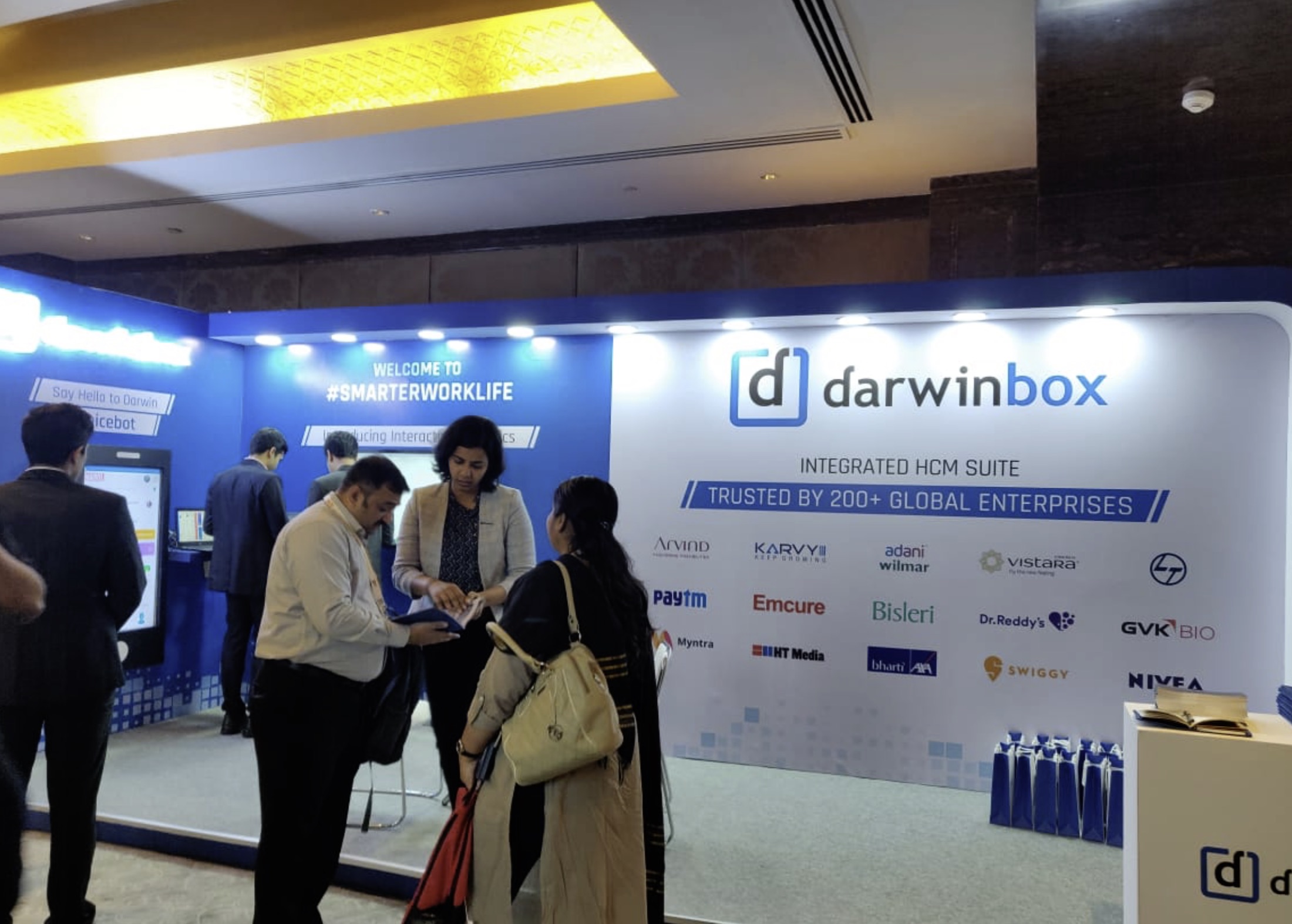
Additionally, Darwinbox is largely focusing on serving companies based in Asia as it believes Western companies’ solutions are not a great fit for people here, said Kanumuru. The startup began courting clients in Southeast Asian markets last year.
“Our growth is a huge validation for our vision,” she said. “Within six months of operations, we had the delivery giant Delhivery with over 23,000 employees use our platform.”
In a statement to TechCrunch, Dev Khare, a partner at Lightspeed Venture, said, “there is a new trend of SaaS companies targeting the India/SE Asia markets. This trend is gathering steam and is disproving the conventional wisdom that Asia-focused SaaS companies cannot get to be big companies. We firmly believe that Asia-focused SaaS companies can get to large impact value and become large and profitable. Darwinbox is one of these companies.”
Darwinbox’s Chennamaneni said the startup will use the fresh capital to expand its footprints in Indonesia, Malaysia, Thailand, and other Southeast Asian markets. Darwinbox will also expand its product offerings to address more of employees’ needs. The startup is also looking to make its platform enable tasks such as booking of flights and hotels.
Chennamaneni, an alum of Google and McKinsey, said Darwinbox aims to double the number of clients it has in the next six to nine months.
from Startups – TechCrunch https://ift.tt/2ndHOrU